Why This Museum Changes How You See Lycia
Most tourists visit Myra's rock tombs, admire the carved façades, snap some photos, and move on without truly understanding who carved them, why they look the way they do, or what kind of civilisation produced them. The Lycian Civilizations Museum at Andriake answers every one of those questions — and it does so inside the restored walls of a Roman granary that Emperor Hadrian built nearly 2,000 years ago. The building itself is an artefact.
I grew up ten minutes from this site. I watched it evolve from a roofless ruin with wildflowers growing between the stones into one of the most compelling archaeological museums in the Mediterranean. Most visitors to Demre drive straight past Andriake on the way to Myra — and that's a mistake I've been correcting with every person I've guided here. The museum doesn't compete with Myra; it completes it. Visit the museum first, then the rock tombs, and suddenly everything clicks.
This isn't a dusty provincial museum with unlabelled pots behind glass. It's a purpose-built exhibition space with atmospheric lighting, interactive elements, a ship simulation room, and a narrative arc that takes you from Lycia's geographical origins through its democratic system, economy, religious practices, burial customs, and maritime trade — all within 1,476 carefully curated artefacts across eight exhibition halls.
The Building: Hadrian's Granarium — From Grain Warehouse to Museum
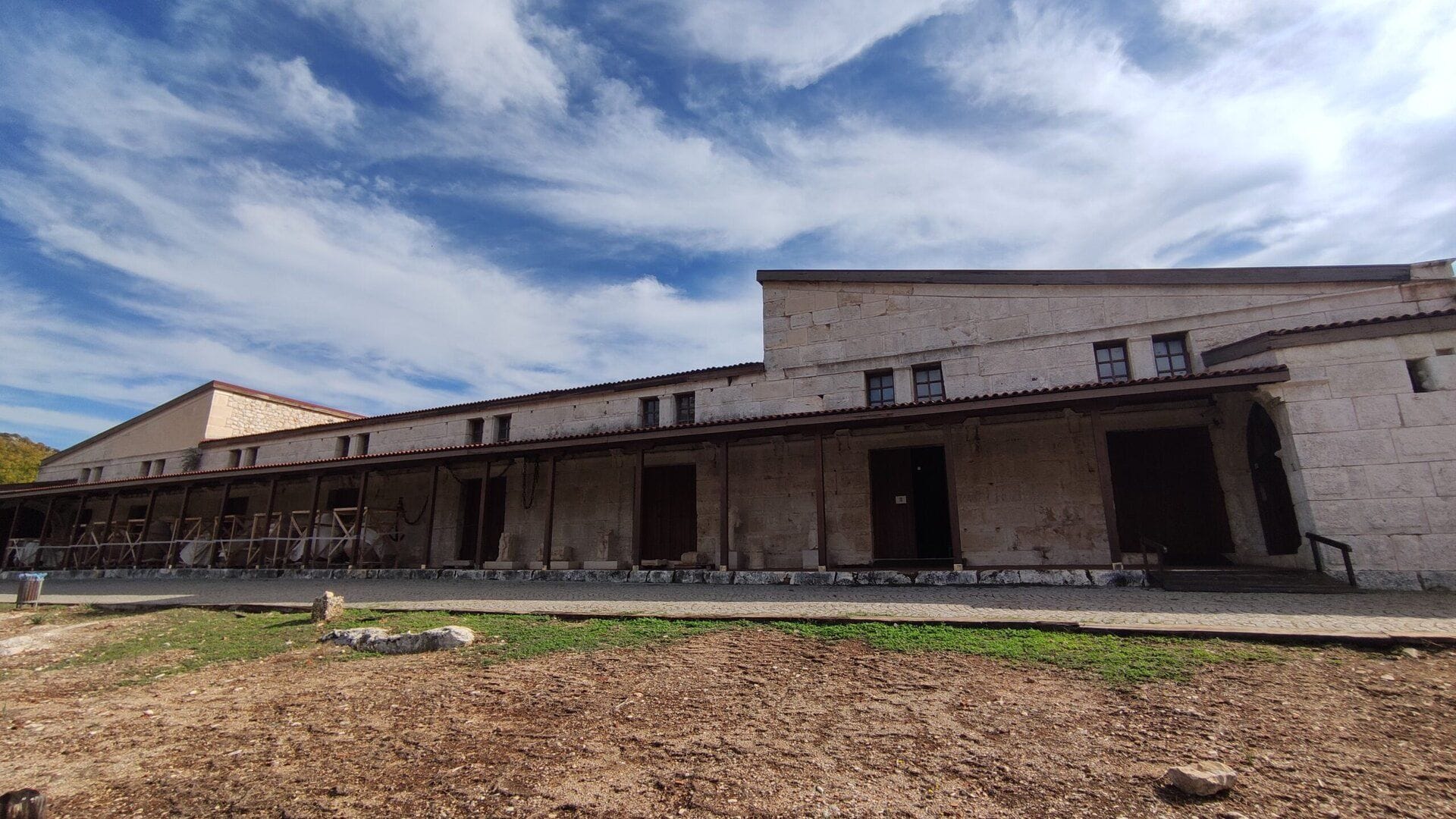
Before you step inside, take a moment to appreciate the building itself. You're about to enter the Granarium (Horrea Hadriani) — a colossal Roman state grain warehouse commissioned by Emperor Hadrian during his visit to Lycia in 129–130 CE. At 2,307 square metres with seven massive storage chambers, it's one of only three surviving Roman granaries at this scale in the entire Mediterranean, alongside the granary at Patara (also in Lycia, 60 km west) and Leptis Magna in Libya.
The façade originally bore a dedicatory inscription with busts of Hadrian and his wife Sabina — fragments are now displayed inside. Look at the stonework: the massive ashlar blocks, the barrel-vaulted chambers, the ventilation channels designed to keep grain dry and at stable temperature. This was Roman industrial engineering at its most practical — climate control for wheat storage, 1,900 years before air conditioning.
The restoration was completed in 2016 by a team from Akdeniz University, and it wasn't without debate. Some archaeologists questioned the extent of modern additions — the roof, the glass panels, the internal partitioning. But the result is a rare thing in Turkish archaeology: a museum inside the original ancient building, where the walls around you are as much part of the exhibition as the objects they contain. You're not looking at Roman architecture in a textbook; you're standing inside it.
I first walked into the Granarium before the restoration, when I was still in primary school. It was a roofless shell — you could see the sky through the barrel vaults, birds nested in the Hadrian inscription, and weeds grew from every crevice. When I walked into the finished museum in 2016, I genuinely didn't recognise it as the same building. That transformation is Andriake's story in miniature: a place that keeps revealing itself, layer by layer, year by year.
Start Here: The Introductory Film
Before entering the exhibition halls, you'll pass through a screening room showing a short documentary film on Lycian civilisation. It runs approximately 10 minutes with English subtitles and provides the essential framework for everything you're about to see: who the Lycians were, where they lived, what made their civilisation distinctive (particularly their democratic system), and how their cultural legacy connects to modern concepts of governance.
I've seen hundreds of visitors walk past the screening room because they're eager to see the artefacts. Don't. The 10 minutes you spend here will transform the remaining hour from “looking at old things” into “understanding a civilisation.” The film explains the Lycian League's voting system — a democratic federation 2,000 years before the European Union — which is the key to understanding almost everything else in the museum.
The Eight Exhibition Halls: A Room-by-Room Guide
The museum is organised thematically, not chronologically. Each of the eight halls occupies one or more of the Granarium's original storage chambers, and together they build a comprehensive portrait of Lycian civilisation. Here's what to look for in each.
Hall 1: Lycian History & Geography
The opening hall sets the stage with large-scale maps of the Lycian territory — the mountainous southwest corner of Anatolia stretching from Telmessos (Fethiye) to Phaselis (near Kemer). You'll see the 23 member cities of the Lycian League, each with its voting weight based on population: major cities like Xanthos, Patara, and Myra held three votes each, smaller towns one or two. This proportional representation system inspired the Founding Fathers of the United States — Alexander Hamilton cited the Lycian League in The Federalist Papers. The topographic relief models show why Lycia developed independently: hemmed in by the Taurus Mountains, these coastal valleys were naturally isolated, fostering a distinct language, culture, and political identity.
Hall 2: Epigraphy
This hall displays inscriptions in Lycian, Greek, and bilingual texts that were crucial to deciphering the Lycian language. The Lycian alphabet, derived from Greek but with unique additional characters, was used from roughly the 5th to 4th century BCE before being gradually replaced by Greek. Look for the large stele fragments with both Lycian and Greek text — these bilingual inscriptions served as the “Rosetta Stones” for Lycian decipherment. Even if you can't read a single character, the sheer physicality of these inscriptions — carved deep into limestone blocks with extraordinary precision — conveys the weight these people placed on the written record.
Hall 3: Coinage
Each Lycian League city minted its own coins, and this collection displays hundreds of examples spanning several centuries. The coins reveal economic relationships, political allegiances, and artistic preferences. Look for the distinctive Lycian triskeles (triple-spiral) symbol that appears on many coins — it was the League's equivalent of a national emblem. The variety of portraits, deities, and symbols on the coins from different cities illustrates how the League balanced local autonomy with federal unity. The magnifying displays allow you to appreciate the remarkable detail of ancient die-cutting — miniature masterpieces in silver and bronze.
Hall 4: Economy & Daily Life
This hall humanises the Lycians with objects from daily life: cooking vessels, storage amphorae, oil lamps, cosmetic containers, bronze tools, bone implements, and jewellery ranging from simple bronze pins to elaborate gold earrings. The ceramic chronology is particularly well-presented, showing how pottery styles evolved over centuries and revealing trade connections — Attic Greek imports alongside locally produced wares. The glass collection includes perfume bottles and drinking vessels that testify to the luxury goods trade through Andriake's harbour. These are the objects that bring an ancient civilisation down from the monumental to the personal — someone held this cup, wore this ring, lit this lamp.
Hall 5: Religious Culture
Lycia had a complex religious landscape that blended indigenous Anatolian cults with Greek Olympian worship. This hall displays votive reliefs, statuettes, altar fragments, and temple architectural elements from sites across the Lycian territory. Look for representations of Apollo (worshipped at nearby Sura's oracle temple where priests read prophecies from sacred fish), Artemis (Lycia's most widely worshipped deity), and the distinctly Lycian hero-gods who appear nowhere else in the ancient world. The transition from indigenous Lycian deities to Greek-style worship is visible in the changing styles of representation across the collection.
Hall 6: Funerary Culture
If you're planning to visit Myra's rock tombs, this is the hall that makes them meaningful. It displays scale models, carved sarcophagus fragments, relief panels, and explanations of the four distinct Lycian tomb types: pillar tombs (freestanding towers), rock-cut tombs (like Myra's façade tombs), sarcophagi (the distinctive “pointed lid” Lycian form), and built tombs. The relief carvings from sarcophagus panels depict funeral banquets, hunting scenes, battle scenes, and mythological narratives — they're essentially biographical comic strips carved in limestone. The hall explains why Lycians invested so heavily in elaborate tombs: in their belief system, the dead continued to “live” in the tomb, making it literally a house for eternity.
After seeing the funerary culture hall here, drive 10 minutes north to Myra's rock tombs and you'll suddenly recognise the tomb types, understand the carved reliefs, and appreciate why the façades imitate wooden houses. The museum provides the theory; Myra provides the spectacle. Together, they're one of the best archaeological experiences in Turkey.
Hall 7: Maritime Trade & Ship Simulation
This is the hall most visitors remember. A full-scale reconstructed section of an ancient Lycian trading vessel forms the centrepiece, and a multimedia simulation allows you to “board” an animated ship and experience the harbour at Andriake as it would have looked at its height — warehouses lining the quay, grain ships at anchor, sailors unloading amphorae, the Granarium in the background. The simulation runs on a loop and combines projected animation with sound effects to create an immersive reconstruction. Around the ship, displays cover Andriake's role in the Egypt–Rome grain trade, the types of cargo that passed through the harbour (grain, olive oil, wine, purple dye, timber), and the maritime technology that made long-distance Mediterranean trade possible. This hall also explains why the Apostle Paul found passage here — the grain fleet was the ancient equivalent of a scheduled shipping line.
The ship simulation room is where children suddenly understand that this wasn't just a building full of old things — it was a living, working harbour where real ships arrived from Egypt, real sailors unloaded real grain, and a real prisoner named Paul boarded a real ship to Rome.
DenizHall 8: Archaeological Excavation
The final hall focuses on ongoing excavation work across the Lycian region, displaying recent finds from Andriake itself as well as from Patara, Myra, Xanthos, and other sites. This hall is updated periodically as new discoveries emerge — which happens regularly, given that Andriake is still actively excavated by the Akdeniz University team each season. You'll see excavation photographs, conservation documentation, and objects that have recently been cleaned, catalogued, and displayed for the first time. It's a reminder that Lycian archaeology is not a closed chapter — new rooms, new artefacts, and new understanding are still being unearthed beneath the alluvial soil every year.
Beyond the Museum Walls: What to See Outside
The museum ticket includes access to the surrounding archaeological site, and there are several features immediately outside the building that most visitors miss. Don't rush to the car park after the last exhibition hall — some of the most evocative elements are outdoors.
The Murex Shell Mound
Near the museum's western wall, a massive mound of crushed murex sea snail shells rises several metres high — the industrial waste of Andriake's ancient purple dye workshops. Each snail yielded approximately one drop of dye fluid, meaning the mound you're looking at represents hundreds of thousands of individual snails processed over centuries. Tyrian purple, extracted from these shells, was the most expensive substance in the ancient world — worth more than gold by weight. Only emperors, senators, and the highest-ranking priests could afford purple-dyed cloth. Stand there for a moment and do the maths. The scale is staggering.
The Trade Ship Replica
In front of the museum, a reconstructed ancient trading vessel sits in the open air alongside harbour equipment — anchors, mooring stones, and cargo-handling tools. The replica gives you a visceral sense of the ships that once filled Andriake's harbour basin: grain carriers that could be 30 metres long, hauling hundreds of tonnes of Egyptian wheat to feed Rome's million-strong population.
The Restored Cistern
A short walk from the museum brings you to the restored Roman cistern — an underground water storage facility that has been partially opened to visitors. If you've seen Istanbul's Basilica Cistern, this is its provincial cousin: atmospheric underground chambers with columns and arches, low lighting, and the faint sound of water. It's smaller than the Istanbul version but arguably more authentic, and far less crowded. Ask museum staff whether the cistern is open during your visit — access can be weather-dependent.
Most tourists visit Myra's rock tombs first and then skip Andriake entirely — or rush through the museum in 30 minutes on the way to the beach. That sequence is backwards. The museum explains the rock tombs. It tells you what the Lycian League was, why tombs were carved to look like houses, what the reliefs on sarcophagi depict. Without the museum, Myra's tombs are spectacular but opaque. With it, they become comprehensible — and far more moving. My recommendation: museum first, then Myra, then Çayağzı Beach for a swim and fresh fish.
Lycian Museum vs Antalya Archaeological Museum
Visitors often ask whether the Lycian Museum is worth the detour when they've already visited (or plan to visit) the much larger Antalya Archaeological Museum. The answer is unequivocally yes — and for a specific reason. The two museums serve fundamentally different purposes.
| Criteria | Lycian Museum, Andriake | Antalya Archaeological Museum |
|---|---|---|
| Focus | Exclusively Lycian civilisation | All civilisations in the Antalya region |
| Collection size | 1,476 artefacts | ~5,000 displayed (30,000+ in storage) |
| Building | Original 2nd-century Roman granary | Modern purpose-built museum (1972) |
| Depth on Lycia | Comprehensive — 8 dedicated halls | 1–2 rooms among many cultures |
| Interactive elements | Ship simulation, intro film | Limited |
| Crowd level | Quiet — rarely crowded | Often crowded (cruise ship groups) |
| Site context | Surrounded by the archaeological site it documents | Urban museum, no archaeological context |
| Best for | Deep understanding of Lycian culture before visiting Myra, Xanthos, or Patara | Broad overview of Antalya region's multi-civilisation history |
The Antalya Museum has a broader collection and world-class Roman sculpture galleries. But if your trip includes Lycian sites — Myra, Xanthos, Patara, Letoon, or Kekova — the Andriake museum provides a focused preparation that the Antalya museum simply doesn't offer. And the experience of viewing Lycian artefacts inside a Roman building at the actual harbour site adds a layer of authenticity that no modern building can replicate.
Practical Information
Getting There
The museum is located at the Andriake archaeological site, 5 km south of Demre centre. Follow the well-signposted road to Çayağzı / Andriake. The drive takes about 10 minutes. Free parking is available at the museum entrance. There is limited dolmuş (minibus) service from Demre — driving or taxi is more reliable. If you're staying in Kaş, it's approximately 45 minutes west on the D400.
Best Time to Visit
The museum building is air-conditioned, making it comfortable in any weather. However, the outdoor archaeological site is best explored in the cooler morning or late afternoon hours. The ideal schedule: arrive when the museum opens, spend 1–1.5 hours inside (including the intro film), then explore the outdoor ruins, murex mounds, and cistern before midday heat. On summer days above 35°C, the outdoor areas become uncomfortable after 11:00.
Accessibility
The museum building is largely accessible — ramps at the entrance and smooth floors inside. Some transitions between halls have small steps. The outdoor archaeological site is partially accessible: the main path is mostly flat but unpaved (gravel and compacted earth). The cistern has steps and is not wheelchair accessible. The Çayağzı beach has no specific accessibility infrastructure.
Insider Tips
Photography: Photography without flash is allowed in all exhibition halls. The ship simulation room and the Granarium's barrel-vaulted ceiling are the most photogenic spots. For the best exterior shot of the building, position yourself near the replica ship in the morning (the façade faces east).
Gift shop & café: A small gift shop near the entrance sells replicas, books, and postcards. There's a basic café for drinks and snacks — but for a proper meal, continue to the harbour restaurants at Çayağzı (5-minute drive).
Combine your visit: The museum + Myra + Çayağzı Beach is the best half-day combination in Demre. Museum first (context), then Myra (spectacle), then beach (reward). Add St. Nicholas Church on the way for a full cultural day.
Guided tours: The museum has some English-language information panels, but no audio guide is currently available. For deeper context, consider hiring a local guide through your hotel or the Demre tourism office.
The Ideal Museum Day: A Suggested Route
If you have a half-day in Demre and want to maximise your cultural experience, here's the route I recommend to every visitor I meet:
This route works because it follows a narrative arc: the museum explains the civilisation, Myra shows you its monuments in situ, and Çayağzı rewards you with a swim and fresh fish at the harbour. If you have more time, add St. Nicholas Church between the museum and Myra (it's on the way), turning a half-day into a full cultural day.