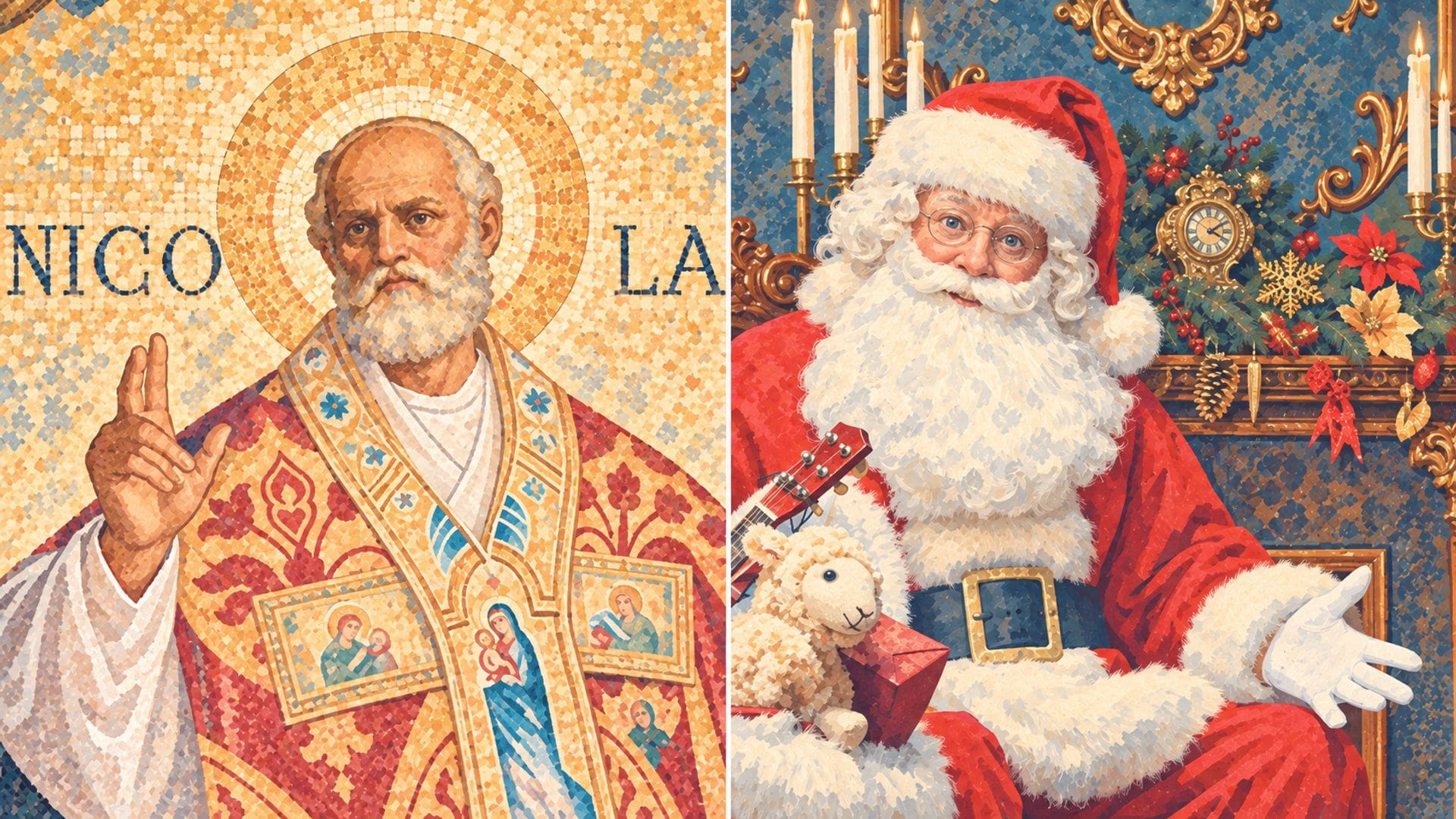
The Longest Makeover in History
Somewhere between the 4th-century bishop who secretly threw bags of gold through a window to save three sisters from slavery and the jolly, red-suited figure who slides down chimneys with a sack of toys, the most extraordinary cultural transformation in history took place. It happened in stages — across centuries, continents, and languages — and it started here, in Demre, in the church where Nicholas of Myra was buried.
This is not the story of who Nicholas was — that page covers his real life. And it's not about the building he was buried in. This is the story of how a Lycian bishop became Santa Claus — how acts of quiet generosity in a small Mediterranean town turned into the most recognisable figure in global popular culture.
The Byzantine Saint's Cult (4th–11th Century)
Within decades of Nicholas's death around 343 CE, veneration began at his tomb in Myra. The cult grew rapidly. Emperor Justinian built a grand basilica over the burial site in the 520s — the church that still stands today. By the 6th century, Nicholas was one of the most popular saints in the Eastern Christian world, with churches dedicated to him across the Byzantine Empire.
The Byzantine iconographic tradition established the image that persists in Orthodox Christianity today: an elderly bishop in red liturgical vestments, white beard, stern but kind expression, holding a Gospel book and making the sign of blessing. If you look at the 11th-century frescoes in the church, you see this exact figure — the template that would eventually, through many transformations, become Santa Claus.
Nicholas became the patron saint of sailors, merchants, children, and the wrongly accused. His feast day, December 6, was widely observed across the Byzantine world with special liturgies and charitable acts. The date would prove crucial — it placed Nicholas firmly in the winter calendar, close enough to Christmas to eventually merge with it.
The Bari Theft & Western Expansion (1087)
The event that launched Nicholas into the Western European imagination was an act of theft. In 1087, Italian merchants from the port city of Bari sailed to Myra, broke open Nicholas's sarcophagus in the church, and removed most of his bones. They brought the relics back to Bari, where a magnificent basilica — the Basilica di San Nicola — was built to house them.
The theft was a catastrophe for Myra and a triumph for Bari. With the relics came the pilgrims, and with the pilgrims came the stories. Nicholas's fame, previously concentrated in the Eastern Mediterranean and Byzantine world, now exploded across Western Europe. Churches dedicated to Saint Nicholas were built from Sicily to Scandinavia. By the 12th century, he was one of the most venerated saints in all of Christendom.
The majority of Nicholas's bones remain in Bari, Italy. A smaller portion ended up in Venice during the First Crusade. A bone fragment is held in the Antalya Museum in Turkey. In recent decades, Turkey has periodically requested the return of the relics — a diplomatic issue that remains unresolved. DNA testing has confirmed that the Bari and Venice fragments belong to the same individual, a man who lived in the 4th century. The 2024 sarcophagus discovery has added a new dimension to the debate.
Medieval Europe: December 6 & the Gift-Giving Tradition
In medieval Western Europe, December 6 — the Feast of Saint Nicholas — became a major celebration, particularly for children. The central tradition was gift-giving: adults would leave small presents in children's shoes on the eve of December 5, imitating Nicholas's legendary act of secretly leaving bags of gold for the three impoverished sisters.
In England and parts of northern Europe, the “Boy Bishop” festivals became popular. A young chorister would be elected “bishop for a day” on December 6, presiding over church services and leading processions — a ritual inversion of hierarchy that delighted children and occasionally alarmed clergy. The tradition survived in various forms until the Reformation.
The key transformation here was subtle but profound: Nicholas shifted from being primarily a saint you prayed to into a figure who gave things to you. The focus moved from his spiritual intercession to his material generosity — from miracles to gifts. This was the seed of Santa Claus.
For years, Demre's town square had both an Orthodox bishop statue and a plastic Santa Claus figure standing side by side. It looked like an identity crisis, but it was actually a perfect summary of this entire story: the same man, meaning completely different things to different people at different times. The bishop gave gold to save lives. Santa gives toys to reward good behaviour. Both are Nicholas — separated by 1,700 years of storytelling.
Sinterklaas: The Dutch Bridge
The Netherlands preserved and elaborated the Nicholas tradition more than any other country. The Dutch Sinterklaas (a contraction of “Sint Nikolaas”) arrives each November by steamship “from Spain” — a reference to the Iberian connection with Mediterranean Christianity. He rides a white horse across rooftops, accompanied by helpers, and delivers gifts on the evening of December 5.
Critically, Sinterklaas retained more of the original bishop's appearance than other European traditions: he wears a red bishop's mitre and cape, carries a crozier (pastoral staff), and has a long white beard. He is dignified, somewhat stern, and keeps a book recording whether children have been good or bad. The modern Dutch celebration remains one of the country's most important cultural events.
When Dutch colonists founded New Amsterdam (later New York) in the 17th century, they brought Sinterklaas with them. The name crossed the Atlantic — and began its final transformation.
The American Reinvention (1809–1863)
Three American writers and one illustrator turned a European bishop into a global cultural phenomenon.
Washington Irving (1809)
In his satirical Knickerbocker's History of New York, Irving depicted St. Nicholas as the patron saint of the Dutch colony, riding over treetops in a flying wagon, dropping gifts down chimneys. It was a joke — but it stuck. Irving's Nicholas was no longer a solemn bishop; he was a mischievous, pipe-smoking folk figure.
Clement Clarke Moore (1823)
Moore's poem A Visit from St. Nicholas (“'Twas the Night Before Christmas”) did more to define Santa Claus than any other single work. Moore's Nicholas is “chubby and plump, a right jolly old elf” who travels by reindeer-drawn sleigh, enters through the chimney, and fills stockings. The poem moved the gift-giving from December 5/6 to Christmas Eve — permanently merging the Nicholas tradition with Christmas.
Thomas Nast (1860s–1880s)
The German-American illustrator Thomas Nast, working for Harper's Weekly, created the visual Santa Claus that the 20th century would inherit. Over two decades of drawings, Nast established Santa's workshop at the North Pole, the naughty-and-nice list, the red fur-trimmed suit, the round belly, and the white beard. Nast drew Santa as a full-sized man rather than Moore's miniature elf — the proportions we recognise today.
The Coca-Cola Santa & Global Icon (1931–Present)
In 1931, the Coca-Cola Company commissioned illustrator Haddon Sundblom to paint a Santa Claus for their winter advertising campaign. Sundblom created a warm, grandfatherly figure in a bright red suit — ruddy cheeks, twinkling eyes, a broad smile, and a bottle of Coke in hand. The ads ran annually from 1931 to 1964.
Coca-Cola did not invent the red suit — red was already associated with both Saint Nicholas's episcopal vestments and Nast's illustrations. But Sundblom standardised the image. Before these campaigns, Santa's appearance varied widely: he could be tall or short, wear green or blue, look stern or jolly. After Sundblom, there was essentially one Santa Claus, and he looked like a Coca-Cola ad.
By the mid-20th century, this image had conquered the world. Santa Claus appeared in department stores from Tokyo to São Paulo, in films, television, advertising, and greeting cards. The 4th-century bishop who had given away his inheritance to help the poor of Myra had become the mascot of consumer capitalism — the ultimate irony of a 1,700-year cultural journey.
Demre's Four Faces of Nicholas
Nowhere is the tension between the bishop and Santa Claus more visible than in Demre itself. Over the years, the town square has hosted several competing representations of Nicholas — each reflecting a different claim on his identity.
In 2000, Russia donated a bronze statue of Nicholas as an Orthodox bishop: solemn, robed, holding a Gospel book and making the sign of blessing. This is the Nicholas that Russian Orthodox pilgrims come to Demre to honour — a patron saint and spiritual figure.
Around 2005, a plastic Santa Claus figure appeared in the square — red suit, white beard, jolly expression. It was intended to attract tourists but triggered controversy. Residents, local politicians, and cultural commentators debated whether a Christian saint should be represented as a commercial Christmas mascot in a predominantly Muslim country. The figure was eventually removed, replaced, and debated again.
A Turkish sculptor's interpretation attempted a middle ground — a more abstract, culturally neutral figure. And the church garden has its own statue, closer to the Orthodox tradition.
These four representations — the Orthodox bishop, the commercial Santa, the cultural compromise, and the ecclesiastical memorial — are the entire history of St. Nicholas condensed into one small Turkish town square. Each one is “correct” in its own context. None captures the whole man.
Growing up in Demre, we always said “Noel Baba is from here” — but understanding what that actually means took years. A Lycian bishop's story of generosity shaped how billions of people celebrate Christmas, and it started in our town, in that church, with a man who gave away everything he had. When tourists ask me where the “real Santa Claus” lived, I point them to the church. The answer to who Santa Claus is hasn't changed in 1,700 years — only the costume has.
Visiting the Source
If you've read this far, you might want to see where it all began. St. Nicholas Church in Demre is open daily, and the town is an easy visit from Antalya, Kaş, or Kalkan. Standing inside the 6th-century basilica, looking at the frescoes that depict Nicholas as a Byzantine bishop, and then walking out to the town square where his various modern incarnations compete for attention — that's when the 1,700-year journey from bishop to Santa Claus becomes physically real.
For information about the annual December 6 Orthodox liturgy — the one day each year when the church functions as a place of worship rather than a museum — see the Pilgrimage Guide. For practical visiting information (tickets, hours, getting there), see the St. Nicholas Guide Hub.
