Still Digging After 37 Years
In December 2024, headlines around the world announced that “Santa Claus's tomb” had been found in Turkey. The reality is more nuanced and more interesting: a limestone sarcophagus was discovered beneath the basilica floor at St. Nicholas Church in Demre, part of a decades-long excavation effort that has already revealed the only surviving Nicholas life-cycle frescoes in Turkey, the original 4th-century floor level, and layers of Byzantine construction spanning six centuries.
This article traces the archaeological history of the church from the first systematic digs in 1988 to the 2024 sarcophagus discovery — and explains what visitors can see at the site today. It is not a story of a single dramatic find but of patient, multi-generational scholarship gradually revealing one of the most important early Christian sites in the Mediterranean.
Excavation Chronology
The 2024 Sarcophagus: What We Know
The Physical Evidence
The sarcophagus is made of limestone, approximately 2 metres long, with a distinctive gabled (ridge-shaped) lid. It was found in a two-storey annex of the church, buried 1.5–2 metres beneath the mosaic floor that visitors walk over. The burial context includes oil lamp fragments and animal bones — consistent with early Christian funerary rituals, where lamps were left burning at the grave and ceremonial meals were shared near the tomb.
Why It Matters
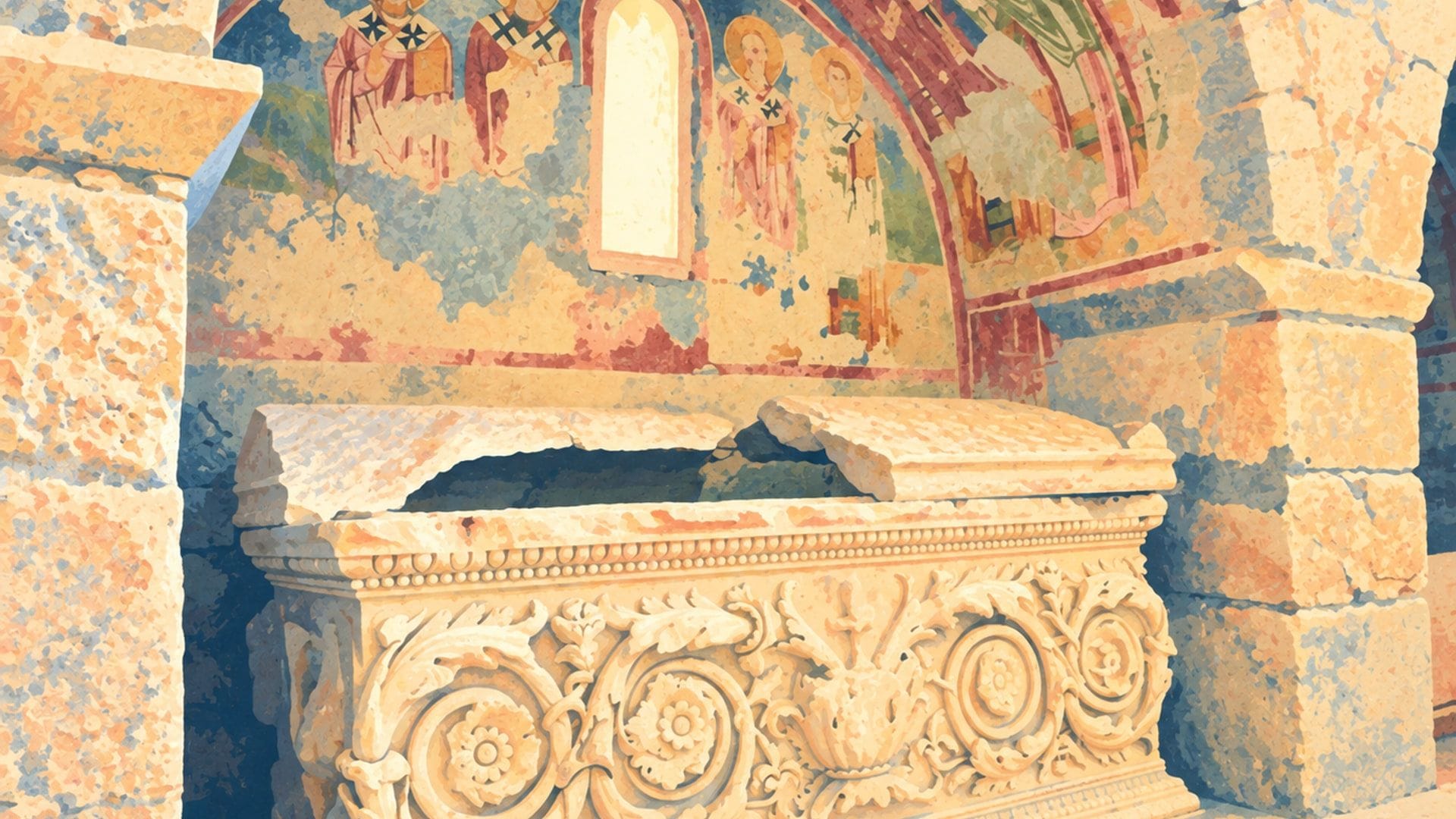
The church already contains a well-known sarcophagus — the broken marble tomb in the south aisle, traditionally identified as Nicholas's burial. That sarcophagus was cracked open by Italian sailors from Bari in 1087 to remove the saint's bones. But some scholars have long questioned whether the marble tomb was actually Nicholas's original burial or a later relocation — it could have been placed there after the church was expanded in the 6th century.
The 2024 sarcophagus opens a new possibility: that this deeper, older burial — beneath the floor, in a location consistent with early Christian practice of burying important figures under churches rather than within them — may be the original 4th-century burial. If confirmed, it would mean the Bari sailors took bones from the wrong tomb, and that Nicholas's actual remains may never have left Demre.
No definitive identification has been made. The headlines “Santa Claus's tomb found” are premature. Carbon dating is ongoing, no inscriptions have been found on the sarcophagus, and the contents have not been publicly described in detail. The archaeological team has been careful to describe this as a “significant discovery” rather than a confirmed identification. Science takes time — results may not be available for months or years.
The Relic Connection
DNA testing in 2017 confirmed that the bone fragments in Bari, Italy and Venice, Italy belong to the same individual — a man who lived in the 4th century. A bone fragment held in the Antalya Museum may also belong to this individual. If the 2024 sarcophagus can be dated and its contents analysed, comparison with the Bari/Venice DNA profile could establish whether this is the same person — or a different burial entirely.
When the sarcophagus news broke in December 2024, it was headlines everywhere — “Santa Claus's tomb found in Turkey.” In Demre, the reaction was quieter. We've had excavation trenches around the church for as long as anyone can remember. Even when I was a child, there were always archaeologists working behind barriers. The real excitement isn't the discovery itself — it's the carbon dating results. When those come, Demre will be on the world's front pages again.
Two Sarcophagi, Two Stories
The church now contains two sarcophagi with competing claims to Nicholas's burial — a situation that captures the complexity of early Christian archaeology.
The Marble Sarcophagus (South Aisle)
Visible, accessible, and dramatically damaged. This is what most visitors see and what most guidebooks describe as “Nicholas's tomb.” Its broken lid tells the story of the 1087 relic theft. For pilgrims, it remains the emotional centrepiece of the church, regardless of whether it was the original burial. The frescoes around it suggest it was venerated for centuries.
The Limestone Sarcophagus (Beneath the Floor)
Hidden for centuries, discovered in 2024. Its position beneath the mosaic floor, in a context consistent with early Christian burial practice, makes it a strong candidate for an earlier — possibly original — burial. But burial contexts can be misleading: it could also be a later interment of a different high-status individual, such as a subsequent Bishop of Myra.
The resolution may come from science rather than archaeology: carbon dating of any organic material in or around the sarcophagus, and potential DNA comparison with the Bari relics, could settle the question. Until then, both tombs tell a story — one of theft and veneration, the other of concealment and rediscovery.
UNESCO & the Future
St. Nicholas Church has been on the UNESCO World Heritage Tentative List since 2000. Full inscription would bring international protection, funding, and recognition — but the nomination process requires completed documentation and a management plan, which ongoing excavations make complex.
The 2024 discovery may actually accelerate the UNESCO process. The find drew global media attention, reminding international bodies of the site's significance. Turkish officials have publicly stated that the sarcophagus discovery strengthens the case for inscription. However, UNESCO processes move slowly — even with renewed momentum, formal nomination and evaluation typically take years.
For visitors, the UNESCO status matters practically: a fully inscribed World Heritage Site would likely mean improved facilities, better signage, and potentially expanded excavation access. For the archaeological community, it would ensure long-term protection of one of the most important Byzantine church sites in the eastern Mediterranean.
Parallel Excavations in the Region
The St. Nicholas Church excavations are part of a broader archaeological effort in the Demre area. Andriake harbour, 5 km south, has been called the “Pompeii of Anatolia” due to its extraordinary preservation under alluvial deposits — the same geological process that buried the church. The Myra Ancient City site, 2 km east, preserves the Roman theatre and Lycian rock tombs from the same world Nicholas inhabited.
Together, these sites form an interconnected archaeological landscape: the city where Nicholas was bishop (Myra), the harbour where his grain miracle took place (Andriake), and the church where he was buried. Visiting all three in a single day gives a sense of the complete world of 4th-century Lycia that produced the man who became Santa Claus.
What Visitors Can See Today
As of early 2026, the main church complex is open to visitors during standard hours. You can see:
- The broken marble sarcophagus in the south aisle (1087 damage visible)
- The fresco gallery in the northeast annex (Nicholas life-cycle frescoes)
- The mosaic and opus sectile floors (11th-century decorative panels)
- The synthronon in the apse (where Nicholas sat)
- Excavation barriers and walkways — visible evidence of ongoing work
The 2024 sarcophagus excavation area is not fully accessible to general visitors due to ongoing archaeological work. Some areas of the church may be temporarily closed as excavation progresses. Check at the entrance for current access status — it can change week to week.
If you're visiting specifically because of the 2024 discovery, manage expectations: you may not be able to see the limestone sarcophagus itself. But the church offers plenty of archaeological interest regardless — the broken marble tomb, the frescoes, the floor mosaics, and the visible layers of construction spanning six centuries. For a complete architectural tour, see the Architecture & Frescoes guide. For photography tips, see the photo guide.
Visitors sometimes arrive disappointed that they can't see everything — barriers, closed areas, scaffolding. But that's exactly what makes this site alive. The church isn't a finished museum where everything is labelled and sealed behind glass. It's a place where people are still finding things, still learning, still surprised by what's under the next layer of stone. The barriers aren't obstacles — they're proof that the story of Nicholas is still being written.
