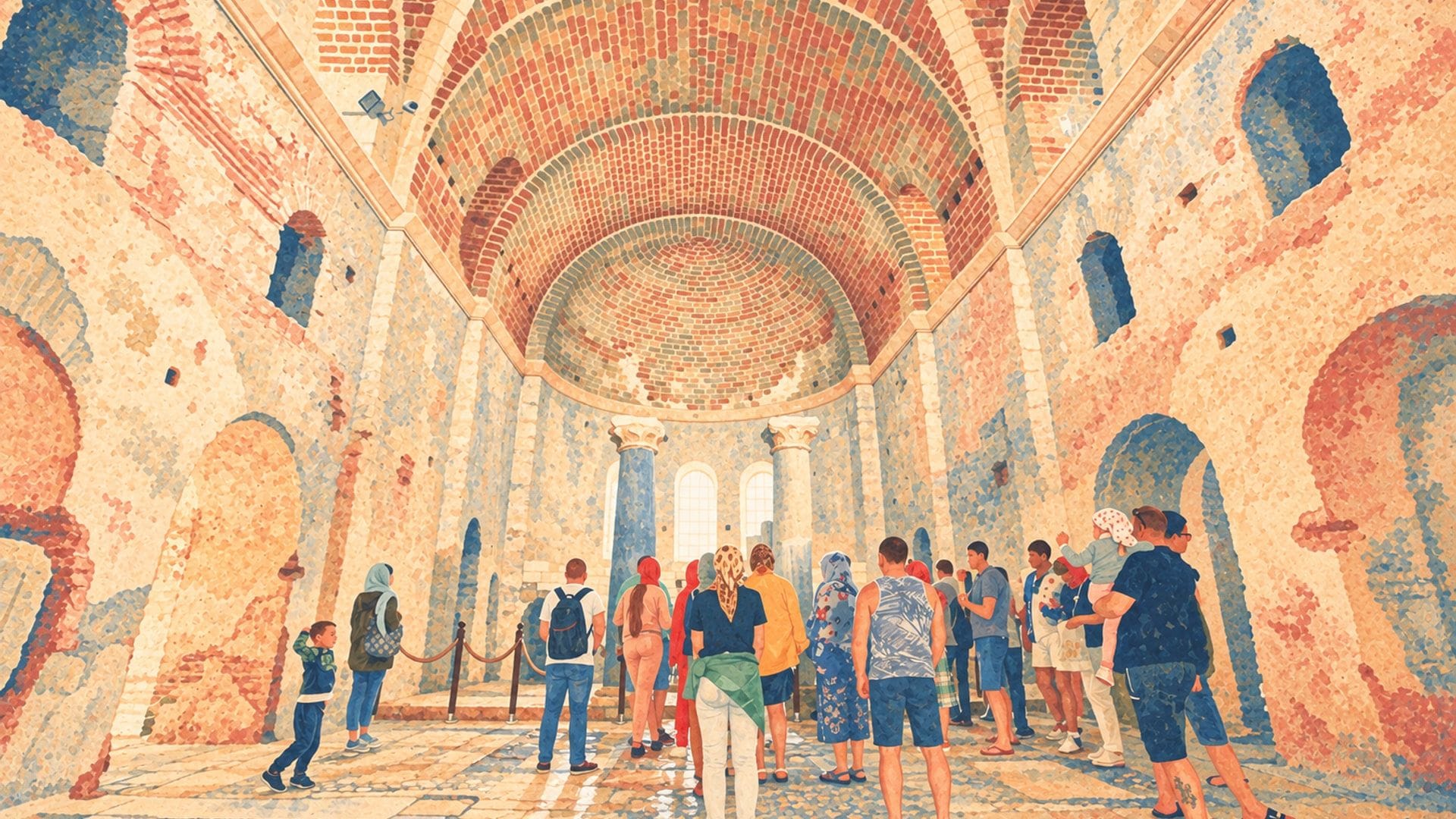
A Church That Becomes a Church Once a Year
For 364 days a year, St. Nicholas Church in Demre is a museum-monument — visitors buy tickets, walk the ancient corridors, photograph the frescoes, and leave. But on one day — December 6, the Feast of Saint Nicholas — the building reverts to its original purpose: a place of worship. An Orthodox liturgy fills the nave with chanting, incense, and the prayers of pilgrims who have travelled thousands of kilometres to stand where Nicholas of Myra was buried 1,700 years ago.
This guide is for two audiences: Orthodox Christians planning a pilgrimage to Demre, and culturally curious travellers who want to understand why this small Turkish town draws devotees from Russia, Greece, and across the Christian world. Whether you come for faith or fascination, understanding the pilgrimage tradition deepens any visit to the church.
December 6: The Feast of Saint Nicholas
The annual Orthodox Divine Liturgy on December 6 is the most significant event on Demre's calendar. It is conducted by the Metropolitan of Myra, a titular bishop of the Ecumenical Patriarchate of Constantinople who resides in Istanbul but retains the ancient title of Nicholas's own episcopal see.
What Happens
The service typically begins in the morning and lasts several hours. It follows the Byzantine liturgical rite, conducted primarily in Greek with elements of Church Slavonic for the Russian faithful who form the largest pilgrim group. Candles are lit, icons are venerated, and the liturgy culminates in the Eucharist — the central sacrament of Orthodox worship, celebrated in the same building where Nicholas himself administered it in the 4th century.
Can Anyone Attend?
Yes. The liturgy is open to the public regardless of faith. However, space inside the church is limited, and December 6 draws significantly more visitors than a typical day. Arrive early — ideally by 8:00 or earlier — to secure a position inside. Late arrivals may need to observe from the courtyard or the street above. Dress respectfully: shoulders and knees covered, as at any active Orthodox service.
The December 6 liturgy requires advance awareness of logistics. Demre is a small town with limited accommodation, and December is off-season for most tourism infrastructure. Hotels in Demre, Kaş, and Kalkan fill quickly around this date. Book accommodation well in advance. Some years, charter buses bring large groups of Russian pilgrims from Antalya, adding to the crowd. Check with local tourism offices for the exact schedule, as timing can shift.
Russian Orthodox Pilgrimage
Saint Nicholas holds a unique place in Russian Orthodoxy. He is one of the most venerated saints in Russia — a protector of the faithful, patron of sailors and travellers, and a symbol of selfless generosity. More Russian churches are named after Nicholas than after almost any other saint. For Russian Orthodox Christians, visiting Demre is not tourism — it is a spiritual homecoming to the source of a tradition that has shaped Russian culture for a millennium.
This connection has concrete, historical expression. In 1862, Czar Nicholas I — named after the saint — funded a major restoration of the church, adding the barrel vaults and bell tower still visible today. In 2000, Russia donated a bronze statue of Bishop Nicholas to Demre, depicting the saint in full Orthodox episcopal vestments. The statue stands near the church — a statement of Russia's ongoing claim to Nicholas's spiritual legacy.
The Antalya region receives more Russian tourists than any other nationality (outside of pandemic disruptions), and many Russian visitors to the beaches of Antalya, Kemer, or Alanya make a specific day trip to Demre to visit the church. For some, it is the primary reason they chose a holiday in this region.
Greek Orthodox Heritage
For Greek Orthodox visitors, St. Nicholas Church carries a different but equally powerful emotional charge. Demre — ancient Myra — had a significant Greek Orthodox community for centuries. The church was not a ruin or a monument to them; it was their parish church, where baptisms, weddings, and funerals took place, where the community gathered for the feasts of the liturgical calendar.
That community departed during the 1923 population exchange between Greece and Turkey, one of the 20th century's largest forced migrations. The Greek Orthodox of Myra/Demre resettled in Greece, leaving behind their homes, their church, and the grave of their patron saint. For descendants of that community, and for Greek Orthodox Christians more broadly, visiting Demre is an act of connection to a lost homeland.
The Metropolitan of Myra — the bishop who conducts the December 6 liturgy — is a living link to this history. The title has been maintained by the Ecumenical Patriarchate since the population exchange, even though no Greek Orthodox community remains in Demre. It is a statement that the spiritual connection to Myra endures, even when the physical community does not.
On December 6, the atmosphere in Demre changes completely. Normally a quiet town, it fills with coaches of Russian and Greek pilgrims. Candles are lit outside the church, Slavonic hymns echo off the stone walls, and for one day Demre feels like the centre of a world that stretches from Moscow to Athens. I've watched this happen every year since I was a child — and it still surprises me that this small town, our town, means so much to people who have travelled so far.
Church or Museum? The Ongoing Debate
The question of whether St. Nicholas Church should function as a museum or as an active place of worship is a recurring point of tension. Currently, the building operates as a museum-monument under the Turkish Ministry of Culture, with the December 6 exception granted annually by special permission.
Orthodox organisations, particularly from Russia and Greece, have periodically called for the building to be returned to regular worship — or at least for more frequent liturgical use. Turkish authorities have generally maintained the museum status, citing the building's archaeological significance and the ongoing excavations. The question has no easy answer: the building is simultaneously an archaeological site of global importance, a functioning museum, a potential UNESCO World Heritage Site, and the burial church of one of Christianity's most beloved saints.
For visitors, this tension is visible in small ways: the broken sarcophagus draws both archaeological interest and devotional gestures; pilgrims sometimes try to touch the stone despite barriers; and the statues in the town square represent competing visions of who Nicholas is and what he means.
The Nicholas Pilgrimage Route
For pilgrims or history enthusiasts who want to follow the arc of Nicholas's life and legacy across the Mediterranean, a multi-stop route traces his story from birth to burial to relic dispersal.
Patara — The Birthplace
Nicholas was born around 270 CE in Patara, a major Lycian port city. Today, Patara is an archaeological site with a Roman parliament building, theatre, and Turkey's longest uninterrupted beach. The connection to Nicholas is commemorated but the ancient city's ruins are the main attraction.
Demre & Myra — Life, Death, and Burial
Nicholas served as Bishop of Myra and was buried in the church that bears his name. Visit the church, the Lycian rock tombs, and the Roman theatre where Nicholas's congregation would have gathered. Andriake harbour is where the grain ships docked — the setting for Nicholas's grain miracle.
Gemiler Island — Alternative Burial Hypothesis
Some scholars have proposed that Nicholas was originally buried on Gemiler Island (near Fethiye), based on archaeological evidence of an important early Christian pilgrimage church there. The hypothesis is disputed, but the island — accessible by boat from Ölüdeniz — is a striking site with Byzantine church ruins overlooking the Mediterranean.
Bari, Italy — Where the Relics Rest
The majority of Nicholas's bones have been in Bari since 1087. The Basilica di San Nicola, built specifically to house the relics, is one of southern Italy's most important pilgrimage churches. A smaller portion of relics ended up in Venice. Completing the route from Patara to Bari follows the physical trajectory of Nicholas's story across the Mediterranean.
Planning a Pilgrimage Visit
For December 6
Book accommodation in Demre, Kaş, or Kalkan well in advance — at least 2–3 months before. Arrive at the church by 8:00 or earlier. The service is conducted in Greek and Church Slavonic. Dress modestly (shoulders and knees covered). Photography during the liturgy is generally tolerated but be respectful — this is an active worship service, not a performance.
Year-Round Pilgrim Visits
Outside December 6, the church operates as a museum. Pilgrim gestures are common — visitors pray at the sarcophagus, cross themselves before frescoes, and light candles in the courtyard. These acts are respected by museum staff. Early morning (8:30–10:00, before tour groups) offers the most contemplative atmosphere.
Nearby Religious Sites
The St. Paul route through Andriake connects to another layer of early Christian history in the Demre area — the Apostle Paul stopped at Andriake harbour on his journey to Rome. For those interested in broader Lycian Christian heritage, the region between Demre and Fethiye contains dozens of Byzantine church ruins, many accessible via the Lycian Way hiking trail.
If you can only visit once, December 6 is the day. Not because the church looks different — it doesn't — but because it feels different. The incense, the chanting, the crowd of people who have come not to take photos but to pray — it transforms the building from a museum back into what it was built to be. You don't need to be Orthodox or even religious to feel it. You just need to be there.
