A Prisoner, a Harbour, and a Grain Ship
St. Paul at Andriake is one of the New Testament's briefest geographical references and one of its most historically grounded. In two verses — Acts 27:5–6 — Luke records that Paul, travelling as a prisoner to Rome, arrived at Myra in Lycia and transferred to an Alexandrian grain ship. Myra's harbour was Andriake, the same ancient port whose ruins you can walk through today, 5 km south of Demre. What makes this stopover remarkable isn't just the biblical connection — it's that the archaeological evidence confirms exactly the kind of harbour activity that Luke describes, down to the grain ships, the trans-shipment infrastructure, and the strategic position on the Egypt-to-Rome trade route.
This article tells the story from three angles: what the Bible records, why Andriake was the logical place for this transfer to happen, and what you can see at the site today that connects directly to that moment in 59 CE.
“And when we had sailed across the sea along the coast of Cilicia and Pamphylia, we came to Myra, a city of Lycia. There the centurion found an Alexandrian ship sailing for Italy, and he put us aboard it.”
Acts 27:5–6 (ESV)The Biblical Narrative: Acts 27
The year is approximately 59 CE. Paul has been arrested in Jerusalem, held in Caesarea for two years, and has appealed to Caesar — his right as a Roman citizen. The governor Festus arranges his transport to Rome under the custody of a centurion named Julius, of the Augustan Cohort. Paul is not alone: Luke (the author of Acts, writing in the first person plural — “we”) and a Thessalonian named Aristarchus travel with him.
The journey begins on a coastal vessel from Adramyttium, working its way along the southern coast of Asia Minor. Progress is slow — Luke notes headwinds. They call at Sidon, sail under the lee of Cyprus, and cross the open sea off Cilicia and Pamphylia before reaching Myra in Lycia.
At Myra — meaning at its harbour, Andriake — the centurion faces a practical problem: the coastal vessel isn't going to Italy. He needs to find a westbound ship. Luke records the solution: an Alexandrian grain ship, part of the imperial fleet that carried Egyptian wheat to Rome, is in port. Julius arranges passage. Paul, Luke, Aristarchus, and the other prisoners board the grain ship. From here, the voyage continues — and worsens dramatically.
After Andriake: The Voyage Continues
The grain ship leaves Andriake but makes slow progress against contrary winds. They struggle past Cnidus, sail under the lee of Crete, and reach a harbour called Fair Havens. Paul warns that the voyage is becoming dangerous — it is after the Day of Atonement, meaning late October, when Mediterranean sailing becomes treacherous. The centurion overrules him. The ship pushes on, is caught by a violent northeaster (the Euroclydon), and is driven helplessly for fourteen days. They survive by jettisoning cargo, running ropes under the hull, and eventually running aground on Malta. Everyone aboard — 276 people — survives. Paul reaches Rome the following spring.
Andriake is the early, calm stage of this epic journey — the last moment of routine before everything goes wrong. It's where Paul stepped off one world (the coast of Asia Minor, familiar territory) and onto another (the open Mediterranean, Rome, and eventual martyrdom).
Why Andriake? The Grain Trade Connection
Paul's transfer at Andriake was not a coincidence. It was a product of Rome's most important supply chain: the annona — the imperial grain supply.
Egypt was Rome's breadbasket. Every year, hundreds of large merchant vessels carried Egyptian wheat from Alexandria to Puteoli (near Naples) and Ostia (Rome's port). These grain ships were among the largest vessels in the ancient world — up to 55 metres long, carrying 1,000–1,300 tonnes of wheat. They couldn't sail directly from Alexandria to Italy; prevailing winds and currents forced them on a northern route, hugging the coast of Cyprus, then the Lycian coast, before turning west toward Crete and Italy.
Andriake was one of the critical stops on this route. Ships put in here for fresh water, provisions, crew rest, and minor repairs. The massive Granary (Horrea Hadriani) that Emperor Hadrian built at Andriake around 70 years after Paul's visit — 2,307 square metres, seven chambers — confirms that the grain trade here was not incidental but systematic. The trade predated the Granary; Hadrian's building formalised infrastructure that had been functioning for generations.
This is why the centurion Julius could find an Alexandrian grain ship at Andriake: there was almost always one in port, or one expected within days. Paul's boarding was a routine passenger transfer on an established trade route — not a lucky encounter.
The Greek geographer Strabo, writing roughly a generation before Paul's visit, described Myra as one of the six largest cities of the Lycian League. He noted the harbour at Andriake and the region's sulphur springs (still flowing today as Burguç Su on the road to Çayağzı). Strabo's account confirms that Andriake was a well-known port before Paul arrived — not an obscure anchorage but a major stop on the Mediterranean trade network.
What You Can See Today: Archaeological Evidence
Paul visited Andriake approximately 2,000 years ago. The harbour has silted up — centuries of alluvial deposits from the Demre River buried the ancient port under metres of sediment. But the excavations that began in 2009 have revealed an extraordinary amount of the infrastructure that Paul would have encountered.
The Harbour Basin
The ancient harbour basin is identifiable in the archaeological landscape. While it no longer holds water (the alluvium filled it in), the outline, quay structures, and mooring installations mark where ships would have docked. The modern Çayağzı harbour, directly adjacent, occupies the same bay — fishermen and tour boats now moor where grain ships once anchored.
The Granary & Museum
Hadrian's Granary was built around 129–130 CE — roughly 70 years after Paul. But the Lycian Civilizations Museum now housed inside it provides essential context: the maritime hall explains how the harbour functioned, the grain trade routes, the types of vessels, and the scale of commercial traffic. Standing inside this building, you're looking at the evolved version of the infrastructure that served Paul's grain ship.
The Agora & Supporting Buildings
The excavated trade agora (Plakoma), Roman baths, and harbour-side buildings show the commercial and civic infrastructure of a working port city. Paul wouldn't have seen these exact buildings in their current form — many postdate his visit — but the functions they served (trade, accommodation, bathing, supply) were already established in the 1st century CE.
What Paul Would Have Seen
In 59 CE, Paul would have arrived at a busy commercial harbour: ships at anchor, warehouses storing grain and goods, a functioning agora for trade, bathhouses, and likely accommodation for travellers and crews. The Granary didn't exist yet, but storage facilities did. The murex purple dye industry was active — the enormous shell mounds beside the museum testify to this. The sulphur springs on the road from Myra were already famous. It was not a quiet fishing village; it was one of the Mediterranean's important trade ports.
Standing at the harbour area of the archaeological site, I sometimes think about what it must have been like for Paulus arriving here. This was a bustling commercial port — grain ships, purple dye workshops, the smell of the sulphur springs carried on the wind, sailors from Alexandria and merchants from across the Mediterranean. He was a prisoner being transferred between ships, waiting for a vessel heading west. Now, 2,000 years later, the harbour is still here. The grain ships are gone, replaced by fishing boats and Kekova tour gulets. But the bay, the mountains behind it, and the quality of the light — those haven't changed.
Visiting Today: A Biblical Heritage Trail
Demre offers one of the most concentrated biblical heritage experiences in Turkey — and one of the least developed for that audience. Competitor sites like Ephesus and Cappadocia have elaborate pilgrim tourism infrastructure. Demre has the sites themselves, largely unmediated, which is both its challenge and its charm.
Suggested Route
Stop 1: Andriake Harbour & Museum (1.5–2 hours) — Start where Paul arrived. Walk the ancient harbour area, see the grain trade context in the museum's maritime hall, and stand at the harbour basin where the ship transfer happened. The museum provides the historical framework for everything else.
Stop 2: St. Nicholas Church (1 hour) — Drive 5 km to Demre centre. The basilica of Bishop Nicholas — the historical figure behind Santa Claus — represents the next chapter of Christianity in this region, roughly 250 years after Paul. Two layers of Christian heritage in one small town.
Optional Stop 3: Patara (half day addition) — 40 km west. The capital of the Lycian League and another New Testament reference point (Acts 21:1 — Paul sailed from Patara on an earlier journey). A magnificent beach and archaeological site. Extends the trail to a full day.
For visitors with a specific interest in pilgrimage and biblical heritage, combining Andriake and St. Nicholas Church creates a narrative arc: the port where Paul passed through as a prisoner in chains, and the church built for a bishop who became one of the most beloved saints in Christianity — both in the same small Lycian town, separated by three centuries but connected by the same faith.
Most tour groups that come to Demre for St. Nicholas never visit Andriake. And most Bible study groups that read about Paul at Myra don't realise there's a physical harbour they can walk through. These two stories — separated by 250 years but happening within 5 km of each other — are what make Demre unique in the Christian heritage landscape. I've walked groups through both sites, and the moment when someone stands at the Andriake harbour and realises this is where it happened is always the most powerful part of the day.
Practical Information
Getting to the harbour area: The ancient harbour is part of the Andriake archaeological site, 5 km south of Demre centre. Follow signs to Çayağzı / Andriake. Combined entrance ticket with the Lycian Civilizations Museum; Museum Pass (Müzekart) accepted.
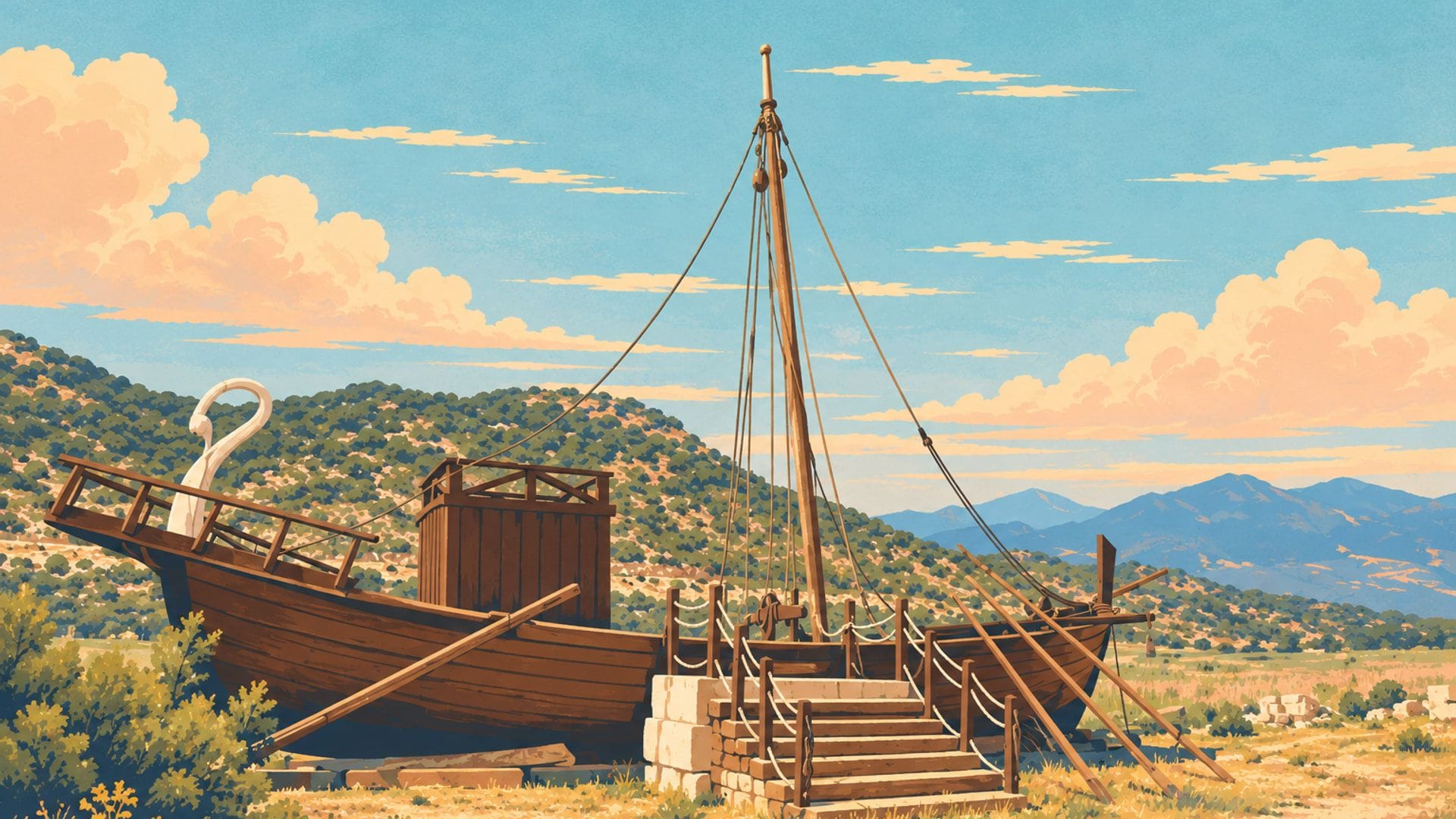
What to visit: The harbour basin area is visible in the outdoor archaeological site (follow the path past the museum toward the coast). Inside the museum, the maritime hall (Hall 7) covers the grain trade, ship types, and harbour operations. The trade ship reconstruction in the outdoor area provides a tangible sense of the vessels Paul would have sailed on.
Combine with: The museum and archaeological site take 1.5–2 hours. Add St. Nicholas Church (5 km, 1 hour) for a half-day biblical heritage itinerary. If you have a full day, add Çayağzı Beach for a swim and lunch at the harbour fish restaurants after your visit.
For Bible study groups: The site has no dedicated Bible trail signage or audio guide. Bring your own text (Acts 27 in full is recommended reading before or during the visit). A printed map of Paul's Mediterranean journeys adds enormously to the experience. If you're leading a group, the museum entrance area and the harbour overlook are the best spots for group discussion.
