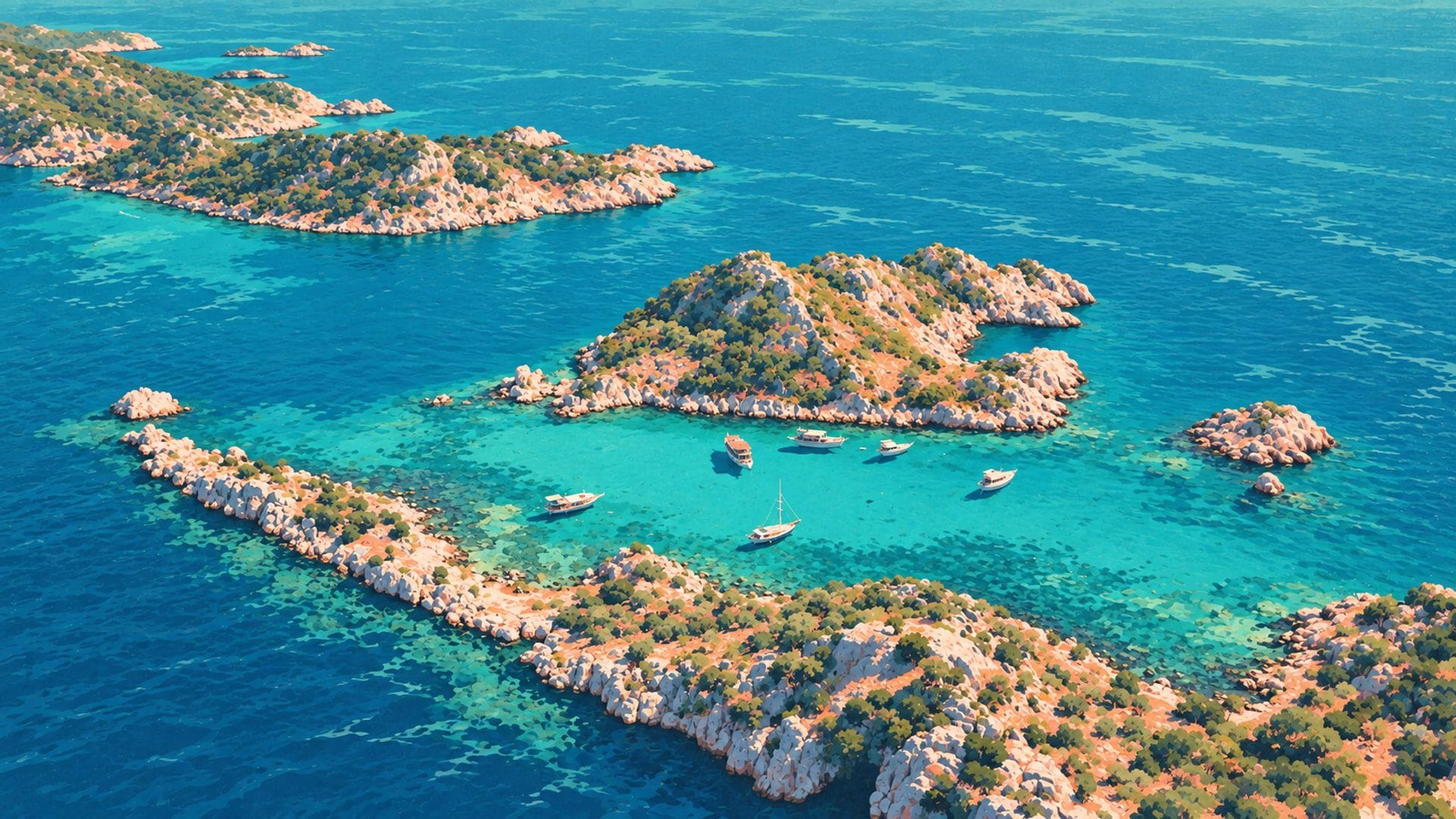
The Question Everyone Asks
“Can you swim at Kekova?” It's the most common question visitors ask, and the answer requires a distinction: you can't swim at the sunken city — the protection zone prohibits it — but you absolutely can swim in the Kekova region, and the bays where it's permitted are among the most beautiful on the entire Turkish Mediterranean coast.
Most boat tours include one or two swimming stops as part of the standard route. But knowing which bay suits your priorities — history, water clarity, solitude, snorkelling — can make the difference between a pleasant dip and a genuinely memorable swim. This guide covers the four main options and the hidden coves beyond them.
Swimming, diving, and snorkelling are prohibited in the sunken city zone along Kekova Island's southern shore. The 1990 SPA regulations are enforced by Coast Guard patrols. All bays described below are outside the protection zone and open for swimming.
For a visual overview of exactly where swimming is permitted and where it's prohibited, see the Kekova protection zone boundaries on our Interactive Map →
Tersane Bay (Shipyard Bay)
The most popular swimming stop on the Kekova circuit — and for good reason. Tersane Bay sits on the northern coast of Kekova Island, sheltered from wind and current by the island's ridge. The water is shallow, warm, and turquoise, with a gently sloping entry that makes it accessible for swimmers of all levels.
What distinguishes Tersane from a generic turquoise cove is the history on the shore. The bay takes its name from the ruins of a Byzantine-era shipyard (“tersane” in Turkish) visible along the waterline — stone slipways, quay walls, and the remains of covered boatsheds where galleys were hauled up for repair. The ruins date to roughly the 7th–11th century, the same period when Simena Castle was built to defend the bay.
Snorkelling: The rocky bottom along the eastern edge of the bay hosts sea bream, ornate wrasse, damselfish, and occasionally octopus hiding in crevices. The water clarity is typically 8–12 metres on calm mornings. Bring your own mask and snorkel — some tours provide gear, many don't.
Crowd management: In July–August, multiple gulets anchor here simultaneously between noon and 2 PM. For a quieter swim, opt for a morning half-day tour (arriving ~11 AM) or a private charter that can visit before or after the rush.
Akvaryum Bay
Named for its aquarium-like clarity, Akvaryum Bay is a small, sandy-bottomed cove on the mainland coast near the western entrance of the Kekova channel. The water is extraordinarily transparent — the sandy bottom reflects sunlight upward, creating the luminous turquoise colour that gives the bay its name.
What makes it different from Tersane: Akvaryum has a sandier, flatter bottom rather than rocky terrain, making it more comfortable for wading and more suitable for young children. There are no historical ruins on the shore. The snorkelling is less interesting (less marine life on sand), but the water clarity is arguably superior.
Depth and entry: Very shallow near the shore (knee-deep for 10–15 metres), deepening gradually to 3–4 metres in the centre. The gentle entry and soft bottom make this the safest bay for non-confident swimmers and families with small children.
Crowd level: Higher than Tersane in peak season — the bay is smaller, and its sheltered position makes it a favoured anchoring spot. In July–August, expect 5–10 boats at any given time during midday. Mornings before 11 AM or late afternoons after 3 PM are significantly quieter.
Gökkaya Bay & the Blue Cave
Further east from the main Kekova circuit, Gökkaya Bay is larger, deeper, and significantly less visited than Tersane or Akvaryum. It's the option for travellers who want solitude over convenience — most group tours don't come here, so you'll need a private charter or a kayak to reach it.
The bay's defining feature is a sea cave at its eastern end — a partially submerged cavern where the water takes on an intense blue colour from light filtering through the underwater entrance. The cave is swimmable (carefully — the entrance is rocky and low-clearance at anything above a dead calm) and the interior, while small, is atmospheric.
Snorkelling: Good to excellent along the rocky perimeter. The deeper water (5–10 metres) supports larger fish species than the shallower bays, and the rock formations create interesting underwater topography. Visibility is typically excellent.
Access: Private boat charter from Üçağız (approximately 8 km east of the main Kekova circuit, adding 30–40 minutes each way to the standard route) or sea kayak (experienced paddlers only — the round trip from Üçağız is roughly 16 km and takes 3–4 hours including swimming time). Not included on standard group tours.
Facilities: None whatsoever. No other boats most of the time. Total self-sufficiency required.
Hidden Coves: Beyond the Tour Route
Kekova Island's northern coast has several unnamed coves that don't appear on tour itineraries. These are reachable only by private charter or sea kayak, and on most days you'll have them entirely to yourself.
The coves share common features: rocky shorelines, pine-fringed slopes dropping to the water, depths of 2–6 metres, and no facilities. What they offer is total privacy and the particular quality of swimming in water where you can see every stone on the bottom, with no other boat in sight and no sound except wind in the pines.
If you're chartering a private boat, ask the captain about the coves between Tersane Bay and the island's eastern tip. Most captains know two or three “secret” spots they'll happily include if you express interest — it's a selling point for them, not a secret they guard.
Which Bay Is Right for You?
I've swum in all four of these bays more times than I can count — Tersane since I was a kid on my uncle's boat, Gökkaya since a friend got a charter licence. People ask me “which is the best bay?” and I always answer with a question: what do you want from your swim? If it's atmosphere and history, Tersane wins — swimming next to Byzantine shipyard ruins while fish circle your ankles is a hard experience to replicate. If it's water quality and ease, Akvaryum's sandy bottom and crystalline visibility can't be beaten, especially with kids. If it's solitude and adventure, Gökkaya with its blue cave is worth the extra effort. And if you just want to float in silence with nobody watching, ask your captain for the unnamed coves. They all exist within the same bay system, minutes apart by boat. If you have a full day, hit all three.
Tersane: Best for history + swimming combo. Rocky bottom, excellent snorkelling, moderate crowds. On all tour routes.
Akvaryum: Best for families and crystal-clear photos. Sandy bottom, gentle entry, less snorkelling interest. On most full-day tours.
Gökkaya: Best for solitude and the blue cave. Deeper water, better for confident swimmers. Private charter or kayak only.
Hidden coves: Best for total privacy. Rocky entry, no facilities, self-sufficient only. Private charter or kayak.
What to Bring
None of the bays have any facilities. This bears repeating because visitors accustomed to organised beaches are sometimes surprised. Here's the checklist:
Essentials: swimsuit (worn under clothes), towel, high-SPF sunscreen (reapply after every swim), drinking water (at least 1.5L per person — heat + saltwater = dehydration), hat for between swims.
Recommended: mask and snorkel (particularly for Tersane), water shoes or reef sandals (the rocky entries at Tersane and Gökkaya are sharp), a dry bag for phone and camera, and a lightweight coverup for sun protection on the boat between stops.
Temperatures: sea water is swimmable from May (20°C) through October (22–24°C), peaking at 27–28°C in August–September. The bays are sheltered and shallow, so they warm up faster than open water. One seasonal note: jellyfish occasionally appear in late August and September, particularly after sustained southerly winds. They're rarely dangerous but can sting — if you see translucent shapes drifting near the surface, give them space.
For an alternative way to experience the bays — paddling rather than motoring — see our Sea Kayaking Guide →. For details on the boat tours that include these swim stops, see Boat Tours →
