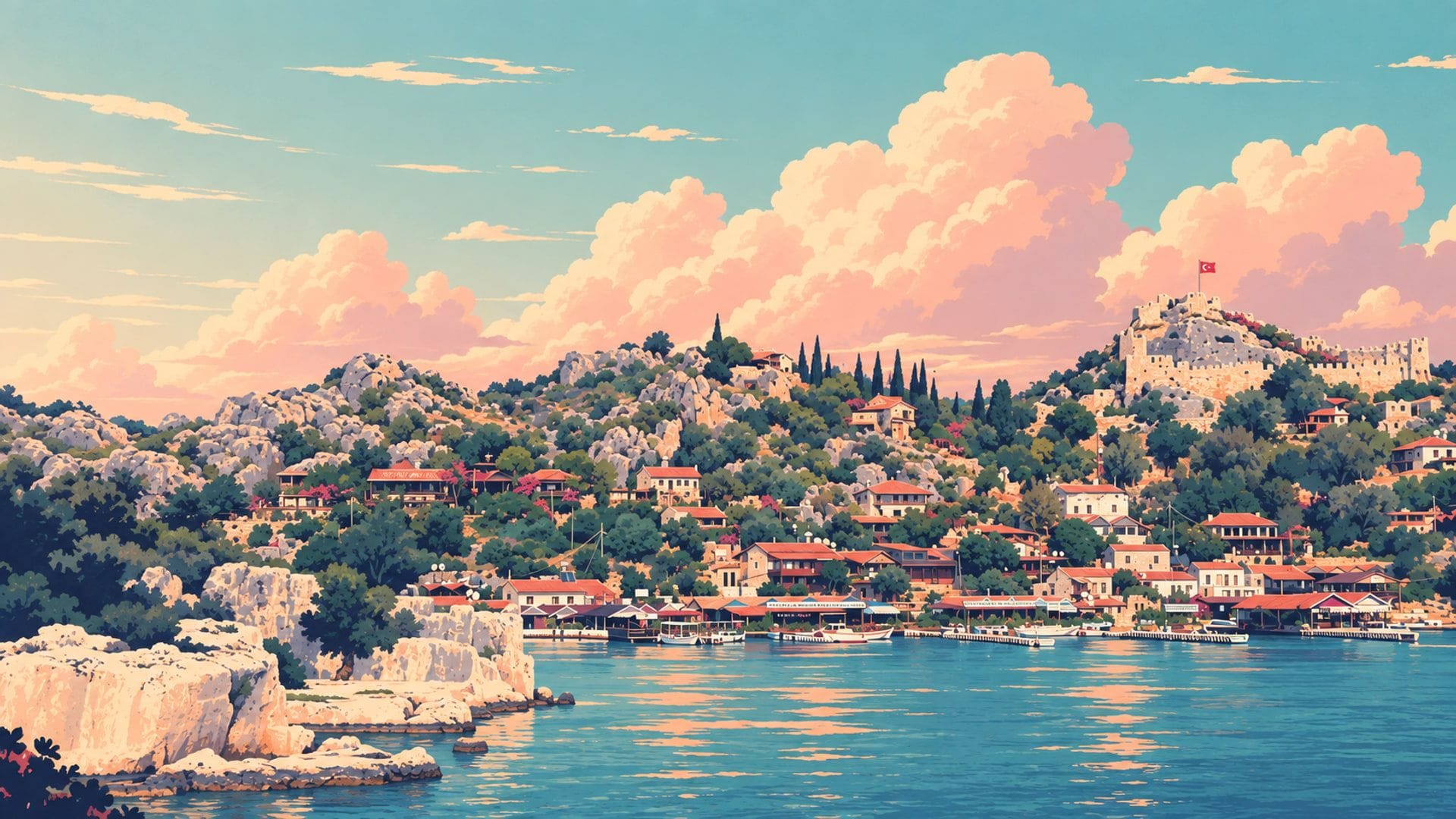
Why Kaleköy Is Different
There are villages in Turkey that tourism has polished into postcard perfection, and there are villages that tourism hasn't quite reached yet. Kaleköy is neither. It's a place that has been on the boat-tour circuit for decades but has remained stubbornly, structurally unchanged — because there's no road in, no room to build, and no way to bring a cement mixer up the hill.
The ancient name was Simena — one of three Lycian settlements that shared the Kekova coastline for centuries. The modern name is Kaleköy (“castle village”). It's a cluster of stone houses clinging to a steep hillside above a tiny harbour, crowned by a fortress that has been watching over the Kekova strait for over a thousand years. There are no cars, no motorbikes, no paved roads — everything arrives by boat and goes up by hand or mule. Lycian sarcophagi sit in gardens, beside footpaths, and in the shallows of the harbour. A 300-seat rock-cut theatre — the smallest known in Anatolia — hides inside the castle walls.
Most visitors see Kaleköy for 30 to 60 minutes on a boat tour. That's enough to climb the castle and take the photograph. But the village rewards a longer stay — an afternoon, or better yet, an overnight — with an atmosphere that the day-trip crowds never experience.
The Climb: Harbour to Summit
From the jetty where your boat docks, the path to the castle leads straight up through the village. There's only one way — you can't get lost. The route passes through narrow lanes between stone houses, under bougainvillea, past cats who have no intention of moving, and alongside sarcophagi that have been sitting in the same spots for two millennia.
The climb takes approximately 15 minutes at a moderate pace. The path is steep in places, with irregular stone steps that have been worn smooth by centuries of foot traffic. Sturdy shoes or sandals with grip are recommended — flip-flops on polished stone plus a steep gradient is a predictable problem. There is no handrail.
The castle entrance is near the top of the village. As of 2026, there is a small entrance fee (€4) payable at the gate; Turkish citizens enter with the Müzekart. Some boat tours include this in the package; others don't — ask when booking.
At the Summit: Theatre, Sarcophagus, and the View
Turkey's Smallest Ancient Theatre
Inside the castle walls, carved directly into the hilltop bedrock, sits a tiny Lycian rock-cut theatre with seven rows of seats and a capacity of roughly 300 spectators. It's widely cited as the smallest known ancient theatre in Anatolia — a miniature version of the great theatres at Myra, Aspendos, and Ephesus. The seating faces south, toward the sea, and on a clear day you can see the open Mediterranean through the gaps in the castle walls from the upper rows.
What makes this theatre surreal is the Lycian sarcophagus that sits among the seating rows — a peaked-lid stone coffin perched at the edge of the auditorium as if its occupant wanted a permanent front-row seat. It's been there for centuries, and it's one of the most photographed objects in the Kekova region.
The Panorama
The castle ramparts offer a 360-degree panorama that is, without exaggeration, one of the finest viewpoints on the entire Turkish Mediterranean coast. To the south: Kekova Island, the strait, and the open sea. Below and to the west: the sunken city — the submerged walls of Dolichiste visible as dark geometric lines beneath the turquoise surface. To the east: the channel leading to Üçağız harbour. To the north: the mountains of the Lycian interior, rising steeply from the coast.
The view from the castle down onto the sunken city is something most visitors don't expect. From a boat, you see individual walls and stairways. From up here, you see the entire layout — the grid of streets, the harbour basin, the outline of a planned settlement drawn in stone beneath the water. Bring binoculars if you have them — or a telephoto lens. Morning light (before 10 AM) gives the best visibility because the sun hasn't yet created surface glare.
Castle Architecture: Reading the Walls
Simena Castle isn't a single-period building — it's a palimpsest of at least three construction phases, and if you know what to look for, you can read the history in the stonework.
Byzantine phase (7th–11th century): The core fortification. Look for walls built with smaller, irregular stones set in thick lime mortar. The defensive towers are positioned at uneven intervals along the curtain wall, and the cistern system inside the castle — crucial for surviving a siege — dates to this period. The original purpose was defence against Arab naval raids.
Knights of Rhodes phase (14th–15th century): The additions are visible as sections of larger, more regularly cut ashlar blocks — a distinctly different masonry style from the Byzantine work. The Knights added bastions, strengthened the gatehouse, and improved the curtain walls. The contrast in stone size and cutting precision between the two periods is clearly visible on the castle's southern wall.
Ottoman and later: No significant building — mostly neglect. The castle gradually fell into disuse as its military function became irrelevant. The village grew around and below it rather than inside it. Outside the castle walls, traces of earlier Byzantine life survive: the foundations of at least two small churches are identifiable on the hillside below the fortification — their apse outlines and fragments of floor paving visible among the undergrowth — along with Roman-era cisterns carved into the rock at several points in the village, some still holding rainwater today.
The Village Below: Sarcophagi and Stone Lanes
Kaleköy isn't a museum village — people live here. Roughly 100 residents maintain the stone houses, tend small gardens, run the waterfront restaurants, and operate the pensions. But the Lycian and Roman past is physically inseparable from daily life in a way that's unique even for this region.
Sarcophagi Everywhere
Lycian peaked-lid sarcophagi are scattered throughout the village — beside footpaths, in restaurant gardens, at the harbour's edge, and on the hillside between houses. Some stand upright; others have fallen or been displaced by earthquakes over the centuries. A few sit partially submerged in the harbour shallows, their bases below the waterline — evidence of the same tectonic subsidence that sank Dolichiste across the strait.
The most photographed sarcophagus at Kaleköy stands alone in the shallow water near the harbour, framed by the village behind it — it has become an unofficial symbol of the entire Kekova region. You'll recognise it from every guidebook and tourism poster.
Rock-Cut Tombs
The western hillside below the castle contains several Lycian rock-cut tombs — smaller and less elaborate than those at Myra, but carved with the same technique and dating to a similar period (4th–3rd century BCE). The tombs are accessible via a rough path that branches off the main village lane — look for the rock face with rectangular openings cut into the cliff.
Kaleköy's car-free character is charming for visitors but genuinely challenging for residents. Everything — food supplies, construction materials, gas canisters, furniture — arrives by boat and goes up the hill by hand or mule. My grandmother's cousin lived here and used to joke that moving house was easy because nobody owns anything heavy. The flip side is that nothing modern or ugly has been built, because you literally can't get a cement truck in. The village looks much as it did a century ago, and that's not a heritage decision — it's geography.
Walking from Üçağız: The Coastal Path
Most visitors arrive at Kaleköy by boat, but there's an alternative that adds a beautiful dimension to the visit: the 30-minute coastal path from Üçağız. This is a marked section of the Lycian Way — the 540-kilometre long-distance trail that runs along the entire Lycian coast.
The path leaves Üçağız from the eastern end of the village, rises gently through olive groves and scrubland, and follows the coastline with views across the bay to Kekova Island. The total elevation gain is modest — roughly 50 to 60 metres — but most of the path is exposed, with limited shade from low scrub and the occasional olive tree. In summer (June–September), start early and carry at least a litre of water per person; there are no fountains or shops along the route. Along the way, you'll pass Lycian sarcophagi and rock-cut tombs that most boat-tour visitors never see. The trail is well-marked with the Lycian Way's red-and-white blazes and is suitable for anyone with moderate fitness and reasonable footwear (trainers or hiking sandals; not flip-flops).
The walk is best done in the morning — you arrive at Kaleköy before the boat tours, have the castle to yourself, eat lunch at a waterfront restaurant, and then catch a boat back to Üçağız in the afternoon (small boats run a regular shuttle, a few minutes each way).
Practical Information
Eating in Kaleköy
Two or three waterfront restaurants serve simple, excellent food: grilled fish (whatever was caught that morning), gözleme (stuffed flatbread cooked on a convex griddle), salads, and fresh-squeezed orange juice from Demre oranges. Prices are moderately higher than on the mainland — everything has to come in by boat — but not unreasonable: expect 250–450 TL per person for a fish lunch with salad and a drink in 2026. The setting is worth every lira: your table is at the water's edge, between sarcophagi, with the castle above and Kekova Island across the strait.
Staying Overnight
Kaleköy has a handful of small pensions offering simple rooms with extraordinary views. Capacity is limited — perhaps 30 to 40 beds in the entire village — so book ahead in summer. Expect to pay roughly 800–1,500 TL per room per night in 2026, depending on the season and whether breakfast is included (most pensions serve a simple Turkish breakfast on a terrace overlooking the bay). The experience of being in Kaleköy after the last boat-tour leaves (around 5 PM) is transformative: the village goes quiet, the light turns golden, and you have one of Turkey's most beautiful coastlines essentially to yourself.
Bring cash — there is no ATM in Kaleköy, and some pensions and restaurants accept only Turkish lira.
Best Time to Visit
For the castle: arrive early morning, before the boat tours (which typically reach Kaleköy between 11 AM and 1 PM). The castle is empty, the light is ideal for photography, and you can take your time.
For the village atmosphere: late afternoon, after the tours leave, or overnight. The transformation is dramatic — from bustling tourist stop to silent Mediterranean village in the space of an hour.
For the view of the sunken city: morning, when the water is calmest and the sun angle illuminates the underwater structures without surface glare.
For the historical context of the castle's construction and its role in defending the bay, see our Kekova History guide. For boat tour options to reach Kaleköy, see Boat Tours →. For photography-specific advice on shooting the castle and village, see Kekova Photography Guide →
