Choosing the Right Boat Tour
The sunken city, the castle, the turquoise bays — Kekova's highlights are spread across water, and the only way to connect them is by boat. But there's a significant difference between spending six hours on a crowded gulet where the captain rushes past the ruins and spending four hours on a small boat where you linger over every submerged stairway. The tour you choose shapes the entire experience.
This guide breaks down every option available in 2026 — from budget group tours to premium private charters — so you can match the right boat to your priorities, your budget, and your travel style. Prices, routes, departure points, and the practical details that most guides leave out.
Three Tour Types Compared
1. Group Gulet Tour (Full Day)
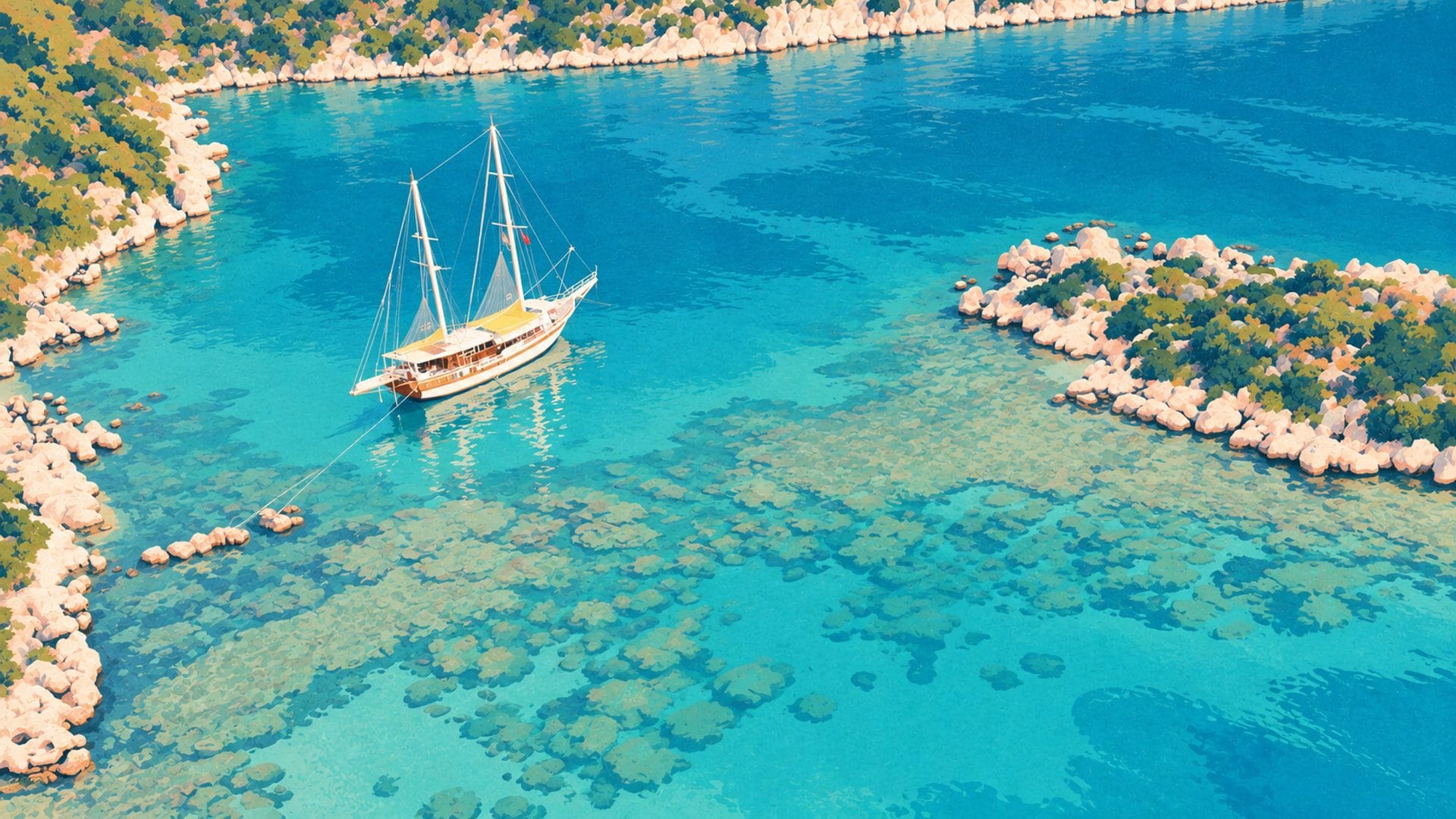
The most popular and affordable option. Traditional wooden gulet boats carry 15 to 30 passengers on a full-day circuit that includes lunch on board. Most depart from Üçağız harbour between 9:30 and 10:30 AM and return by 4:30–5:00 PM.
What's included: lunch (typically grilled fish or chicken, salad, rice, fruit), tea and water, all stops on the standard route. Some boats include snorkelling gear for the swimming stops.
The trade-off: You're on a fixed schedule with a large group. The captain decides how long you spend at each stop. The sunken city pass is often rushed — 15 to 20 minutes of slow cruising rather than the 45 minutes you'd want for a proper look. The Kaleköy stop may be as short as 30 minutes, barely enough to climb the castle and get back.
Price range (2026): from 3,000 TL per person from Üçağız. Tours originating from Demre (Çayağzı) or Kaş add 20–30% for the longer transit.
Best for: Budget travellers, solo travellers who want a social atmosphere, first-time visitors who want the full overview.
2. Small Boat / Speedboat (Half Day)
Smaller boats — typically 6 to 10 passengers — run half-day tours from Üçağız, departing around 9:00 or 10:00 AM and returning by 1:00–2:00 PM. Some operators offer a second departure in the afternoon.
The advantage: Fewer people, more flexibility. Captains on smaller boats tend to linger longer at the sunken city, often making two slow passes along the coastline rather than one. You're closer to the water, which dramatically improves visibility of the underwater ruins. The Kaleköy stop is usually 45–60 minutes — enough to actually climb the castle, take in the view, and walk back at a human pace.
The trade-off: No lunch included (eat at Kaleköy or back in Üçağız). Usually only one swimming stop instead of two. Less comfortable seats and less shade than a gulet.
Price range (2026): from 3,000 TL per person, shared, for a half-day from Üçağız.
Best for: Photography enthusiasts, anyone who prioritises the sunken city experience, visitors short on time who want maximum impact in 4 hours.
3. Private Charter
Hire a boat and captain for your group exclusively. Available in every size from a 4-person fishing boat to a 15-metre gulet with a crew. Duration, route, and pace are entirely yours to decide.
The advantage: Total freedom. Want to spend an hour drifting over the sunken city at 8 AM before any other boats arrive? Done. Want to skip the swimming stops and add a second visit to Kaleköy? Done. Private charters are the only way to reach the quieter coves on Kekova Island's northern shore that group tours don't visit.
The trade-off: Cost. A private boat for a half day is roughly the same as putting 6–8 people on individual group tours — economical for families or groups, expensive for solo travellers or couples.
Price range (2026): from 10,000 TL for the entire boat depending on size, duration, season, and whether lunch is included. Negotiable, especially off-peak.
Best for: Groups of 4+, families with children, photography professionals, anyone who wants the premium experience.
I know most of the captains at Üçağız by name — they're family friends, former schoolmates, or my uncle's fishing buddies. Here's what they won't tell you unprompted: there's a “tourist price” and a “local price,” and the difference can be 30–40%. You won't get the local price as a visitor, but you can negotiate. The magic phrase is “Son fiyat ne?” (“What's your final price?”). Ask it with a smile, after you've chatted for a minute. Off-peak season (May, early June, October), you'll get bigger discounts than you'd expect.
The Typical Kekova Boat Tour Route
Whether you're on a gulet or a speedboat, most tours follow a similar circuit. Knowing the route in advance lets you prepare — camera ready for the sunken city, walking shoes on for the castle, swimsuit accessible for the bays.
Stop 1: Departure from Üçağız Harbour
The journey starts among the Lycian sarcophagi and fishing boats of Üçağız. As the boat pulls out, look back — the rock-cut tombs along the eastern shore of the village are visible from the water at an angle you can't get from land.
Stop 2: Kaleköy / Simena (30–60 min)
Most boats moor at the small jetty below Simena Castle. You have the option to climb to the castle (15 minutes up, steep but short) or stay in the village for tea and photos. The waterfront restaurants here serve simple but good food — grilled fish, gözleme (Turkish flatbread), and fresh-squeezed orange juice. If your boat offers lunch on board, you might want to eat here instead — the setting is better.
Stop 3: Sunken City Pass (15–45 min)
The boat slows to a crawl along the southern shore of Kekova Island. This is it — the submerged remains of Dolichiste visible beneath the surface. Put on your polarised sunglasses, get to the side of the boat closest to the shore, and look for harbour walls, stairways, and room foundations. For detailed viewing tips, see our three key viewing points guide.
Stop 4: Tersane Bay — Swimming (30–45 min)
The first swim stop. Tersane (“Shipyard”) Bay sits on the northern coast of Kekova Island, sheltered and warm. The water is shallow and turquoise, with the ruins of a Byzantine-era shipyard visible on the shore. Snorkelling here is excellent — the rocky bottom is home to sea bream, wrasse, and occasionally octopus.
Stop 5: Akvaryum Bay — Swimming (20–30 min)
Named for its aquarium-clear water, this sandy-bottomed cove is the second swim stop on full-day tours. It's often more crowded than Tersane in peak season (multiple boats anchor here simultaneously), but the water clarity is genuinely remarkable. Half-day tours usually skip this stop.
Return to Üçağız
The return trip passes through the channel between the island and the mainland. Some captains take a slightly different route back, passing closer to the mainland shore where Lycian sarcophagi stand in the shallow water near Kaleköy.
Where to Depart From: Üçağız vs Demre vs Kaş
Üçağız is the primary departure point and the home of the classic Üçağız boat tour experience. It offers the widest choice of boats, the lowest prices, and the shortest transit time to the ruins. The downside: you need your own transport to get there (35 km from Demre centre, ~40 minutes by car). Dolmuş (minibus) service exists but is infrequent.
Demre (Çayağzı harbour) is convenient if you're based in Demre without a car. Tours include the bus transfer to Üçağız or depart directly from Çayağzı port via the Andriake coastline. The route is longer, which means less time at the ruins themselves, but you avoid the logistics of getting to Üçağız independently.
Kaş is a valid option if you're staying there, but the transit adds over an hour in each direction. Tours from Kaş typically cost 20–40% more and spend the least amount of time at the sunken city. If Kekova is a priority, consider driving to Üçağız instead.
Booking Tips: Online vs Harbour Walk-Up
Online platforms (Viator, GetYourGuide, local operator websites) offer convenience: fixed prices, confirmed availability, free cancellation policies, and English-language support. Book online if you're visiting in July–August, when boats fill up, or if you want the certainty of a confirmed reservation.
Walking up to Üçağız harbour and negotiating directly with a captain offers savings of 15–25% and more flexibility. Captains will adjust departure times, extend stops, or modify the route if you ask. The risk: on peak summer days, the best boats may already be full by the time you arrive. For private charters, direct negotiation almost always beats platform pricing.
Here's the strategy I recommend to friends visiting: book nothing in advance, drive to Üçağız early (by 9 AM), and walk the harbour. Talk to two or three captains, compare what's offered, and pick the boat that feels right — the captain's English, the boat's condition, the quoted itinerary. This works perfectly in May, June, September, and October. In July and August, pre-book a specific small boat or private charter — don't gamble on availability.
What to Bring on Board
Pack for a day that combines sightseeing, climbing, and swimming. Most boats have minimal facilities — no changing rooms, limited shade, and sometimes no card machine.
Essentials: swimsuit (worn under clothes), towel, high-SPF sunscreen (reapply every 2 hours — reflected water sun is fierce), hat, polarised sunglasses (critical for the sunken city), drinking water (at least 1.5 litres per person), and cash (some boats and all Kaleköy vendors accept only Turkish lira).
Recommended: a light long-sleeved shirt for sun protection, sturdy shoes or sandals with grip for the Simena Castle climb (flip-flops on steep ancient stone is a bad combination), a waterproof phone pouch, and a snack if you're on a half-day tour without lunch.
Leave behind: valuables you'd worry about near saltwater, bulky bags (storage space on boats is minimal), and beach umbrellas (no room and no need — most gulets have built-in shade).
Tipping: Not mandatory but appreciated. On group gulet tours, 50–100 TL per person for the crew (pooled) is a generous gesture; many passengers leave nothing and that's fine too. On private charters, 10–15% of the total price for the captain is customary if you're happy with the service. At Kaleköy restaurants, round up or leave 10% — the same as anywhere else in Turkey.
Language: Most boat captains at Üçağız speak functional English — enough to explain the route, point out ruins, and negotiate. Some speak German or Russian, reflecting the region's main tourist demographics. For anything beyond basics, a translation app works fine. The key Turkish phrases are “Yavaş gidebilir miyiz?” (“Can we go slowly?” — useful at the sunken city) and “Son fiyat ne?” (“What's your final price?” — useful everywhere).
Seasickness: Should You Worry?
Almost certainly not. Kekova Bay is a sheltered body of water — Kekova Island acts as a natural breakwater, blocking open-sea swells from reaching the channel where the tour operates. The water inside the bay is typically flat calm, especially in the morning. The route never enters open sea.
If you're particularly sensitive: choose a larger gulet (more stable than a small speedboat), sit near the centre of the boat rather than the bow, look at the horizon rather than the water surface, and avoid heavy food before departure. In years of taking family and friends on this tour, I've never seen anyone get seasick — the conditions simply don't produce enough motion.
With Children
Kekova boat tours are generally excellent for families. The calm water means no safety concerns beyond standard boating sense (life jackets are provided, and children should wear them). The swimming stops at Tersane and Akvaryum bays have shallow entry zones suitable for young swimmers. The Simena Castle climb is manageable for children over 6 — younger ones may struggle with the steep, uneven stairs.
For families with very young children (under 4), a private charter is strongly recommended: you control the pace, the noise level, and the schedule. Group tours on busy days can be loud, crowded, and inflexible about timing — not ideal when a toddler needs a nap or a change of plan.
Seasonal Differences
May–June: Warm but not hot, uncrowded waters, good water clarity. Many operators offer discounted early-season rates. The downside: some boats haven't started their season yet, reducing choice at Üçağız.
July–August: Peak season. Every boat is running, but the bay is busy — multiple gulets at each stop, congested anchoring at the swimming bays, and afternoon winds that reduce visibility at the sunken city. Book in advance. Go early in the morning.
September–October: Arguably the best months. The sea is at its warmest (27–28°C), the summer crowds have thinned, and the light is golden. Most operators are still running full schedules but are more willing to negotiate on price and customise itineraries.
November–March: Most tour boats are out of service. A few operators at Üçağız run on-demand trips for small groups, weather permitting. The water is cold for swimming but the ruins are often at their most visible — winter rains clear the water and there are no other boats to stir up sediment.
Want to skip the boat entirely and paddle over the ruins yourself? See our Sea Kayaking Guide → — a fundamentally different way to experience the sunken city. For the bays where you can actually swim, see Swimming Bays →
