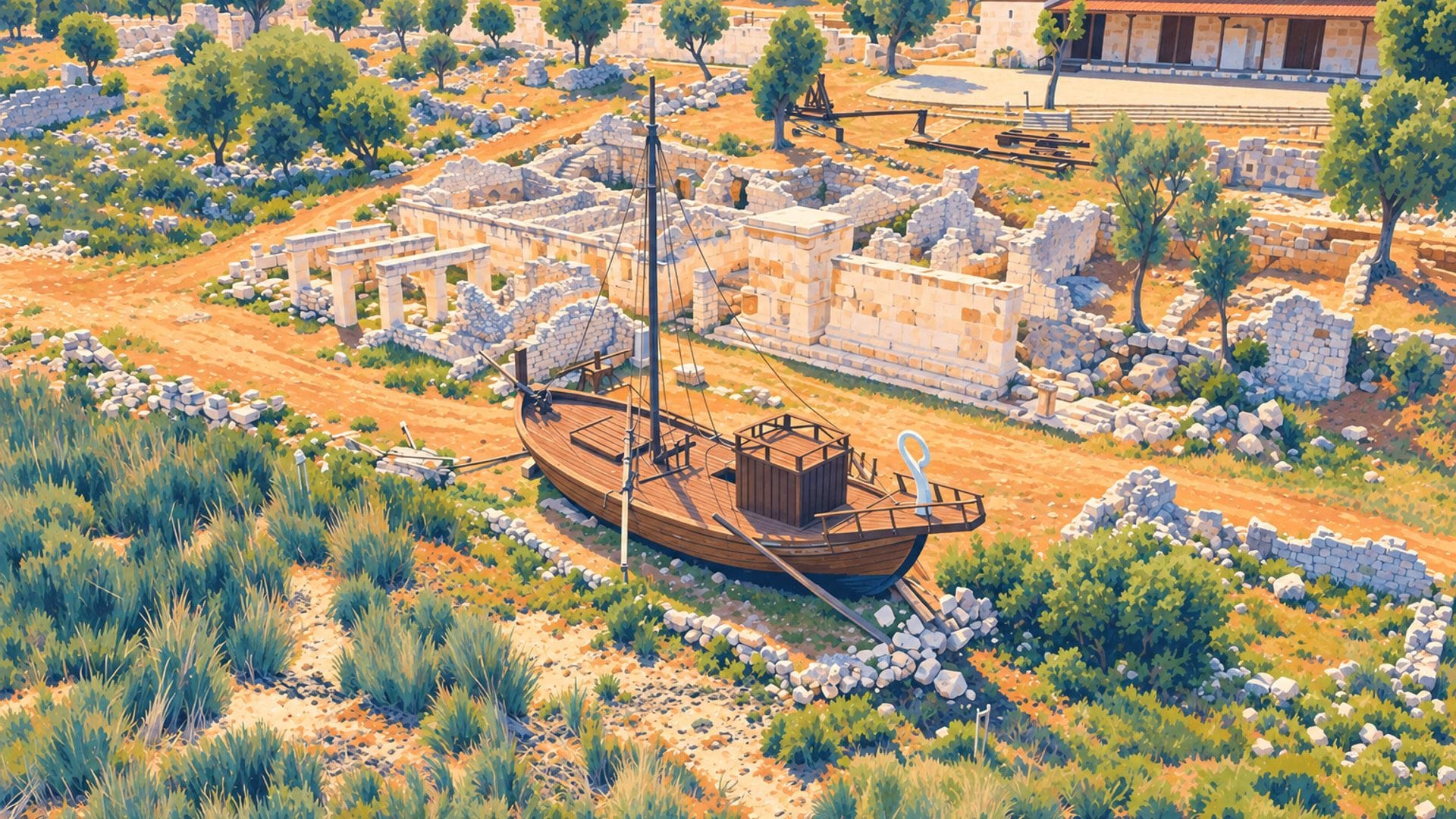
Why Andriake's History Matters
Most visitors come to Andriake for the museum and leave within an hour. But the site you're standing on was once one of the most strategically important harbours in the eastern Mediterranean — a place where Rome's bread supply was stored, where Tyrian purple dye was manufactured at industrial scale, where the Apostle Paul changed ships on his way to trial in Rome, and where a Jewish merchant community built one of Lycia's only known synagogues. Then the river buried it all under ten metres of mud.
Andriake's history is inseparable from Myra's. Where Myra was the civic and religious capital — the seat of a Lycian League metropolis, a Roman provincial city, and later a Christian bishopric — Andriake was its economic engine: the harbour where goods moved, where ships were loaded and unloaded, and where the wealth that built Myra's monuments was generated. Understanding Andriake transforms Myra from a pretty cliff of carved tombs into a powerful, connected, commercially sophisticated city.
And unlike Myra, where the visible remains are limited to the rock tombs and theatre, Andriake is still being excavated. Every season, the Akdeniz University team pulls new structures from the alluvial soil — buildings preserved so well that archaeologists have nicknamed the site “the Pompeii of Anatolia.”
Lycian Origins: Myra's Gateway to the Sea (5th–4th Century BCE)
Andriake was established at the mouth of the Andrakos River — known today as Kokar Çayı (“Stinking Creek,” named for the sulphur springs upstream) — where a natural lagoon formed a sheltered harbour. The site offered a rare combination on the rocky Lycian coast: deep enough water for commercial vessels, protection from storms, and a river connection to the fertile Demre plain and the mountainous Lycian interior beyond.
From the beginning, Andriake functioned as a component of the larger Myra settlement rather than an independent city. It was Myra's port district — the point where agricultural produce from the inland valleys, timber from the Lycian forests, and manufactured goods were loaded onto ships for export across the eastern Mediterranean. In return, imported goods — Egyptian grain, Phoenician glass, Aegean pottery — arrived at Andriake and were transported the 5 kilometres north to Myra.
The harbour was one of three major ports in the Lycian League, alongside Patara (which served Xanthos) and Phaselis to the east. Together, these three harbours connected the Lycian interior to the wider Mediterranean trade network — a network that extended from Egypt and the Levant in the east to Italy and the western Mediterranean.
The Purple Trade: Murex Dye at Industrial Scale
One of Andriake's most distinctive economic activities was the production of Tyrian purple — the most expensive dye in the ancient world, extracted from the hypobranchial gland of Bolinus brandaris and Hexaplex trunculus murex sea snails. The process was laborious, malodorous, and extraordinarily wasteful: each snail yielded approximately one drop of dye fluid, meaning thousands of snails were required for even a small quantity of finished dye.
The evidence at Andriake is unmistakable. Enormous mounds of crushed murex shells — some several metres high — are still visible near the museum building. These shell middens represent centuries of production and constitute some of the largest concentrations of murex waste in the eastern Mediterranean. The scale indicates not a cottage industry but a systematic, commercially significant operation.
The economics explain the scale. Purple-dyed cloth was reserved for royalty, the Roman senatorial class, and the highest-ranking priests. A single pound of Tyrian purple dye could cost the equivalent of a skilled worker's annual salary. Andriake's position — with access to rich murex beds in the surrounding waters and a harbour for export — made it an ideal production centre.
The murex shell mound near the museum is one of those things that most visitors walk past without a second glance — it looks like a pile of crushed shells, which is exactly what it is. But when you understand that each of those shells was individually cracked open, its gland extracted by hand, and the result used to dye cloth that only emperors could afford — the scale of the mound becomes staggering. Thousands upon thousands of snails, over centuries, for a single colour. Stand there for a moment and do the maths in your head. It changes how you look at a purple stripe on a Roman toga.
Roman Andriake: The Grain Trade and Hadrian's Granary (1st Century BCE–3rd Century CE)
Conquest and the Lentulus Siege (42 BCE)
Andriake's entry into Roman history was violent. In 42 BCE, during the civil wars following the assassination of Julius Caesar, the Republican general Brutus sent his legate Lentulus Spinther to secure the Lycian coast. According to the Roman historian Appian, Lentulus approached Andriake harbour and found its entrance blocked by a defensive chain stretched across the harbour mouth — a common Mediterranean fortification technique. Lentulus broke the chain, entered the harbour, and took the city.
This detail — the harbour chain — tells us that by the 1st century BCE, Andriake had substantial harbour infrastructure and was considered worth defending. It was not a casual anchorage but a fortified commercial port.
The Egypt–Rome Grain Route
Under Roman rule, Andriake's strategic importance grew dramatically. The harbour became a critical node in the annona — Rome's state-managed grain supply system. Wheat grown in Egypt's Nile Delta was loaded onto enormous grain ships at Alexandria and transported across the Mediterranean to feed Rome's population of over a million people.
The voyage from Alexandria to Rome was not direct. Prevailing winds and currents forced the grain fleet to sail north along the Levantine coast, then west across the southern coast of Anatolia. Andriake, positioned roughly midway on this route, served as a trans-shipment and resupply point — ships stopped to take on fresh water, provisions, and sometimes transfer cargo to different vessels for the onward journey to Italy.
Hadrian's Granarium (129–130 CE)
The physical monument to this grain trade stands at the centre of the site: the Granarium (Horrea Hadriani), commissioned by Emperor Hadrian during his visit to the region in 129–130 CE. At 2,307 square metres with seven massive storage chambers, it is one of only three surviving Roman state granaries at this scale in the entire Mediterranean — the others are at Patara (also in Lycia) and Leptis Magna in Libya.
The façade bore a dedicatory inscription with busts of Hadrian and his wife Sabina — fragments of which are now in the museum. The building was designed for functional efficiency: raised floors to prevent moisture damage, ventilation channels for air circulation, and massive walls to maintain stable temperatures — Roman climate control for grain storage.
Beyond the Granarium, Roman Andriake included a harbour agora known as the Plakoma, public baths (both east and west bath complexes have been excavated), a monumental fountain visible from the modern highway, warehouses, and the harbour infrastructure — quays, mooring stones, and the repaired harbour chain apparatus.
St. Paul's Stopover (c. 59 CE)
Approximately seventy years before Hadrian built his Granarium, Andriake harbour played a cameo role in one of the most consequential journeys in religious history. According to the Acts of the Apostles (27:5–6), the Apostle Paul — travelling as a prisoner to stand trial in Rome — arrived at “Myra, a city of Lycia,” where the Roman centurion escorting him found an Alexandrian grain ship bound for Italy and transferred his prisoners aboard.
“Myra's harbour” was Andriake. The grain ship Paul boarded was part of the same annona fleet that would later justify Hadrian's Granarium. Paul's stopover wasn't coincidence — it was a function of Andriake's position on the grain route. Where there were grain ships, there was passage west.
For the full story of Paul's journey, the Biblical context, and what you can see at the harbour today, see our dedicated St. Paul at Andriake →
Byzantine Andriake: Churches, Synagogue, and Cosmopolitan Commerce (4th–7th Century CE)
The transition from pagan Rome to Christian Byzantium transformed Andriake's built environment while preserving its commercial function. Six churches were constructed across the site — two in the northern settlement area, four in the southern — serving the harbour's transient population of sailors, merchants, and travellers. Notably, none of these churches contained a baptistery, suggesting they were not parish churches for a permanent residential community but rather chapels for visiting seafarers.
The Synagogue Discovery (2010)
One of the most significant recent discoveries at Andriake is a 5th-century synagogue, unearthed during the 2010 excavation season by the Akdeniz University team. The building contained a Torah niche oriented toward Jerusalem, marble floor panels, column capitals, and Greek inscriptions. It's one of only a handful of ancient synagogues discovered in Lycia, and its presence at a commercial harbour is consistent with what we know about Jewish merchant networks in late antiquity — Jewish communities were established at major Mediterranean trading ports from Egypt to Spain.
The synagogue's coexistence with six Christian churches speaks to Andriake's cosmopolitan character. This was not a homogeneous settlement but an international trading hub where different religious and ethnic communities lived and traded side by side — a pattern common to port cities across the ancient Mediterranean.
Earthquakes and the Beginning of the End
Two major earthquakes — one in the 5th century and another in the 7th — caused significant structural damage across the site. Walls collapsed, the harbour infrastructure was disrupted, and the already-silting harbour basin became increasingly difficult to maintain. The combination of seismic damage and accelerating alluvial deposits from the Demre River created a vicious cycle: earthquake debris obstructed drainage channels, which accelerated sedimentation, which made the harbour shallower, which reduced commercial viability.
The synagogue discovery in 2010 surprised everyone — including the excavation team. A Jewish community at a Lycian port? It makes perfect sense when you think about it: international trade requires international traders. But it overturned the assumption that Lycia was ethnically and religiously uniform. Andriake was a meeting point, not a closed community. Standing in the synagogue today — Torah niche facing east, Greek inscriptions on the marble — you get a sense of just how connected this “remote” harbour actually was.
Decline, Burial, and Silence (7th–19th Century)
By the 7th century, the combination of Arab naval raids (which devastated the entire Lycian coast), earthquake damage, and harbour silting had rendered Andriake commercially unviable. The population dispersed. The harbour — once deep enough for the largest grain ships in the Mediterranean — became a shallow lagoon, then a marsh, then a reed-choked wetland.
The Demre River, the same waterway that had sustained the harbour for a millennium, became its gravedigger. Alluvial deposits — sand, silt, and debris carried down from the mountains — gradually buried the entire settlement. Buildings that had stood to their full height were entombed under metres of mud. By the Ottoman period, the site was farmland and marsh, the ancient city invisible beneath the surface.
When the Seljuk Turks needed a harbour in the region, they established one at Taşdibi (ancient Stamira), several kilometres to the east — a tacit acknowledgement that Andriake's harbour was irretrievably lost.
The first modern documentation came from Captain Francis Beaufort of the Royal Navy, who surveyed the Lycian coast in 1811–1812 and noted the Granarium's ruins — the only structure still partially visible above the alluvial plain. Scattered visitors followed throughout the 19th and 20th centuries, but no systematic excavation was attempted.
The same river that made the harbour possible eventually destroyed it. The silt that once provided fertile farmland for the hinterland gradually filled the harbour basin, turning deep anchorage into shallow lagoon, lagoon into marsh, and marsh into farmland — burying the port that had fed Rome.
DenizThe Pompeii of Anatolia: Excavation and Rebirth (2009–Present)
The modern chapter of Andriake's story begins in 2009, when Professor Nevzat Çevik of Akdeniz University launched systematic excavations. What the team found was extraordinary: buildings preserved far better than anyone had expected, their walls standing to near-original height, mosaic floors intact, even organic materials preserved in the waterlogged soil. The comparison with Pompeii became inevitable — though at Andriake, the preserving agent was alluvial mud rather than volcanic ash.
The most dramatic restoration was the Granarium itself, which was stabilised, roofed, and opened as the Lycian Civilizations Museum in 2016 — one of Turkey's first purpose-built archaeological museums housed within the original ancient structure. The restoration was not without controversy (some archaeologists questioned the extent of modern additions), but the result is a functioning museum that allows visitors to experience a Roman industrial building at its original scale.
Beyond the Granarium, excavations have revealed the harbour agora, both bath complexes, the monumental fountain, multiple churches, the synagogue, residential structures, and the massive cistern — now partially restored and open to visitors. Crucially, each season continues to produce new discoveries. As late as 2024, previously unknown structures were still emerging from the alluvium.
I remember Andriake before the excavations. It was a marshy field with some old walls poking out — the Granarium was a roofless shell, the lagoon was full of reeds, and local kids (including me) used the area as a shortcut to the beach. Watching a 2,000-year-old harbour city materialise from the ground over the past fifteen years has been one of the most remarkable things about living in Demre. The excavation director once told me: “Every year, the city gets bigger.” That's still true.
Excavation at Andriake is ongoing. New structures and artefacts are discovered annually by the Akdeniz University team. The information in this article reflects the state of knowledge as of early 2026. For the latest finds, visit the Lycian Civilizations Museum at the site, which updates its displays with recent discoveries.
Complete Chronological Timeline
