Why Andriake Is a Photographer's Site
Andriake photography offers something rare on the Lycian coast: a single location where you can shoot monumental Roman architecture, atmospheric interior spaces, macro-scale archaeological textures, a living Mediterranean harbour, wetland birdlife, and a Kekova Island sunset — all within a 20-minute walk. Most visitors come with a phone and leave with snapshots. This guide is for anyone who wants to leave with photographs — whether you're shooting with a full-frame mirrorless system or a careful eye on a smartphone.
The site divides naturally into two zones. The archaeological area — Hadrian's Granary (the Lycian Civilizations Museum), the restored cistern, the murex shell mounds, and the ancient harbour ruins — rewards early morning light and wide-angle compositions. The coastal zone — Çayağzı harbour, beach, and wetland — comes alive at the edges of the day: sunrise over the fishing boats, sunset behind Kekova Island, and the golden hour in between when the wetland birds are most active.
This guide covers eight specific Andriake photo spots in the order you'd encounter them on a full-day shoot, from morning to evening. Each entry includes the best time, recommended lens range, and composition ideas.
Gear & Settings Quick Reference
Don't have all this? A smartphone handles spots 1, 2, 4, 7, and 8 well. The cistern (spot 2) benefits from any ultra-wide mode. The wetland birds (spot 6) are the only subject that genuinely demands a telephoto. Everything else responds more to timing and position than to equipment.
The Eight Spots
1. Hadrian's Granary / Museum Façade
The façade of Hadrian's Granary faces east, which means morning golden hour delivers warm, directional light across the massive stone surface. This is the single most photogenic structure at Andriake — 2,307 square metres of restored Roman engineering, with the Hadrian inscription visible above the entrance.
Composition: Include a human figure for scale — the building is deceptively large in person and photographs flat without a reference point. Shoot from the path 30–40 metres back for a full elevation view. For detail shots, the inscription panel and the door arches both respond well to 35–50mm. From the side angle (northwest corner), you can include the archaeological landscape behind the building.
2. The Restored Cistern (Interior)
The restored cistern is Andriake's most visually striking interior space — think a smaller, quieter cousin of Istanbul's Basilica Cistern. Walkways with atmospheric lighting run between rows of stone arches, and standing water on the floor creates mirror reflections that double the architectural geometry.
Composition: Centre yourself between two rows of columns for maximum symmetry — the repeating arches create a natural leading line into depth. A wide-angle lens (16–20mm) is essential to capture the full width. Shoot low — from knee height or lower — to emphasise the water reflections. The artificial lighting is consistent, so this is a good indoor option on overcast days or during midday heat. A tripod at slow shutter speeds (1/4–1s) smooths out the water surface for a glassier reflection.
3. Murex Shell Mounds
Beside the museum building, enormous mounds of crushed murex sea snail shells testify to Andriake's industrial-scale production of Tyrian purple — the most expensive dye in the ancient world. This is a subject that works on two scales simultaneously.
Macro (50mm or closer): Individual shell textures, the spiral geometry, the pale interior surfaces. Overcast light or open shade prevents harsh shadows on the fine details. Shallow depth of field isolates a single shell against the mound behind it — a frame that tells the purple dye story in one image.
Wide-angle: Step back and shoot the full mound with the Granary building in the background. This establishes context — these aren't decorative; they're the waste product of an entire industry. Morning sidelight from the east rakes across the shell surfaces and adds texture.
4. Ancient Harbour & Ship Reconstruction
The wooden trade ship replica, positioned within the archaeological site alongside agora ruins, creates a rare frame that places a three-dimensional object within an ancient landscape. Afternoon light from the west warms the timber hull and casts long shadows through the agora columns.
Composition: The ship works best as a mid-ground element — shoot from 10–15 metres with agora stones in the foreground and the granary visible behind. A 35–50mm focal length compresses the layers naturally. If you include visitors examining the ship, the human scale makes the scene immediately readable. This is also the spot to frame the museum building from a less conventional angle — from the harbour side rather than the formal entrance.
5. Çayağzı Harbour at Sunrise
The Çayağzı harbour at sunrise is Andriake's most atmospheric location. Colourful fishing boats and tour gulets moored in still water, reflections doubling the scene, warm light from the east catching the painted hulls. This is a frame that could be from any century — the boats have changed, but the harbour, the mountains behind, and the quality of the light have not.
Composition: Arrive 20 minutes before sunrise. Position yourself on the western side of the harbour looking east — the sun rises behind the mountains and casts soft colour across the sky before appearing. Low angles from the quay edge maximise the water reflections. If fishermen are working, they add human context — but don't interrupt or stage anything. A 24–70mm zoom gives flexibility to shift between wide harbour panoramas and tighter boat details. If you're camping at Andriake, this is a 5-minute walk from the campsite.
6. Wetland & Bird Photography
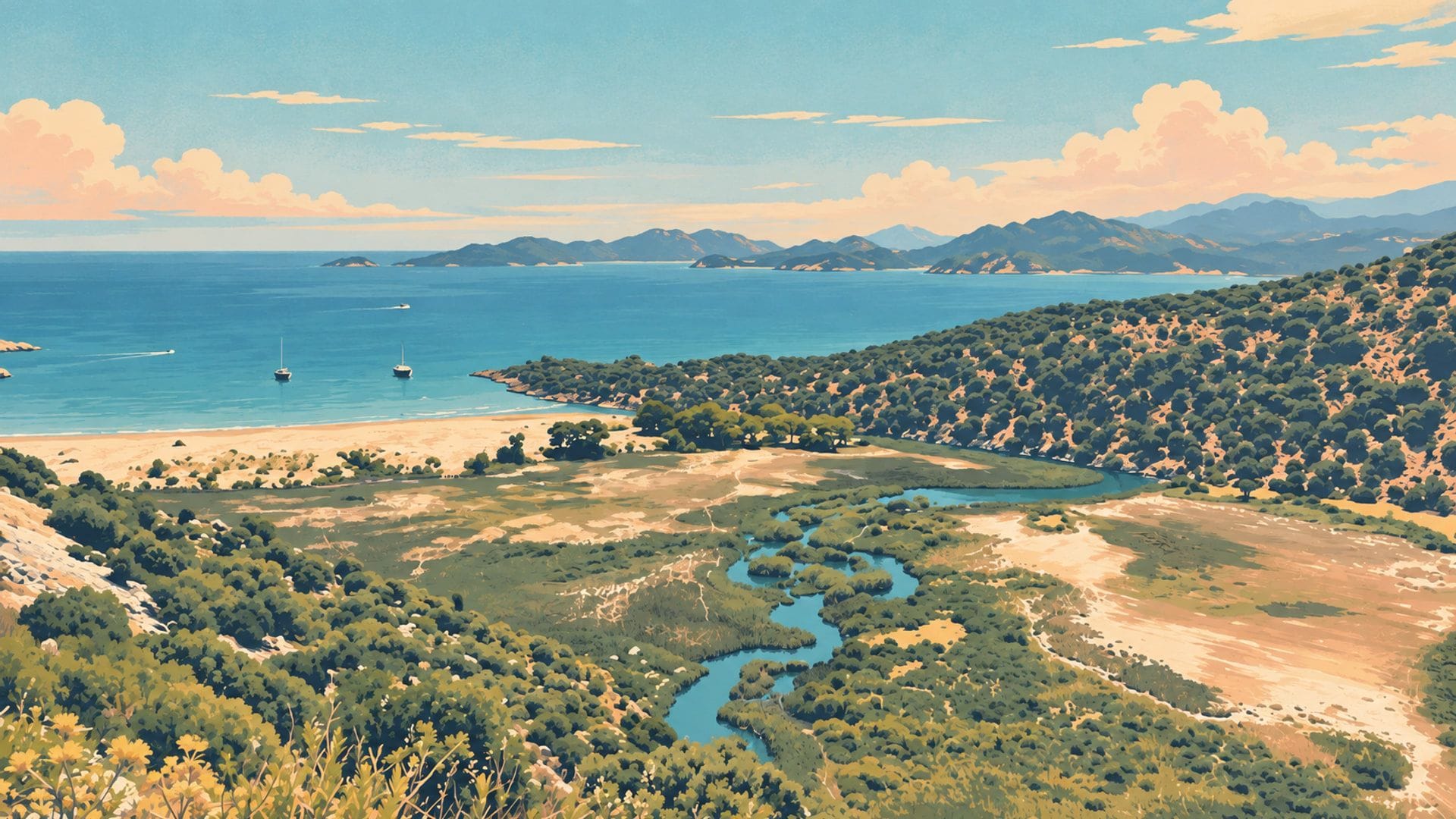
The Andriake wetland — where the Demre River meets the sea — hosts 149 documented bird species. For bird photography, this is a serious spot: observation hides positioned along the wetland edge provide stable, concealed shooting positions. For landscape photography, the wetland at sunset with Kekova Island silhouetted in the distance is one of the finest wide-angle frames on the Lycian coast.
Birds (telephoto 200mm+): Patience is the lens that matters most. Grey herons, kingfishers, stilts, and egrets are year-round residents and relatively predictable. Spring migration (April–May) brings bee-eaters and rollers — fast-moving, colourful, challenging. From the observation hides, a 200–400mm telephoto on a monopod gives you reach without bulk. Shoot at the widest aperture for bokeh that separates the bird from the reed background.
Landscape (wide-angle): The sunset view from the western edge of the wetland — reeds in the foreground, water in the mid-ground, Kekova Island on the horizon — is extraordinary in clear weather. A 16–24mm lens at f/8–f/11 keeps everything sharp from the nearest reeds to the island. Include a silhouetted heron or boat mast if the composition allows.
7. Çayağzı Beach Sunset
This is Andriake's postcard frame. From the western stretch of Çayağzı Beach, the sun sets behind Kekova Island, creating a dark silhouette against orange, pink, and violet sky. In the foreground, fishing boat silhouettes or the dark shapes of beached gulets add depth and scale.
Composition: Arrive at least an hour before sunset for the full progression of colour. Position yourself at the waterline for foreground reflections in the wet sand, or step back to include driftwood, beached boats, or — if you're lucky — a campfire from the campsite. The 24–70mm range covers everything from wide panoramas to tighter island silhouettes. Bracket your exposures: the dynamic range between the bright sky and dark foreground is extreme. Smartphone HDR modes handle this surprisingly well.
8. Details Along the Path
Between the major spots, the archaeological site path is rich with smaller subjects that reward a slower eye. Wildflowers push through ancient masonry in spring (March–May) — red poppies against grey limestone is a reliable and striking combination. Cats patrol the ruins year-round. Goats wander the scrubland. And in the museum grounds, resident peacocks occasionally pose on ancient column capitals — a frame so improbable it looks staged, but it isn't.
Technique: A 50–85mm prime lens at f/2 or f/2.8 creates creamy bokeh that isolates these small subjects against the ancient backdrop. Open shade or overcast conditions prevent harsh shadows on delicate flower petals. For stone textures — weathered inscriptions, carved reliefs, column fluting — sidelight (early morning or late afternoon) reveals surface depth that flat light obscures.
My favourite shot at Andriake always happens at sunset — the orange light falling on Kekova Island's silhouette from the beach, with the dark shapes of fishing boats in the foreground. But the most surprising frame I've ever got here was in the museum grounds: a peacock landing on an ancient column capital, spreading its tail against a 2,000-year-old stone wall. I've been trying to repeat that shot for three years. The peacocks are still there. They just don't cooperate on demand.
Suggested Photography Day Plan
05:30–07:00 — Çayağzı Harbour at sunrise (spot 5). Arrive 20 minutes early. Calm water, warm sidelight.
07:00–09:00 — Walk to Hadrian's Granary (spot 1). Morning golden hour on the east-facing façade. Then murex shells (spot 3) in soft raking light.
09:00–10:30 — Cistern interior (spot 2) and path details (spot 8). Indoors — lighting is constant, no golden hour dependency.
10:30–14:00 — Break. Visit the museum galleries for content (not photo-optimised), swim at the beach, eat at the harbour. Midday light is harsh and flat — rest your eyes and your sensor.
14:00–16:00 — Ancient harbour & ship reconstruction (spot 4). Warm afternoon light from the west.
17:00–19:00 — Wetland birds (spot 6). Golden hour builds. Telephoto for birds, then swap to wide-angle for the landscape.
19:00–20:00 — Beach sunset (spot 7). The crescendo. Stay until the last colour fades.
If you only have a half day, pick either the morning sequence (spots 1–3 and 5) or the evening sequence (spots 6–7). The morning is better for architecture; the evening is better for mood and landscape.
If you're choosing one time slot and one shot, come for the last hour of light. Stand at the western end of the beach, face Kekova Island, and wait. The sky will do everything for you. No lens recommendation — every focal length works. No composition rule — every angle is beautiful. Just be there, and the light will find the photograph.
Best Seasons for Photography
Spring (April–May): The most photogenic season overall. Wildflowers across the archaeological site, migratory birds filling the wetland, soft golden light, and almost no other visitors in your frames. Green vegetation contrasts with the pale limestone architecture. This is when the peacocks are most active too.
Summer (June–August): The most dramatic sunrise and sunset colours, but brutally harsh midday light and heat haze that softens distant detail (Kekova Island views suffer). Shoot exclusively at the edges of the day and rest during midday. The harbour is busiest with boats — more colourful, but more cluttered frames.
Autumn (September–October): Dramatic cloud formations, autumn bird migration in the wetland, deepening golden-hour tones, and thinning crowds. The light quality rivals spring with more atmospheric texture. This is arguably the best month for the sunset shot.
Winter (November–March): Mist rising from the wetland, moody grey skies, rain-darkened stone that saturates colour and texture. The site is virtually empty. Shorter days compress the golden hours. If you like atmospheric, melancholic landscapes, winter Andriake is remarkable — but bring weatherproofing for your gear.
Practical Notes
Tripods: Freely used in the outdoor archaeological site and the cistern. Small travel tripods generally tolerated inside the museum building; full-size professional rigs may attract staff attention. No flash photography inside the museum.
Drones: Not permitted over the archaeological site (protected cultural heritage). The beach and wetland are technically possible with permits, but drone flights near the beach during Caretta caretta nesting season (May–September) are strongly discouraged. Check current regulations before flying.
Access: The archaeological site and museum have a combined entrance fee (Museum Pass accepted). The beach, harbour, and wetland are free to access. For sunrise shots at the harbour (spot 5), you don't need to enter the ticketed area — the harbour is public.
Mosquitoes: The wetland means mosquitoes from June to September, especially at dawn and dusk — exactly when you'll be there for the best light. Bring repellent and apply it before you set up. Nothing ruins a long-exposure like slapping at your ankles.
Combining with Myra: If you're also photographing Myra Ancient City (5 km north), shoot Myra's east-facing rock tombs in the morning, then come to Andriake for afternoon and sunset. The two sites complement each other visually — vertical rock facades at Myra, horizontal harbour architecture at Andriake.
