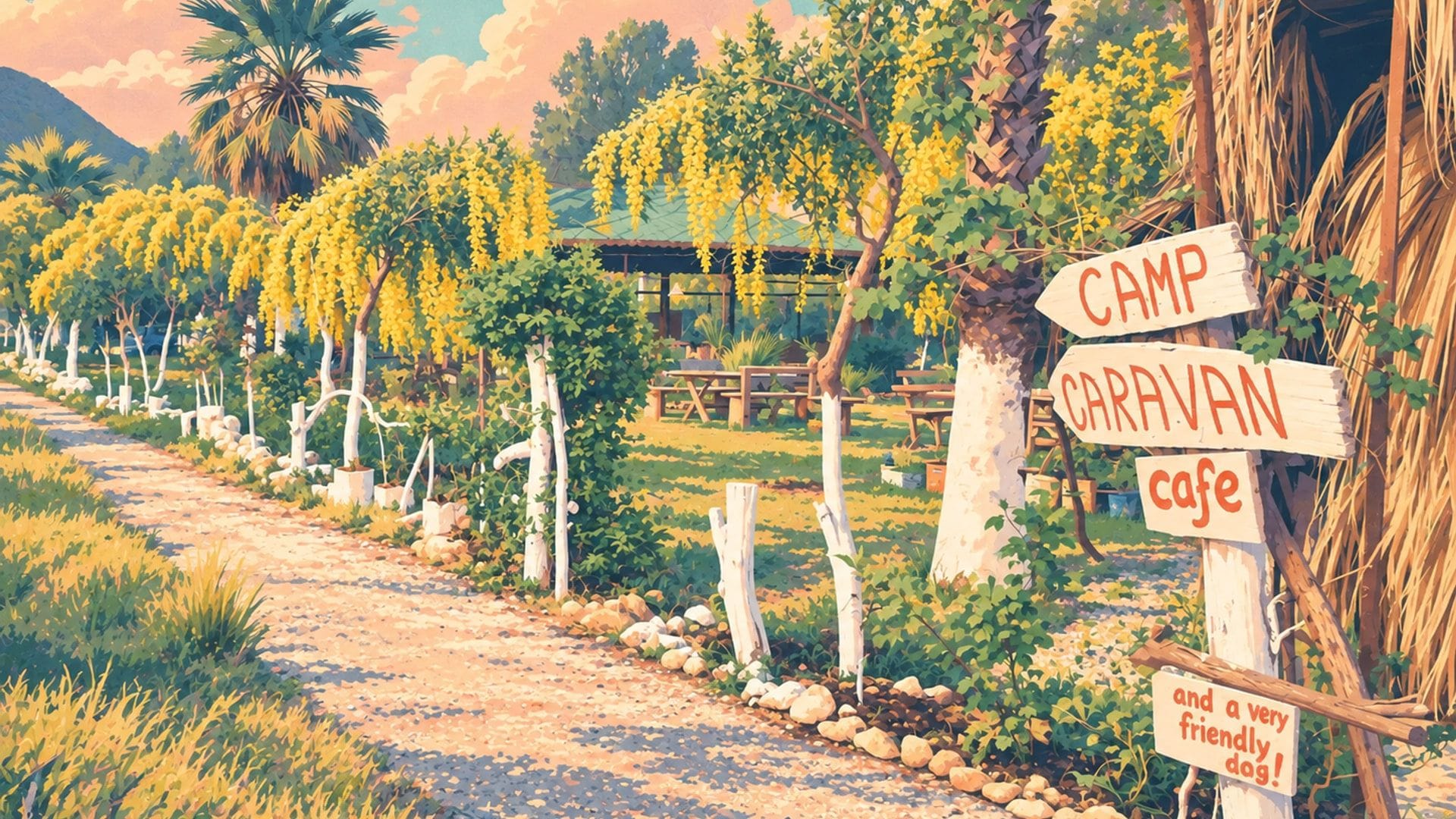
Why Camp at Andriake?
There are campsites with better facilities. There are campsites with more activities. But there is no campsite in Turkey where you can pitch your tent between a 2,000-year-old Roman harbour, a sea turtle nesting beach, a bird-filled wetland, the departure point for Kekova boat tours, and a Lycian Way trailhead — all within walking distance. As the only established campsite in the Demre area, Andriake Camping occupies perhaps the most historically layered camping spot on the Mediterranean coast — and it's also the closest place to camp near Kekova without staying in a hotel.
The setting is extraordinary even by Turkish standards. To the north, the restored Lycian Civilizations Museum rises from the archaeological site of Andriake — a 10-minute walk from the campsite. To the south, Çayağzı Beach stretches for a kilometre, its sand marked with the tracks of Caretta caretta sea turtles that nest here every summer. The Demre River estuary, fringed with reeds, hosts 149 documented bird species. And from the harbour beside the beach, boats depart for Kekova's sunken city.
I've been coming here since I was a child — long before there was an organised campsite. Back then it was just a wild beach where local families had bonfires and fishermen pulled their boats ashore. The campsite has evolved, but the essential magic hasn't changed: that feeling of being at the edge of the world, where ancient history and raw Mediterranean nature overlap.
Where to Camp at Andriake: Your Options
Andriake Camping & Glamping
The main established campsite in the area, Andriake Camping & Glamping occupies a prime position between the beach and the archaeological site. It's a small, family-run operation with a genuine outdoor atmosphere — not a resort pretending to be a campsite.
Facilities: Hot showers, toilets, electricity at pitches (hook-up for caravans available), Wi-Fi (basic — functional for messaging, don't plan on streaming), bicycle rental, tent rental if you're travelling light. The campsite also rents basic camping gear for Lycian Way hikers passing through without full kit.
Nomadic Kitchen: The campsite's on-site restaurant serves home-cooked Turkish meals using local ingredients — gözleme (stuffed flatbread), grilled fish, seasonal salads, and Turkish breakfast. It's one of the more authentic food experiences in the Demre area. If you're self-catering, note that the nearest market is in Demre centre (5 km) — stock up before arriving.
Glamping: For those who want the setting without the tent-pitching, pre-erected glamping tents come with beds, basic furniture, and linens. Not luxury — but a significant step up from sleeping bag on the ground, especially for couples or families with young children.
Pets: Dogs are generally welcome at the campsite, but keep them on a leash around the communal areas and the beach — especially during Caretta caretta nesting season when the beach has protected zones. Confirm the current pet policy when booking, as it may vary by season.
Andriake Camping is a small operation — advance booking is recommended for July–August and public holidays. Contact them directly by phone or through their social media. Check-in is typically from 14:00 onward; check-out by 11:00 — but these are flexible, especially off-season (confirm when booking). Quiet hours are observed after 23:00. Early arrivals can usually leave bags and use the beach. Note: andriake.com is the campsite's own website, not connected to demre.net. Prices listed here are approximate 2026 ranges — confirm directly as rates vary by season and tent size.
Wild Camping on the Western Beach
The western end of Çayağzı Beach has an informal free camping area used by Lycian Way hikers, budget travellers, and locals. Look for the stretch of sand roughly 500 metres west of the harbour, past where the beach restaurant and sunbed area ends — you'll see traces of previous camps and fire circles. This is truly wild camping: no showers, no electricity, no toilets, no rubbish collection. You're on your own.
The appeal is obvious — you're sleeping on a sandy beach with the Mediterranean lapping at the shore and the stars overhead. But the responsibilities are equally clear: pack everything out, use biodegradable soap (if any) well away from the water, and respect the Caretta caretta nesting zones.
From May to September, Caretta caretta sea turtles nest on Çayağzı Beach. Nesting zones are marked with stakes and tape. Do not camp within marked nesting areas. Do not use bright lights on the beach at night — artificial light disorients hatchlings heading for the sea. If you see a turtle nesting or hatchlings emerging, observe from a distance without flashlights. This is a protected species on a protected beach — the privilege of camping here comes with the responsibility of sharing it.
The Lycian Way Connection
Andriake is a natural stopover on the Lycian Way (Likya Yolu) — Turkey's first and most famous long-distance walking trail, tracing 540 km of the ancient Lycian coast from Fethiye to Antalya. The Demre section of the trail passes directly through Çayağzı, making the campsite the most convenient Lycian Way camping accommodation in the Demre area — an ideal base for hikers looking to rest, resupply, and explore the surrounding ruins before continuing on the trail.
Coming from the east: The trail descends from the hills above Demre, passes through the town, follows the road toward Çayağzı, crosses the Göçebe bridge over the Demre River, and arrives at the beach and campsite. Total from Demre centre: approximately 5 km, about 1–1.5 hours of easy walking.
Heading west (next stage): From the campsite, the trail continues along the coast toward Sura — the ancient temple of Apollo where Lycian priests read prophecies from the movements of sacred fish. The walk to Sura takes approximately 1.5 hours along a marked coastal path with sea views. It's one of the most atmospheric stages on the entire Lycian Way.
The walk from Andriake to Sura is my favourite stretch of the Lycian Way in the Demre section. You leave the campsite, pass the ancient harbour ruins, follow the coast past rocky coves, and arrive at a ruined temple in a hidden valley where an ancient civilisation believed fish could predict the future. It's pure Lycia — where the monumental and the mythical overlap. Do it early morning before the heat, and you'll have the trail entirely to yourself.
Things to Do From Andriake Camping
Andriake Camping's unique position means you have an unusual range of activities within walking distance. Here's what's possible without getting in a car.
When to Camp: Seasonal Guide
Practical Details
Getting There
From Demre centre, follow the road signposted to Çayağzı / Andriake — 5 km, about 10 minutes by car. The campsite is signposted on the left before you reach the harbour. If you're on the Lycian Way, follow the trail markers from Demre through the Göçebe bridge crossing. In summer (roughly June–September), dolmuş minibuses run between Demre centre and Çayağzı approximately every 60–90 minutes during daytime; in other seasons, you'll need your own transport or a taxi from Demre (~80–120 TL).
Drinking Water & Emergencies
Tap water at the campsite is not safe to drink — use it for washing only. The campsite kiosk sells bottled water, but stock up at a Demre supermarket before arriving to avoid running short. The natural sulphur spring at Burguç Su (on the road from Demre) is locally popular for drinking, but the mineral taste isn't for everyone.
For medical emergencies, Demre State Hospital (Demre Devlet Hastanesi) is 5 km away in the town centre, with a 24-hour emergency department. The nearest pharmacy is also in Demre centre. Save the hospital's location on your phone before arriving — there is limited mobile signal in some parts of the beach. For non-emergencies, the campsite staff can usually help arrange transport.
Supplies & Shopping
The campsite has a basic kitchen and the Nomadic Kitchen restaurant, but the nearest proper market is in Demre centre (5 km). Stock up on food, water, and any supplies before arriving. If you're cycling, the ride to Demre is flat and easy. The campsite sells basic necessities (bottled water, snacks), and the harbour restaurants offer fresh fish if you'd rather eat out.
What to Bring
Essential: Insect repellent (non-negotiable near the wetland), sun protection (hat, SPF 50), comfortable walking shoes for ruins and Lycian Way, headlamp (no street lighting), reusable water bottle, cash (limited card payment options).
Recommended: Binoculars (for birdwatching), snorkelling mask (the rocky areas east of the beach have interesting underwater life), a good book (evenings are quiet here — blissfully quiet), Turkish phrasebook or translation app (staff may have limited English).
Leave behind: Bluetooth speakers (this is a place for natural sound, not DJ sets), single-use plastics (pack it out), expectations of resort-level amenities (this is camping, in the genuine sense).
The Andriake Night: What It's Actually Like
Andriake Camping, kamp sevenler için Demre'deki en iyi pozisyonda — sabah antik kenti geziyorsun, öğleden sonra plajda yüzüyorsun, akşam Kekova'dan dönen tekneleri izleyerek yemek yiyorsun. Ama gerçek büyü gece oluyor: gökyüzünde yıldızlar, sazlıkta kuş sesleri, ve 2000 yıllık liman kalıntılarının silüeti.
DenizLet me translate that, because it captures the experience better than any marketing copy: “For camping lovers, Andriake has the best position in Demre — in the morning you explore the ancient city, in the afternoon you swim at the beach, in the evening you eat dinner watching the boats returning from Kekova. But the real magic happens at night: stars in the sky, bird calls from the reed beds, and the silhouette of 2,000-year-old harbour ruins.”
There's no light pollution here. On clear nights — and most nights on the Mediterranean coast are clear from April to October — the Milky Way is visible with the naked eye. The sounds are cicadas in summer, frogs and wading birds from the wetland, the occasional distant murmur of a fishing boat engine returning to harbour. The air smells of salt, pine resin from the hills, and — if you're downwind of the estuary — a faint sulfurous tang from the natural springs upstream.
It's not for everyone. If you need reliable hot water, air conditioning, and a full restaurant menu, stay at a hotel in Demre or Kaş. But if you're the kind of traveller who values atmosphere over amenities, who can trade a bathroom door for a sky full of stars, and who finds the idea of waking up to walk to a Roman grain warehouse genuinely exciting — this is your campsite.
The best moment at Andriake Camping isn't sunrise or sunset — it's the ten minutes after sunset, when the sky is still orange over Kekova Island, the fishing boats have gone quiet, and the wetland birds start their evening chorus. Find a spot facing west with a çay (Turkish tea) in hand. That moment is why people come back year after year.
Combine Your Stay
The beauty of camping at Andriake is that you can base yourself here and explore the entire Demre region without driving. It's the closest campsite to the Kekova boat tour departure point — walk to the harbour in five minutes, spend a day exploring the sunken city, and return to your tent by evening. Here's what a three-day camping itinerary might look like:
Three days covers the highlights. Four or five days lets you add St. Nicholas Church, a full birdwatching morning in the wetland, and a cycling day trip to Demre's greenhouse district and orange groves. A week lets you add day trips to Simena Castle and Üçağız village.
