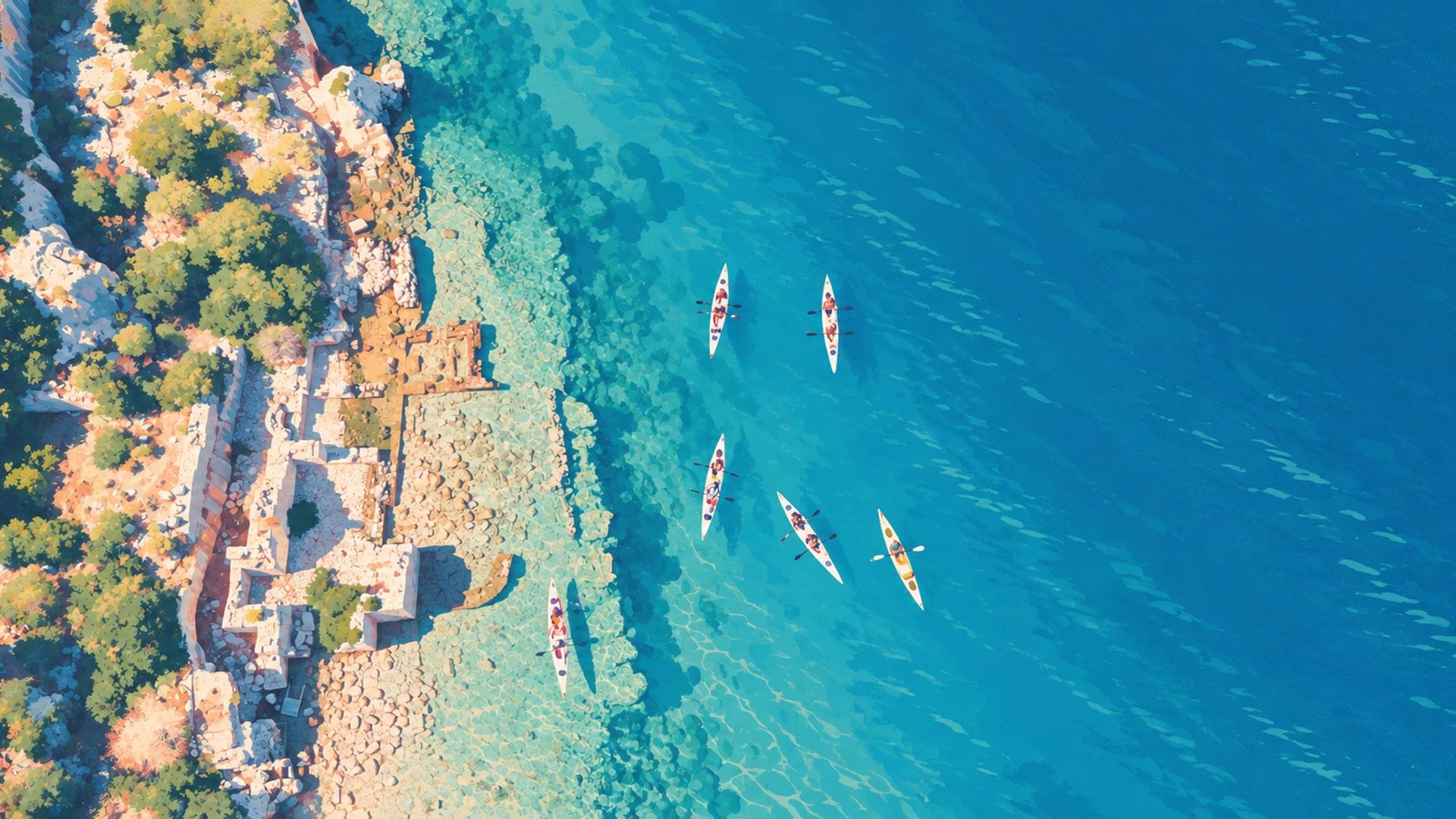
Why a Kayak Changes Everything
A boat tour shows you Kekova from above — a gulet deck sits 2 to 3 metres above the waterline, and engine vibration blurs the surface. A sea kayak puts you a metre above the ruins, in absolute silence, with nothing between your eyes and the submerged walls of Dolichiste except a sheet of clear Mediterranean water. It's a fundamentally different experience.
On a still morning, paddling over the sunken city in a kayak, you can see individual stone blocks in the harbour walls, count the treads on submerged stairways, and trace the outlines of rooms that people lived in two millennia ago. Fish swim through doorways. Seagrass sways over cistern floors. And because your paddle barely disturbs the surface, the water stays clear for as long as you linger.
This guide covers routes, tour options, rules, practical preparation, and the details that help you get the most from what is — in my biased opinion — the single best activity in the Kekova region.
The Route: Üçağız to the Sunken City and Beyond
Most kayak tours follow a circuit that covers the bay's highlights in 3 to 6 hours, depending on the itinerary. The full half-day circuit covers approximately 8–10 km of paddling; a full-day route with swimming bay stops extends to 12–15 km. Here's the typical route:
Departure from Üçağız: paddle out of the harbour, passing the Teimiussa rock tombs along the eastern shore. The first 15 minutes are open water across the channel — the widest and most exposed section of the route.
Sunken city coastline: the main event. You turn west along Kekova Island's southern shore and paddle slowly over the submerged district of Dolichiste. The guide will point out the harbour entrance, stairway section, and cistern area. This is where you'll spend the most time — 30 to 60 minutes of slow paddling and drifting, looking down.
Kaleköy stop: most tours include a 30–45 minute break at Kaleköy (Simena), where you can climb the castle, explore the village, or have tea at a waterfront café. Kayaks are beached or tied at the jetty.
Bay stop: full-day tours add a swim stop at Tersane Bay or one of the quieter coves on the island's northern shore. Half-day tours usually skip this.
Return: back across the channel to Üçağız. With afternoon wind, the return leg can be the hardest part of the trip — another reason to start early.
Tour Options and Prices
Guided Group Tour (Most Popular)
Groups of 6 to 12 paddlers with a certified guide. Equipment, basic instruction, and safety briefing included. The guide sets the pace, explains the ruins, and manages the route. No prior experience required — the sheltered bay and calm conditions make this accessible to beginners.
Half-day (3–4 hours): 800–1,200 TL per person. Covers the sunken city and usually Kaleköy. Full-day (5–6 hours): 1,200–1,800 TL per person. Adds swimming bay stops and a longer Kaleköy break, often with lunch.
Solo Kayak Rental
For experienced paddlers who want to set their own pace. Rental includes the kayak, paddle, life jacket, and a dry bag. No guide — you navigate independently. You'll need to know the protection zone boundaries and the basic geography of the bay.
Half-day rental: 400–600 TL. Full-day: 600–900 TL. Available from operators at Üçağız harbour.
Tandem Kayaks
Two-person kayaks are available from most operators — ideal for couples, parent-child pairs, or anyone who wants the extra stability of a wider hull. One strong paddler can effectively pilot a tandem while the other person focuses on looking at the ruins and taking photos.
Protection Zone Rules for Kayakers
Kayaks follow the same protection rules as boats in the Specially Protected Area — but the practical implications are slightly different:
You CAN: paddle over the sunken city zone (same route as tour boats), drift and observe the ruins from your kayak, take photographs from the kayak.
You CANNOT: enter the water from your kayak in the protection zone — no swimming, no snorkelling, no diving. This applies specifically to the sunken city stretch along the island's southern shore. At Tersane Bay, Akvaryum Bay, and other permitted coves, you can get in and out freely.
You CANNOT: fly a drone. The ban applies to the entire SPA, including from a kayak.
The kayak's advantage over a boat isn't just the lower perspective — it's the silence. There's no engine noise, no propeller wake, no vibration. The water around your kayak is undisturbed, which means no suspended sediment, no ripples breaking the surface — just glass. On a calm morning, looking down from a kayak over the sunken city, I've been able to count individual stairway treads 2 metres below the surface. On a boat, even a slow one, you'd see blurred shapes. That difference in clarity is why I recommend the kayak to anyone who says the sunken city is their primary interest.
What to Wear and Bring
You'll be sitting in a kayak for 3 to 6 hours in Mediterranean sun, getting intermittently splashed with saltwater. Dress accordingly:
Wear: a UV-protective long-sleeved shirt (rash guard or quick-dry fabric), swimsuit underneath, a hat that won't blow off (visor with strap or buff), and water shoes or sport sandals with heel straps. Sunglasses with a strap — polarised, of course, for the ruins.
Bring: high-SPF waterproof sunscreen (reapply every 90 minutes — water reflection doubles the UV exposure), at least 2 litres of drinking water, a waterproof phone pouch or dry bag, and a light snack. If you wear prescription glasses, secure them with a sports strap.
Leave behind: cotton clothing (gets wet, stays wet, chafes), flip-flops (will fall off), valuables you'd worry about dropping in the sea, and heavy camera equipment (a waterproof phone or action camera is more practical from a kayak — GoPro-style cameras can be mounted on the kayak's bow with a suction or clamp mount for hands-free video of the ruins as you paddle over them).
Best Time to Paddle
Time of day: depart by 8–9 AM. The morning window before the imbat (afternoon sea breeze) is critical. Before 11 AM, the water is flat calm, the sunken city visibility is at its peak, and the bay is empty of tour boats. After noon, the wind builds from the south-southwest, creating chop that makes paddling harder and visibility worse. Most guided tours depart early for this reason.
Season: May through October. The optimal months are May–June and September–October — warm water, manageable air temperatures, and smaller crowds. July–August is hotter (bring extra water) and busier, but the calm morning window still exists. November–March is too cold and windy for most paddlers, though operators may run trips on exceptional days.
Wind check: if the forecast shows winds above 15 km/h from the south or west, the crossing from Üçağız to the island can be choppy. Reputable operators will reschedule or cancel in unsafe conditions — take their advice seriously.
Fitness and Experience
No prior kayaking experience is required for guided group tours. The bay is sheltered, the water is calm, and the pace is gentle with frequent stops. If you can sit upright and move your arms for a few hours, you can do this. The kayaks used are sit-on-top models — wide, stable, and very difficult to capsize in calm bay conditions. If you do somehow tip (usually from leaning too far to photograph something), the water is shallow and warm, the life jacket keeps you floating, and remounting a sit-on-top kayak is straightforward. In years of watching groups go out, capsizing is rare and never dangerous.
That said, a reasonable base fitness helps. You'll paddle for 2 to 4 hours with breaks, covering 8 to 15 kilometres depending on the route. Arms, shoulders, and core do the work. If you exercise regularly, you'll be fine. If you're sedentary, you'll feel it the next day but shouldn't struggle during the tour.
Children: most operators accept children aged 8–10+ in tandem kayaks with an adult. Younger children aren't practical — they can't reach the water from the seat, they get bored, and the sun exposure is significant. Check your operator's specific age policy before booking.
How to Book
At Üçağız harbour: three or four dedicated kayak operators have kiosks or signboards at the harbour. You can book in person the day before or on the morning of the tour. This works well in shoulder season (May–June, September–October) when availability is good.
Online: Viator, GetYourGuide, and operator websites offer advance booking with fixed pricing and cancellation policies. Recommended for July–August when popular morning slots fill up, or if you want English-language guides guaranteed.
What to confirm when booking: departure time, duration, whether lunch is included (full-day), whether Kaleköy stop is included, tandem kayak availability if needed, group size maximum, and the cancellation policy for bad weather.
If you have the choice between a group kayak tour and a group boat tour and your main interest is the sunken city, choose the kayak without hesitation. The boat covers more ground and includes swimming, but no boat — not even a small one — gives you the visibility that a kayak provides over the ruins. You sit lower, you move slower, you make no wake, and you can stop and hover over a specific wall or stairway for as long as you want. It's the closest you can legally get to the ruins, and the difference in what you see is not marginal — it's transformative.
For a detailed guide to the underwater structures you'll paddle over, see The Sunken City →. For the bays where you can swim during kayak breaks, see Swimming Bays →. For a comparison of kayak vs boat, see Boat vs Kayak →
