Shooting Kekova: What You Need to Know First
Kekova photographs well from almost any angle — turquoise water, ancient stone, and a castle on a hill are hard to get wrong. But the difference between a good Kekova photo and a great one comes down to three things: being in the right spot, at the right hour, with the right filter on your lens. This guide covers all six key locations with the specific timing and technical details for each.
One critical rule first: drones are prohibited over the entire Kekova Specially Protected Area. No exceptions, no permits, no workarounds. The alternative for elevated shots — and it's a good one — is Simena Castle, which provides a naturally elevated vantage point with telephoto lens access to the entire bay. More on that below.
Spot 1: Simena Castle Summit
The shot: 360° panorama — Kekova Island, the sunken city visible as dark lines beneath turquoise water, the open Mediterranean to the south, the Lycian mountains to the north, and Kaleköy village tumbling down the hillside below you.
Best time: morning golden hour (6:30–8:00 AM in summer). The castle faces east, so sunrise light hits the island and water directly while the village and castle walls glow warm. Sunset from the castle is also spectacular — the light turns the water molten gold — but the castle closes before the best sunset light in midsummer. Shoulder-season evenings (May, October) work better for sunset when daylight ends earlier.
Lens: wide-angle (16–24mm) for the panoramic sweeps. Telephoto (100–200mm) for isolating the sunken city walls from above — this is the best legal alternative to a drone shot. A mid-range zoom (24–70mm) covers both needs.
Tip: arrive before the boat tours (which reach Kaleköy around 11 AM). Between 8 and 10 AM, you'll have the castle to yourself, and the light is infinitely better than the flat midday glare when most tourists photograph it.
Spot 2: Üçağız Harbour at Dawn
The shot: colourful fishing boats reflected in still water, Lycian sarcophagi at the water's edge, the harbour framed by mountains — with nobody in the frame because it's 6:30 AM.
Best time: sunrise to 7:30 AM. The harbour faces east, so the early light is direct and warm. More importantly, the water is dead calm at dawn — no boat traffic, no wind — which creates mirror reflections that disappear by mid-morning.
Lens: 35–50mm for harbour scenes with boats and sarcophagi. 24mm for wider harbour panoramas including the mountains. Move to the eastern shore path for the rock-cut tombs — here a 50–85mm isolates individual tombs against the water background.
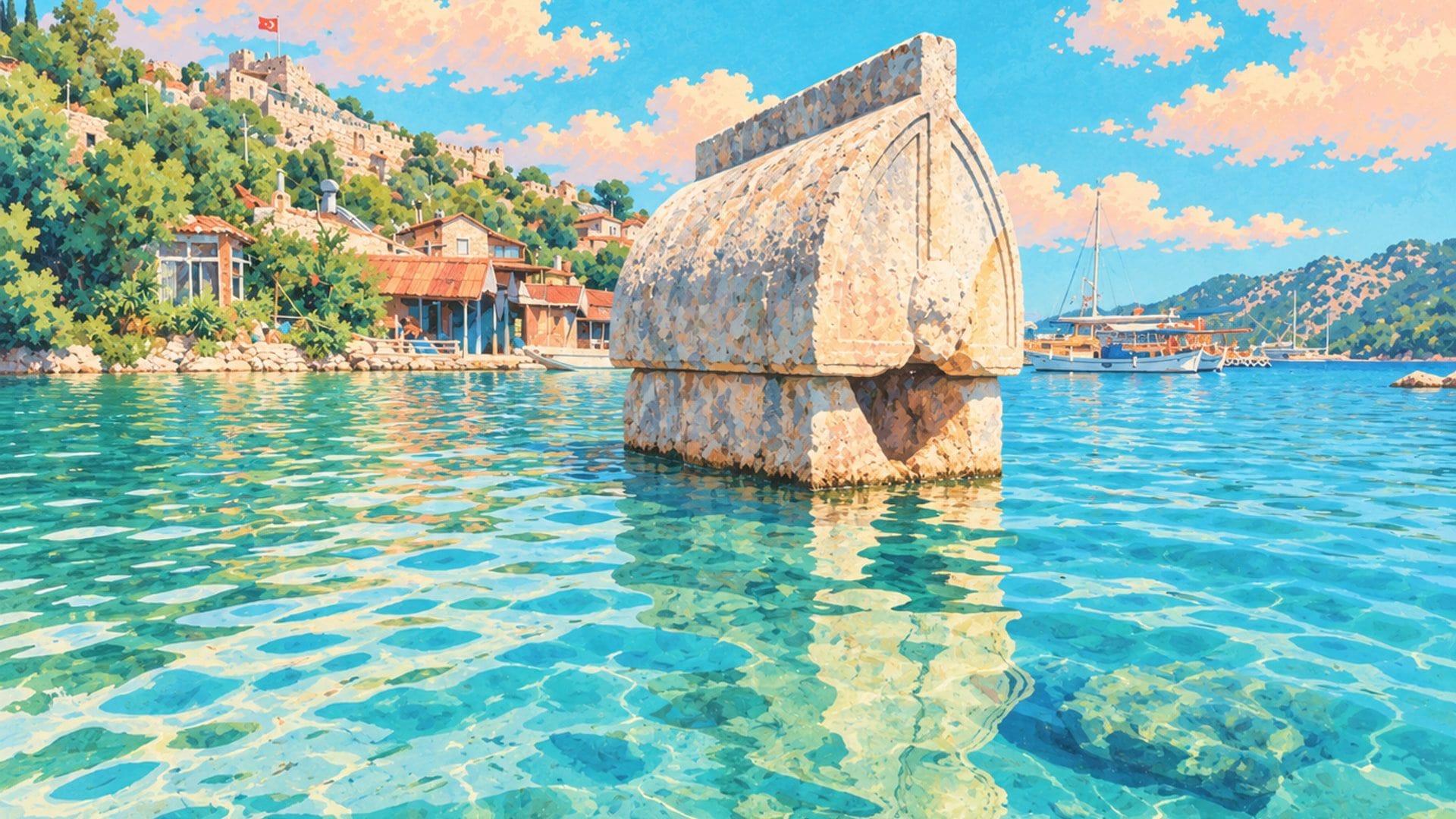
Tip: the waterfront sarcophagi photographs best with a low shooting angle — crouch or kneel to get the sarcophagus at eye level with the village and castle as a background layer. The semi-submerged sarcophagus near the Kaleköy jetty is the most iconic composition in the region.
Spot 3: The Sunken City from the Water
The shot: ancient walls, stairways, and room foundations visible through crystal-clear water — the unique image that defines Kekova.
Best time: 8–10 AM on a windless morning. Before that, the light angle is too low and creates long shadows on the water surface. After that, wind chop and boat traffic destroy the clarity. The sweet spot is a narrow 2-hour window.
Lens: 24–70mm zoom for flexibility. Circular polarising filter (CPL) is non-negotiable — it cuts surface glare and transforms a reflective surface into a clear window to the ruins below. Without it, you'll see bright blue water. With it, you'll see stone walls 2 metres down.
Technique: shoot from the lowest possible angle — lean over the gunwale or shoot from a kayak for the closest perspective. Use burst mode to compensate for boat movement. Rotate the CPL until the underwater structures snap into maximum clarity — the optimal angle varies with the sun position. Video often captures the texture better than stills because the moving water helps reveal the 3D structure.
Phone tip: hold a polarised sunglass lens flat against your phone camera for an improvised CPL effect. It works surprisingly well.
Spot 4: Tersane Bay
The shot: impossibly turquoise water with Byzantine shipyard ruins on the shore — the colour photograph that makes people say "is that real?"
Best time: midday (11 AM–1 PM) — unusually, this is one location where the harsh overhead sun is your friend. The steep sun angle penetrates the water vertically, illuminating the sandy bottom and creating the intense turquoise colour that gives the bay its visual identity. Morning side-light produces a duller, greener tone.
Lens: wide-angle (16–24mm) to capture the full bay with ruins, water, and boats. For the ruins on shore, 50–70mm isolates the stone slipways against the turquoise background.
Tip: the best vantage point is from the hill on the bay's eastern side, accessible by a short scramble from the beach. This elevated angle gets both the ruins and the water colour in a single frame — from sea level, you lose the overhead perspective that makes the turquoise so striking.
Spot 5: Kaleköy Village Lanes
The shot: narrow stone paths, bougainvillea cascading over walls, cats lounging on ancient stonework, sarcophagi beside doorways — the “Santorini without the crowds” aesthetic that has made Kaleköy one of Kekova's most Instagrammed locations, but with 2,000 years more history behind every frame.
Best time: morning (8–10 AM) before the tour groups arrive, or late afternoon (4–6 PM) after they leave. The village lanes run roughly north-south, so morning light creates long, warm shadows down the stone steps. Afternoon light is softer and warmer, with the western sun illuminating the harbour-facing facades.
Lens: 35mm is the ideal focal length — wide enough to capture the narrow lanes with context, tight enough to avoid the distortion that ultra-wide lenses create in confined spaces. For portrait-style shots of sarcophagi, doors, and details, 50–85mm.
Tip: the most photographed composition in Kaleköy is the half-submerged sarcophagus at the harbour — shoot it at water level with the village and castle rising behind it. Use a low f-stop (f/2.8–f/4) to separate the sarcophagus from the background, or a high f-stop (f/8–f/11) for everything sharp.
Spot 6: The Üçağız–Simena Coastal Path
The shot: elevated panorama of the entire bay — Üçağız harbour, Kekova Island, the channel, with Lycian sarcophagi in the foreground and the sea stretching to the horizon.
Best time: afternoon (3–5 PM). The path follows the western coast, facing roughly southwest, so afternoon light hits the landscape directly while the water takes on a deep, saturated blue. Morning light leaves the foreground in shadow.
Lens: 24–35mm for the panoramic bay views. 70–100mm for the sarcophagi along the path, isolating them against the sea background. The 30-minute walk has at least three excellent viewpoints — you'll know them when you see them because the view opens up suddenly after a bend.
Tip: the sarcophagi along this path are less visited and less photographed than those at the harbour. They sit in scrubland with the bay behind them — a more natural, less "touristic" composition than the harbour shots. Use them as foreground anchors for wide-angle bay panoramas.
Drone Rules: What's Banned and the Alternative
Drones are prohibited over the entire Kekova Specially Protected Area. The ban covers the sunken city, the waters around Kekova Island, Kaleköy, and the surrounding airspace. Coast Guard and gendarmerie enforce the ban. Violations can result in equipment confiscation, fines (reportedly 5,000–15,000 TL), and in serious cases, criminal proceedings. No permits are available for civilian use.
The alternative: Simena Castle provides a natural vantage point approximately 60–70 metres above sea level. With a telephoto lens (100–200mm), you can capture overhead-perspective shots of the channel, the sunken city walls, boats in the bay, and the island coastline that approximate a drone's-eye view. The castle is free to access (entrance fee for the castle itself), and shooting from it is entirely legal.
For wider elevated shots, the highest point on the Üçağız–Simena walking path also offers a vantage — lower than the castle but with a different angle that includes Üçağız harbour in the frame.
Equipment Summary
Camera + zoom lens (24–70mm): covers 90% of situations. Add a CPL filter for the sunken city.
Telephoto (70–200mm): essential for Simena Castle summit shots and useful for isolating details from boats.
CPL filter: the single most important accessory for Kekova photography. Without it, the sunken city is a blue surface. With it, it's an underwater archaeological site.
Action camera (GoPro-style): the best tool for video from a kayak or boat — waterproof, shockproof, and mountable hands-free on a chest harness or kayak bow clamp. Use video mode over stills: the wide-angle distortion that plagues action-cam photos becomes an asset in video, where the moving water reveals the 3D texture of the sunken ruins beneath you. Particularly effective for the slow-pass over the stairway section, where the combination of kayak-level proximity and continuous footage captures detail that even a DSLR struggles to match from a rocking boat.
Phone photographer: modern phones handle Kekova beautifully in good light. Bring a clip-on polariser (cheap, effective) and a waterproof pouch for boat/kayak use. A quick guide to translating the lens recommendations above into phone terms: your default 1x lens is roughly equivalent to 24–26mm (use it for panoramas, bay views, and wide castle shots), 2x gives you approximately 50mm (ideal for village lanes, sarcophagi, and harbour scenes), and 3x or 5x approximates 70–120mm (useful from Simena Castle summit). Avoid ultra-wide (0.5x) unless you want dramatic foreground distortion.
What to leave behind: tripod (impractical on boats and castle stairs), flash (useless outdoors), drone (illegal). Pack light — you'll be climbing stairs, getting on and off boats, and possibly kayaking.
Short on Time? How to Prioritise
2 hours (morning only): Spot 1 (Simena Castle summit at golden hour) + Spot 3 (sunken city from the water on the boat ride back). These two give you Kekova's most distinctive images — the elevated panorama and the underwater ruins.
Half day: add Spot 2 (Üçağız harbour at dawn, before your boat departs) and Spot 5 (Kaleköy village lanes while waiting for or after the castle). Four spots, all before lunch.
Full day: all six spots in sequence. Start with Spot 2 at sunrise, Spot 6 (coastal path) in early morning, Spots 1 and 5 mid-morning at Kaleköy, Spot 3 on the boat, and Spot 4 (Tersane Bay) at the midday swim stop when the turquoise colour peaks.
I've photographed this bay hundreds of times, and my favourite spot isn't the castle summit — though that's the most spectacular. It's the Üçağız waterfront at 6:30 AM, when the harbour is empty and the sarcophagi throw long shadows across still water. The castle shot is the one that gets the most likes. The harbour-at-dawn shot is the one I've printed and hung on my wall. Sometimes the quietest frame is the most powerful one.
For detailed viewing and photo tips specific to the underwater ruins, see Sunken City Photography →. For reaching the castle summit, see Simena Castle Guide →. For the kayak perspective, see Sea Kayaking →
