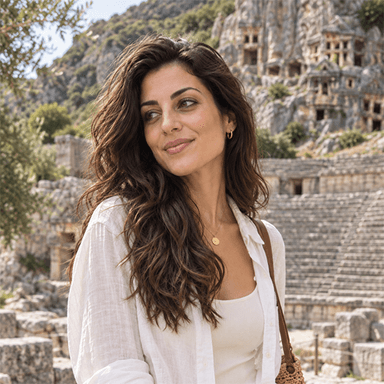
Deniz
Greenhouse farmer's daughter. History graduate. Amateur historian.
The local behind Demre.net.
The Strangest Thing About Growing Up in Demre
The strangest thing about growing up in Demre is that history isn't something you go to see — it's something you walk past on the way to school.
My father's greenhouse borders a field where construction workers found column fragments. The ice cream shop I visited as a child sits thirty metres from a Roman-era water channel. People here don't treat 2,000-year-old ruins as attractions — they're just part of the scenery, like the mountains or the sea.
I was born and raised in Demre in the mid-1990s — the child of a farming family that grows oranges and peppers in the same alluvial soil that buried ancient Myra. After studying history in Istanbul, I moved to London, where I live now. But Demre never quite lets go.
Demre.net is my way of sharing the place I grew up in with people who want to see it the way locals do — not as a checklist of sights, but as a living town where ancient ruins, greenhouse agriculture, and Mediterranean life overlap in ways that still surprise me.
My Demre
I've been visiting St. Nicholas Church since childhood — watching excavation trenches appear and expand for as long as I can remember. When the news broke in December 2024 that a sarcophagus had been found beneath the church floor, the rest of the world was stunned. In Demre, people shrugged. We'd been watching archaeologists dig for decades. But standing in the church where Nicholas served as bishop 1,700 years ago is still a very particular feeling — pride, and strangeness, and a kind of vertigo.
I learned to swim at Çayağzı — the beach at Andriake harbour — long before anyone thought of it as a destination. I saw my first sea turtle there. My perfect day formula since age twelve has been the same: arrive in May, swim, walk the wetland, watch the fishermen come in, stay for sunset over Kekova Island. I still choose that over resort beaches every time.
I got my first camera at fourteen and started photographing Andriake's ruins and coastline. I visited the Granarium years before the museum opened — it was a roofless ruin, wildflowers growing between the stones, the Hadrian inscription half-buried in rubble. When the restored museum opened in 2016, I barely recognised the building. That transformation is Andriake's story in miniature: a place constantly being unearthed, constantly surprising.
Growing up, the Kekova boat trip was how every summer began. I grew up in the shadow of St. Nicholas Church, watching the bishop and Santa Claus coexist in the same town square. Nicholas's entire world was the sixty kilometres of coastline I grew up on — yet it produced a story that reached every corner of the planet. It still strikes me as strange and wonderful every time I think about it.
What I Know (And What I Don't)
I have a lifelong interest in Lycian rock tombs, Roman grain logistics, Byzantine ecclesiastical politics, and Ottoman provincial records. I'm an amateur historian, not an academic — I read the papers, walk the sites, talk to the archaeologists when they'll let me, and try to connect the dots for visitors in a way that textbooks don't.
What I bring to this site is thirty years of living context. I know which beach has turtle tracks in May and which restaurant serves the peppers my father grows. I know that the Friday market moves from summer to winter location. I know the light at Myra's theatre is best at 4 PM in October and that the church fresco colours change with the seasons.
What I don't bring is pretence. I'm not an archaeologist, an architect, or a marine biologist. When this site discusses structural restoration, underwater ecology, or academic dating controversies, I cite the sources. When I share a local tip or a childhood memory, I tell you it's mine. The line between research and personal experience is always clear.
I write about the places I've known my whole life.
How This Site Works
Every word on Demre.net is written by me. There are no sponsored posts, no paid placements, and no affiliate links disguised as recommendations. When I recommend a restaurant, it's because I've eaten there. When I say a beach is quiet in May, it's because I've been there in May.
The site covers five main areas — each with a comprehensive hub guide and detailed articles on specific topics:
- Myra Ancient City — rock tombs, Roman theatre, lost monuments
- Kekova & Simena — sunken city, boat tours, castle, sea kayaking
- St. Nicholas Church — real story, architecture, Santa Claus connection
- Andriake — ancient harbour, Lycian museum, beach, camping
- Demre Town — getting there, where to stay, food, beaches, agriculture
Practical information — ticket prices, opening hours, transport schedules — is checked and updated regularly. Historical content is based on published academic sources, archaeological site information, and local knowledge passed down through generations.
If you find something outdated or incorrect, I'd genuinely like to know. → Contact me
The Places I Write About
A Note on the Name
In Turkish, deniz means "the sea." Growing up on the Mediterranean coast with that name felt less like coincidence and more like instruction. The sea is the first thing I see when I come home to Demre and the last thing I hear at night from my family's house. It seemed only right that a site about this coast should be written by someone the language itself named after it.
Get in Touch
Have a question about Demre? Spotted something outdated on the site? Just want to say hello?
Write to Me→