Four Towns, Four Reasons to Hit the Road
Demre is one of those rare places where you could spend a week without leaving the district and still not see everything. But the Lycian coast doesn’t stop at the Demre valley — and some of Turkey’s most memorable destinations are less than two hours away in either direction. Whether you have a spare afternoon or a couple of extra days, these four towns each offer something Demre doesn’t: the boutique energy of Kaş, the endless sand of Patara, the quiet harbour charm of Finike, or the mythic fire of Olympos.
At a Glance — Distances & Time
All four destinations sit along the D400 — Turkey’s main Mediterranean highway — making logistics simple. Here’s what you’re working with:
| Destination | Direction | Distance | Drive Time | Dolmuş? | Recommended Time |
|---|---|---|---|---|---|
| Kaş | West | 40 km | 45 min | ✓ Every 30–60 min | Half day – Full day |
| Patara | West | 60 km | 1 hour | Via Kaş | Full day |
| Finike | East | 25 km | 25 min | ✓ Every 30–60 min | Half day |
| Olympos & Chimera | East | 90 km | 1.5 hours | ✗ Car needed | Full day |
All four destinations lie on the same coastal road, the D400. You can visit Finike and Olympos on an eastbound day, and Kaş and Patara on a westbound day — no backtracking, no wasted driving. If you’re renting a car for Demre (which we strongly recommend), these day trips are effortless additions.
Kaş — The Lycian Riviera’s Boutique Capital
Kaş is Demre’s glamorous neighbour. Where Demre is a working agricultural town that happens to sit on world-class ruins, Kaş is a self-aware resort town that has leaned fully into its appeal — boutique hotels lining narrow Ottoman streets, rooftop restaurants overlooking the harbour, dive shops on every corner, and the tiny Greek island of Kastellorizo (Meis) shimmering just 7 km offshore. The two towns are 40 km apart, but the contrast is striking.
The standout site is the Antiphellos Amphitheatre — a small but perfectly preserved Hellenistic theatre perched above the town with direct sea views and Meis island framed between the stage walls. Unlike Myra’s much larger Roman theatre, Antiphellos is open-access and uncrowded, sitting right in the middle of town. Beyond the theatre, Kaş offers world-class scuba diving (the Uluburun replica wreck dive is famous), sea kayaking, a boat trip to Kastellorizo, and the best evening atmosphere on the Lycian coast — something Demre honestly lacks.
The drive from Demre to Kaş takes about 45 minutes on the D400 heading west. The road is well-maintained and scenic — you’ll climb out of the Demre valley through dry Lycian hills with occasional sea glimpses before descending into the Kaş bay. Dolmuş minibuses run the route every 30 to 60 minutes from Demre Otogar, costing approximately 200 TL one way (2026 prices). The last return dolmuş typically leaves Kaş around 18:00–19:00 — check the schedule if you’re not driving.
As a half-day trip, Kaş works well for a wander-and-lunch visit: see the amphitheatre, explore the old town streets, eat on the waterfront, and drive back. But Kaş really comes alive in the evening — the harbour bars, the rooftop terraces, the sunset over Meis — and a single afternoon doesn’t capture that energy. If you can spare one night, staying in Kaş and returning to Demre the next morning gives you the full picture. It also sets up a natural Patara combination: drive west to Kaş one day, continue to Patara the next, return to Demre via Kaş.
“Everyone asks me Kaş or Demre, as if you have to choose. They’re completely different experiences. Kaş is where you go when you want a proper dinner out, a cocktail with a sunset, maybe some shopping. Demre is where you go when you want to stand alone in a 2,400-year-old theatre at eight in the morning. I like having both within 45 minutes of each other — that’s the beauty of this coast.”
Patara — The Longest Beach & The Lycian Parliament
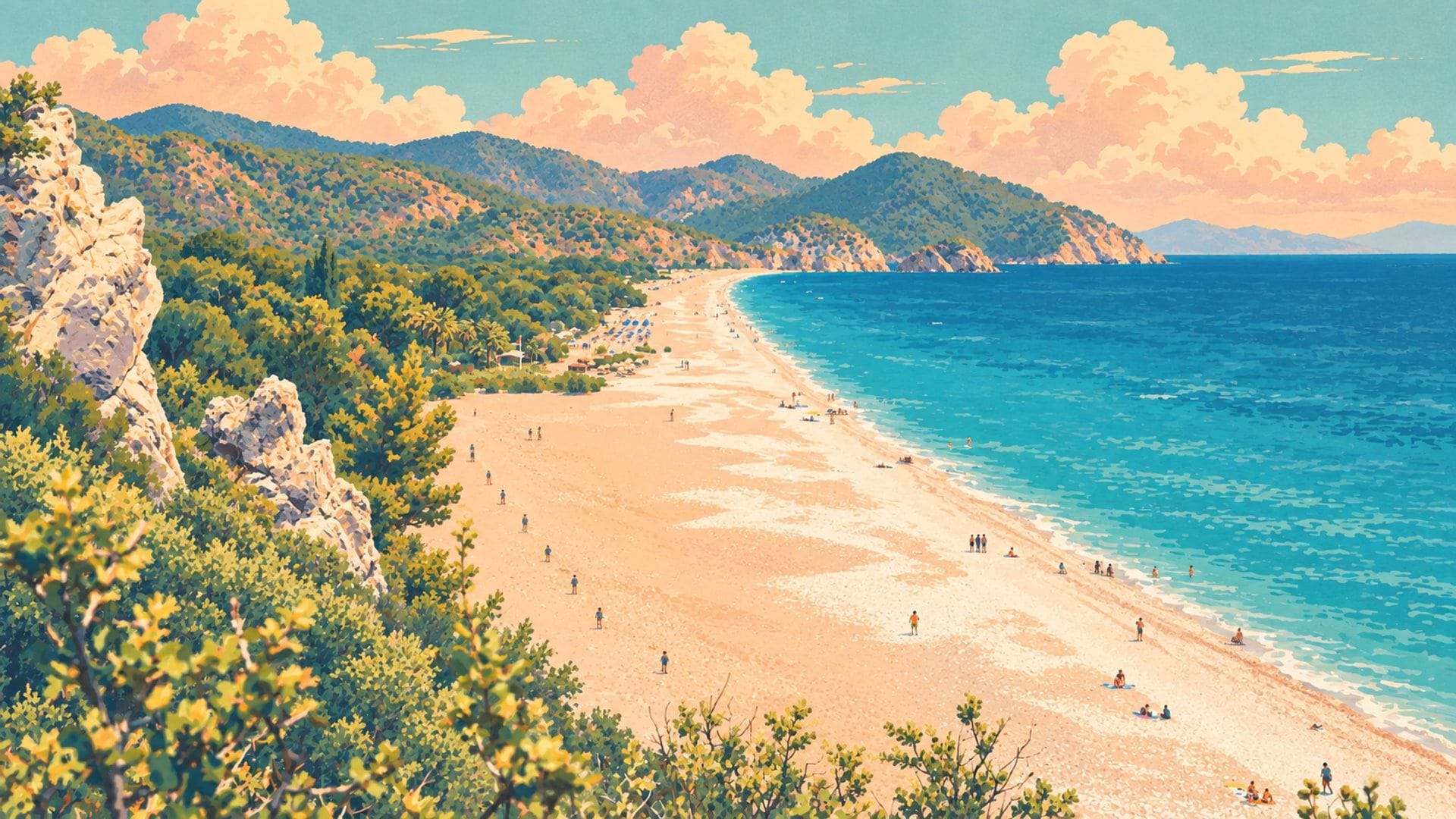
Patara is two destinations in one: a significant Lycian–Roman archaeological site and Turkey’s longest uninterrupted beach, stretching 18 kilometres of golden sand along the Mediterranean. It also holds a connection to the same figure who made Demre famous — St. Nicholas (Nikolaos of Myra) was actually born in Patara before moving to Myra, where he became bishop. The two towns share a saint, separated by 60 km of Lycian coastline.
The ancient city is worth at least two hours. The Bouleuterion (parliament building) of the Lycian League is the headline — this is where the world’s first known democratic federation held assembly, predating the Roman Senate’s adoption of similar structures. The recently restored Roman theatre is impressive, and the triumphal arch, colonnaded street, and harbour baths fill out a visit that feels less touristed than Myra but equally substantial. The site entrance fee covers both ruins and beach access (a single ticket).
The beach itself is a nature reserve — no hotels, no sun lounger empires, no waterfront bars. Just 18 km of sand, dunes, and sea. Caretta caretta turtles nest here from May to October (just as they do at Çayağzı near Demre), and sections of the beach are restricted during nesting season. There’s a simple café and changing facility at the beach entrance, and that’s it. If you’ve been to Çayağzı and wanted something bigger and emptier, Patara is the answer.
Patara is approximately 60 km west of Demre — about 1 hour by car on the D400 via Kaş. You pass through Kaş at the halfway point, which makes combining the two destinations into a single day trip natural. From the D400, a signed turn-off leads 4 km south to Patara village and the archaeological site entrance. Without a car, take a dolmuş from Demre to Kaş, then a second dolmuş from Kaş to Patara village — doable but adds 30–45 minutes each way. No direct Demre–Patara dolmuş exists.
Patara works as either a focused half-day (ruins only, morning visit) or a leisurely full day (ruins in the morning, beach in the afternoon). The beach is at its best from May to October when the water is warm — outside these months, the ruins alone still justify the trip. If combining with Kaş: drive to Patara first thing in the morning (the ruins are less hot and empty before 10:00), spend time at the beach, then drive 20 minutes back to Kaş for a late lunch and evening wandering.
“People who come to see St. Nicholas Church in Demre are always surprised when I tell them he was actually born in Patara. The connection between the two towns goes deeper than one saint — they were both part of the Lycian League, both voting members of the world’s first democratic federation. Walking from the Patara parliament building to the Myra rock tombs, you’re tracing the same political network that connected this coast 2,400 years ago.”
Finike — The Quiet Harbour Next Door
Finike doesn’t have Kaş’s glamour or Patara’s spectacle. What it has is something rarer: genuine ordinariness. This is a working harbour town 25 minutes east of Demre — a place where the marina serves fishing boats, not charter yachts, and the main street still belongs to locals buying groceries rather than tourists browsing souvenirs. For visitors who enjoy Demre’s unpolished character, Finike offers more of the same — amplified. It is the most “undiscovered” destination on this list, and that is precisely its appeal.
The main cultural draw is Limyra — a Lycian city 10 km inland from Finike that most visitors to this coast never hear about. Limyra was the capital of the Lycian king Perikles (4th century BC), and its ruins include a theatre, a cenotaph (empty tomb monument), rock tombs scattered across the hillside, and the remains of a Byzantine basilica. The site is free to enter, rarely visited, and surrounded by orange orchards. If you’ve been to Myra and want to understand more about the Lycian civilisation’s extent, Limyra puts Myra in perspective — same culture, different power centre, completely different atmosphere.
Beyond Limyra, Finike offers a pleasant harbour promenade, a weekly Tuesday market (smaller than Demre’s Friday market but less touristy), and a detour to Mağaralı Köy — a tiny hamlet 20 minutes south with sea caves, crystal-clear swimming coves, and virtually no visitors. Finike is also the gateway to the citrus orchards that define the eastern Lycian coast — the “Finike portakalı” (Finike orange) is a regional brand, and the orange groves between Finike and Kumluca are stunning from November to March when the fruit is on the trees.
Finike is the closest destination on this list — just 25 km east on the D400, a 25-minute drive through the spectacular cliff-edge section of the coastal road. This stretch of the D400 between Demre and Finike is genuinely one of Turkey’s most scenic short drives: mountain on your right, open Mediterranean on your left, tight curves carved into the rock face. Dolmuş minibuses run the route every 30 to 60 minutes from Demre Otogar.
Finike is a natural half-day trip. Drive there in the morning, visit Limyra (allow 1–1.5 hours — the site is spread out), have a waterfront lunch at the Finike harbour, and return to Demre by mid-afternoon with time for a swim at Çayağzı. Or combine Finike with an afternoon Olympos–Chimera trip (Finike is on the way) for a full east-coast day.
“Finike is where Demre people go when they want a change of scenery without actually going far. The harbour fish restaurants are slightly cheaper than Çayağzı, the Tuesday market has some things our Friday market doesn’t, and Limyra is the kind of place where you might be the only visitor all morning. My favourite thing about Finike? The drive there. That 25-minute stretch of the D400 — tight curves, sea below — is the best quarter-hour of road on this entire coast.”
Olympos & Chimera — Beach Ruins and Eternal Flames
Olympos is the most dramatic day trip from Demre — and the longest drive. At 90 km east via Finike, it asks more of your time than the other three destinations, but delivers something none of them can match: ancient ruins emerging from a forested riverbed that empties onto a beach, and 7 km away, the Yanartaş — natural gas flames that have been burning from the mountainside for at least 2,500 years. The Greeks believed this was the lair of the Chimera, the fire-breathing monster of myth. The geology says methane seeping through ophiolite rock. Both explanations feel equally plausible when you see it.
Olympos was a Lycian city-state and a member of the same Lycian League as Myra and Patara. The ruins are spread along a stream valley that runs to the beach — you walk through overgrown walls, doorways, tomb fragments, and a Byzantine church half-swallowed by trees. Unlike Myra’s neatly excavated and fenced site, Olympos is wild and atmospheric. The entrance fee covers both the ruins and the beach. The ruins are shaded by the forest canopy, making even a mid-summer visit comfortable — a significant advantage over the exposed sites at Myra and Patara.
The Yanartaş (meaning “burning rock”) is 7 km north of Olympos, accessed from a separate car park with a 20-minute uphill walk. Dozens of small flames flicker from cracks in the rocky hillside — the largest about knee-high, the smallest the size of a candle. The flames are visible day and night, but the experience is incomparably better at dusk when the fires glow against the darkening sky. Bring a torch for the walk back down. There is no lighting on the trail after dark.
The site has been burning since antiquity — ancient sailors used the flames as a navigational landmark. The mythological connection to the Chimera (a creature with a lion’s head, goat’s body, and serpent’s tail that breathed fire) was how the ancients explained the phenomenon. The scientific explanation — natural methane and hydrogen gas escaping through fault lines in the ophiolite rock — arrived considerably later but is no less remarkable.
The drive from Demre to Olympos is approximately 90 km east on the D400 via Finike and Kumluca — about 1.5 hours. The road is good but includes the winding Demre–Finike mountain section and then the longer Kumluca–Olympos stretch through hills and pine forest. There is no direct dolmuş from Demre. If you’re combining Finike and Olympos in a single day (recommended), stop at Limyra and Finike harbour on the way out, then continue east to Olympos.
The ideal Olympos day trip from Demre follows this rhythm: leave Demre by 09:00, arrive at Olympos by 10:30, explore the ruins and have a beach swim until 14:00–15:00, have a late lunch in Olympos village (tree house restaurants with shaded platforms), then drive to the Yanartaş car park by 16:30. Walk up to the flames, watch the sunset from the hillside, and return to Demre by 20:30–21:00. It is a full, long day — but the combination of forest ruins, beach, and eternal flames in a single afternoon is hard to beat anywhere on the Mediterranean.
The Chimera flames are at their most impressive at dusk. But the 20-minute trail back down to the car park has no lighting. Bring a torch or headlamp — phone torches work but drain your battery. Wear proper shoes (the path is rocky and uneven). In summer, carry water — the uphill walk is steep and hot. The site closes late but check seasonal hours. Driving back to Demre in the dark means 1.5 hours on mountain roads — drive carefully and don’t rush.
“Olympos is the day trip that surprises people the most. They expect some ruins and a fire — and they get this half-wild ancient city in a forest, a beach at the end of it, and then flames coming out of a mountain at sunset. It’s the one destination I’d say is worth the longer drive, every time. My tip: don’t rush back. Have dinner in Olympos village, let the traffic thin out, and drive back to Demre on the empty night road. The D400 through Finike at night, with the sea below and the stars above, is something else.”
Combining Destinations — The Smart Routes
The D400 makes multi-stop days logical. Here are the combinations that work best from a Demre base:
The Western Loop — Kaş + Patara (1 Full Day)
Drive west to Patara first (1 hour, arriving by 09:00 for cool ruins exploration). Spend the morning at the archaeological site and the beach. After lunch at Patara village, drive 20 minutes back to Kaş for afternoon exploring and an early dinner on the waterfront. Return to Demre by evening (45 min from Kaş). Total driving: ~2 hours.
The Eastern Loop — Finike + Olympos (1 Full Day)
Drive east to Finike (25 min), visit Limyra ruins in the morning, have an early lunch at the Finike harbour. Continue east to Olympos (45 min from Finike). Explore the ruins and beach in the afternoon. Drive to Yanartaş for the sunset flames. Return to Demre via the D400 (1.5 hours). Total driving: ~2.5 hours.
The Grand Circuit — 2 or 3 Extra Days
If you have 2–3 days beyond your Demre exploration, this sequence covers all four destinations without backtracking:
Day 1 (East): Demre → Finike (Limyra + harbour lunch) → Olympos (ruins, beach, Chimera at dusk) → Demre
Day 2 (West, part 1): Demre → Kaş (full day: amphitheatre, old town, optional dive, dinner) → stay overnight in Kaş
Day 3 (West, part 2): Kaş → Patara (morning ruins, afternoon beach) → Demre
The Museum Pass (Müze Kart) that covers Myra, St. Nicholas Church, and Andriake Museum in Demre also covers Patara and Olympos entrance fees. If you’re planning multiple day trips, the pass pays for itself quickly. Finike’s Limyra is free to enter.
