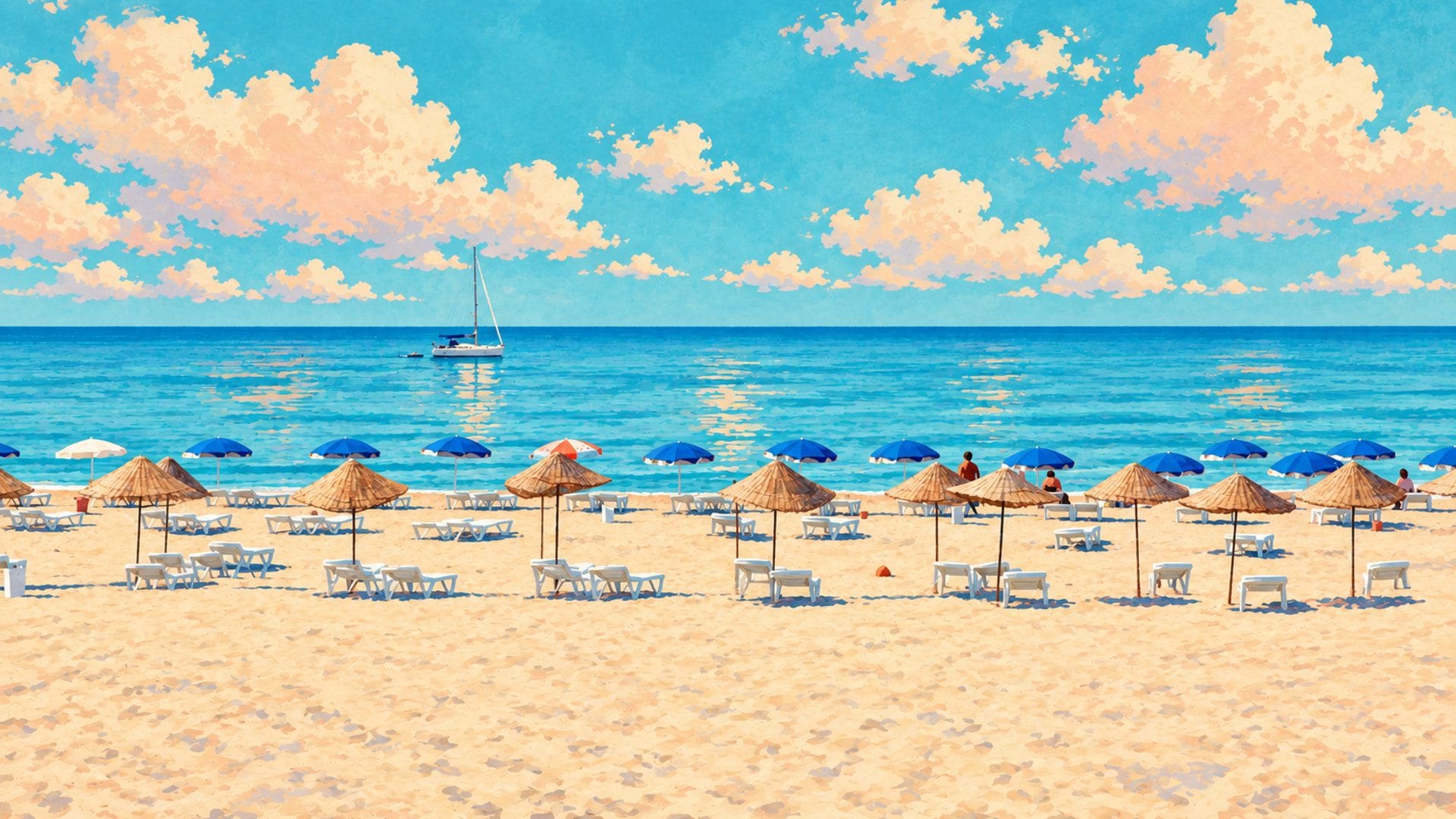
Three hundred days of sunshine. Mediterranean winters that barely dip below 10°C. Summers so hot the greenhouses create their own microclimate. Demre’s weather is its greatest asset and its most common underestimation — knowing when to come and what to expect is the difference between an extraordinary trip and an uncomfortable one.
Demre’s Climate — Why It’s Different
Demre sits at sea level on a flat river plain enclosed by the western Taurus Mountains. This geography creates a textbook Mediterranean climate — long, dry, hot summers and mild, wet winters — but with a local twist. The Taurus range blocks cold northern air masses, making winters warmer than inland Anatolia. The valley floor traps summer heat like a bowl, making July and August significantly hotter than the open coastline at Kaş or Kalkan just forty kilometres away. And the thousands of hectares of plastic greenhouses covering the plain act as a thermal amplifier, radiating stored heat back into the air and raising local temperatures by a perceptible margin.
The result: Demre is warmer than you expect in winter (good news) and hotter than you expect in summer (less good news). Annual rainfall is around 1,000 mm, but it falls almost entirely between November and March — summer is bone-dry. The sea is swimmable from mid-April to early November, with peak water temperatures of 27–28°C in August.
Demre Weather by Month
Select a month below to see average temperatures, sea conditions, rainfall, and crowd levels. All figures are based on long-term climate averages for the Demre/Finike coastal area. Use the °C/°F toggle if you prefer Fahrenheit.
Climate averages based on historical data for the Demre–Finike coastal zone. Actual conditions vary year to year. Crowd levels are estimates based on local observation.
Spring — March to May
Spring is when Demre is at its most beautiful. March brings the first warmth (18°C average highs) and a hillside explosion of wildflowers — poppies, chamomile, wild orchids — carpeting the landscape around Myra and along the Lycian Way hiking trails. By April the days are reliably warm (22°C), the sea edges toward swimmable (19°C — cold but possible), and Kekova boat tours resume their regular schedules after the quiet winter months.
May is, without reservation, the best month to visit Demre. Average highs of 27°C are warm enough for beaches but comfortable enough for spending hours at outdoor archaeological sites. The sea reaches a genuinely pleasant 21°C. Tourist numbers are a fraction of July–August levels, meaning shorter queues at Myra’s entrance, empty stretches at Çayağzı beach, and boat tours with space to breathe. Accommodation prices are at their lowest outside winter. If you can choose any month of the year, choose May.
In late March and April, Demre’s remaining orange groves (the ones that haven’t been replaced by greenhouses) burst into blossom. The scent is extraordinary — sweet citrus perfume drifting across the valley. Walk between the town centre and Andriake in the late afternoon for the full effect.
Summer — June to August
Summer in Demre is glorious and brutal in equal measure. June is the transition month — hot (32°C) but not yet punishing, with the longest days of the year (sunset after 20:00) and a sea that has finally warmed to a comfortable 24°C. If you can visit in June rather than July or August, you get summer conditions with spring crowd levels.
July and August are a different proposition. Average highs of 36–37°C are the official numbers, but temperatures in the Demre valley routinely hit 40–42°C. The greenhouse effect is real and literal here: thousands of hectares of plastic roofing absorb and re-radiate solar energy, creating a localised heat island. The result is that Demre feels noticeably hotter than Kaş or Kalkan, despite being on the same stretch of coast. Rain is essentially impossible — you will not see a cloud from June to September.
In July and August, every local follows the same rhythm: work in the greenhouses from dawn until the heat becomes unbearable around 11:00, then disappear indoors until late afternoon. Tourists should do the same, adapted to sightseeing: be at Myra when the gates open at 08:30, finish by 10:30, then head to the beach or retreat to your air-conditioned room until 16:00. The idea of walking around ruins at noon in August is something only first-time visitors attempt once. Don’t be that visitor.
The compensating factor is the sea. At 27–28°C, the Mediterranean off Demre’s coast is bathwater-warm and utterly perfect. Çayağzı Beach, the Kekova swimming bays, even the deeper water off Sülüklü — everything is ideal for swimming. If your priorities are beach, boat, and water, summer is genuinely excellent. Just restructure your days around the heat: early mornings for ruins, midday for sea, evenings for food and exploration.
Autumn — September to November
September is May’s equal as the ideal visiting month. The worst of the heat subsides (33°C average, dropping through the month), the sea is at its warmest (27°C — it lags behind air temperature by several weeks), and the summer crowds evaporate almost overnight as European school holidays end. Accommodation prices drop. Boat tours continue at full schedule. Everything that makes summer appealing is still there, minus the excess.
October brings a golden quality to the light that photographers treasure. Temperatures settle to a comfortable 27°C — perfect for spending full days at archaeological sites without the urgency of escaping the sun. The sea remains a very pleasant 24°C. The orange harvest begins in the groves that dot the valley between the greenhouses, turning patches of the landscape from green to vivid orange. Rain returns occasionally (4 days average), but storms are brief and followed by clear skies.
November is true shoulder season. Tourist numbers drop to near-zero. Rain increases (7 days average), and some days have an autumnal chill (21°C highs, 10°C lows). The sea is still technically swimmable at 20°C but most visitors won’t bother. This is a wonderful month for visitors who prefer solitude: you may be the only person at Myra at opening time, the church will be empty, and Üçağız harbour will have more fishing boats than tour boats. Bring a waterproof jacket and enjoy having the Lycian coast to yourself.
Winter — December to February
Winter in Demre bears no resemblance to winter in northern Europe. Average highs of 15–16°C and lows of 6–7°C mean daytime temperatures that are cool but comfortable — a single layer with a light jacket is usually sufficient. Snow is unheard of at sea level (though the Taurus Mountains behind the town are often snow-capped, creating spectacular backdrops). Rain is the main weather factor: 10–11 days per month in December through February, with annual peaks often in December and January.
The rain falls in Mediterranean style — intense, short-lived bursts rather than the grey all-day drizzle of northern climates. A morning downpour may give way to afternoon sunshine. St. Nicholas Church, being an enclosed structure, is a natural rainy-day activity. The Lycian Civilizations Museum at Andriake is another. Between showers, archaeological sites are at their most atmospheric: the stone catches low winter light in ways that summer visitors never see, and the complete absence of crowds creates a meditative quality.
The one date that brings visitors to Demre in winter. Every December 6, an Orthodox Christian ceremony is held at St. Nicholas Church, with clergy, pilgrims, and media from around the world. Demre’s town square hosts events and markets. If your dates are flexible, this is a remarkable cultural experience — and the town has a festive energy you won’t find at any other time of year. → See our pilgrimage guide for details.
Winter accommodation is minimal and cheap — many pensions close, but those that remain open offer their lowest rates. Restaurants are quieter and more welcoming. The Friday market continues year-round. And the one undeniable advantage of a winter visit is the light: low-angle Mediterranean sun, often breaking through dramatic clouds, creates the best conditions for photography at every site in the region.
What to Pack
Demre’s packing list depends entirely on your season, but some items are essential year-round. Here is what a local would tell you to bring — and what most travel guides forget to mention.
Every Season (Essentials)
Sturdy closed-toe walking shoes are non-negotiable. Every archaeological site in Demre — Myra, Andriake, St. Nicholas Church, Simena Castle — has uneven stone surfaces, exposed foundations, and slopes. Flip-flops and fashion sandals are a sprained ankle waiting to happen. Beyond footwear: SPF 50 sunscreen (the Mediterranean UV is stronger than most visitors expect, even in winter), a wide-brimmed hat, and a refillable water bottle. Demre tap water is safe but tastes heavily mineralised; bottled water is cheap and everywhere.
Spring & Autumn (Apr–Jun, Sep–Nov)
Lightweight clothing for warm days (25–32°C), a light jacket or cardigan for evenings (temperatures drop quickly after sunset), swimwear for the beach and boat tours, and a compact rain jacket for October–November. A light scarf or cover-up is useful for visiting St. Nicholas Church out of respect, though there is no strict dress code. Layers are your friend: mornings can be cool, afternoons warm, and evenings breezy.
Summer (Jul–Aug)
The lightest, most breathable clothing you own. Cotton or linen, loose-fitting, in light colours. Swimwear will get more use than anything else. A UV-protection rash guard is worth considering if you plan to kayak at Kekova or snorkel at length. Sunglasses (polarised if possible — essential for seeing underwater ruins at Kekova from a boat). And water: carry at least 1.5 litres per person when visiting sites. Dehydration is a genuine risk in 40°C heat.
Winter (Dec–Feb)
A waterproof jacket or lightweight rain shell is essential — you will encounter rain. Underneath: a medium-weight layer (fleece or wool sweater) and a long-sleeved base. Daytime temperatures are usually mild enough that heavy winter coats are unnecessary. An umbrella is more practical than a full rain suit. Evenings are cool (6–8°C) — if you plan to eat outdoors, bring an extra layer. The rest of the year’s essentials (walking shoes, sunscreen, hat) still apply, even in winter.
The Verdict — When Should You Come?
If I could send every visitor to Demre in one month, it would be May. The wildflowers are still on the hillsides, the sea has warmed up enough to swim, the ruins are uncrowded, the evening air is perfect for eating outside, and everything costs half what it costs in August. October is my second choice — the light is magical, the oranges are ripening, and there’s a mellowness to the town that you just don’t get when the summer rush is on.
But honestly? I also love winter. Demre in January, in the rain, with nobody at Myra except you and the carved faces in the cliff — that’s when you feel the weight of 2,500 years. It’s not Instagram-friendly, but it’s real.
For most visitors, the best time to visit Demre is May or October. Both months offer comfortable temperatures (25–27°C), warm sea water, minimal crowds, and lower prices. June and September are excellent alternatives. July and August deliver perfect beach weather but extreme heat for sightseeing. Winter (December–February) is underrated: mild, empty, atmospheric, and cheap — ideal for history-focused visitors and photographers who don’t need the beach.
Use our day-by-day itineraries to plan your visit around the season. Summer plans prioritise early mornings and water activities; shoulder-season plans offer more flexibility. → See Demre Itineraries
