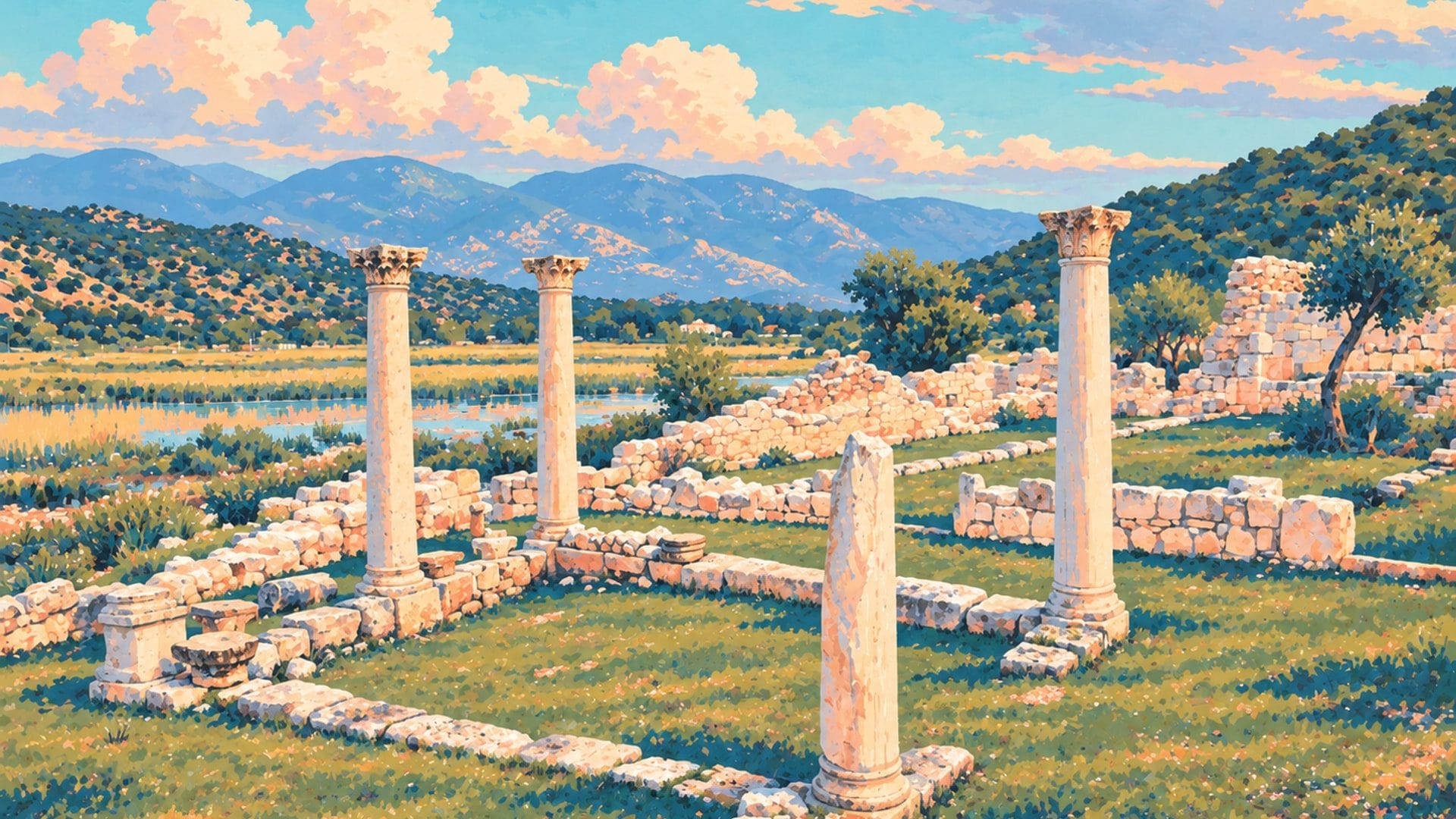
Every town has a history. Demre has five — stacked on top of each other, sometimes literally. A Lycian city-state buried under Roman prosperity, a Roman harbour buried under river sediment, a bishop’s church buried under centuries of neglect, and all of it now flanked by plastic greenhouses that feed the nation. This is the story of a place that keeps reinventing itself while its past refuses to stay underground.
Lycian Origins — The Birth of Myra
The story of Demre begins not with that name, but with Myra — one of the most powerful city-states of ancient Lycia. By the 5th century BCE, Myra was already significant enough to carve monumental tombs into the cliff faces above its river plain, the earliest physical evidence of a settlement that would endure for millennia.
Lycia occupied a mountainous strip of southwestern Anatolia, roughly between modern Fethiye and Antalya. Unlike the empires that surrounded it, Lycia governed itself through a federation — the Lycian League — that is now recognised as one of history’s earliest experiments in representative democracy. Each member city received one, two, or three votes in the federal assembly based on its size and importance. Myra held three votes — the maximum — placing it alongside Xanthos, Patara, Pinara, Olympos, and Tlos as one of the League’s six most powerful cities.
The Lycian League’s system of proportional representation attracted the attention of Montesquieu, who praised it in The Spirit of the Laws (1748), and the Founding Fathers of the United States. Alexander Hamilton and James Madison referenced it during the Constitutional Convention in 1787 as a model for balancing federal and state power. Two thousand years after its creation on this coast, Lycian governance helped shape American democracy.
Myra’s wealth came from two sources: fertile agricultural land on the river plain and maritime trade through its harbour at Andriake, five kilometres to the southwest. The harbour connected Myra to the broader Mediterranean trading network — grain from Egypt, olive oil from Greece, timber from the Taurus Mountains. The rock-cut tombs that still dominate the cliff face above the town are monuments to this prosperity: only wealthy families could commission the elaborate carved facades that imitate Lycian wooden architecture and Greek temple fronts.
The tombs are Myra’s most recognisable feature today — over a hundred carved chambers in two separate groups, the River Necropolis and the Sea Necropolis. Some preserve traces of the original painted decoration that once covered their facades in vivid red, blue, and yellow. For a detailed guide to the tombs’ architecture, symbolism, and best viewing spots, see our dedicated article on the Lycian rock-cut tombs of Myra.
Rome, St. Paul & the Bishop Who Became Santa Claus
Rome absorbed Lycia in 43 CE, and Myra entered its most prosperous period. The city’s theatre — a 10,000-seat semicircle carved into the hillside — was expanded and adorned with elaborate stone masks and friezes. But it was Andriake harbour that made Myra strategically vital to the empire. Rome depended on Egyptian grain to feed its capital, and the sea route from Alexandria to Italy passed directly through the Lycian coast. Andriake became a mandatory stopping point — ships transferred cargo, waited for favourable winds, and restocked provisions.
In 129 CE, Emperor Hadrian visited the region personally and commissioned a colossal granarium at Andriake — a seven-room warehouse measuring 2,307 square metres, large enough to store grain for the entire eastern Mediterranean fleet. An inscription above the entrance, still readable today, records Hadrian’s patronage. The granary’s scale tells you everything about Myra’s importance to Rome: this was not a provincial backwater but a linchpin of the empire’s food supply chain.
Around 59 CE, a prisoner named Paul of Tarsus — the apostle Paul — stopped at Andriake harbour while being transported to Rome for trial. The Acts of the Apostles records the moment with characteristic brevity: “And there the centurion found a ship of Alexandria sailing into Italy; and he put us therein” (Acts 27:5-6). Paul changed ships at the harbour that Hadrian would later monumentalise — the same quay where fishing boats and Kekova tour boats dock today.
But it is another figure — born a generation before the Roman Empire became Christian — who would make this town known to the entire world. Nicholas was born around 270 CE in Patara, a coastal city sixty kilometres west of Myra, to a wealthy Christian family. When his parents died in an epidemic, he gave away his inheritance to the poor. He became Bishop of Myra in his thirties and served for approximately three decades, surviving imprisonment under Emperor Diocletian’s persecution and attending the Council of Nicaea in 325.
The legends that grew around Nicholas — secret gifts of gold coins to save three sisters from poverty, miraculous provision of grain during a famine, the calming of a deadly storm at sea — became the foundation for the figure the world would come to know as Santa Claus. He died in 343 and was buried in a church built over his grave in Myra’s town centre. That church, rebuilt and expanded over the following centuries, still stands today — the most visited site in Demre.
Growing up here, “Noel Baba” (Santa Claus) was just part of the furniture. The church was where tourists went, the statue in the town square was where we met friends, and every December a TV crew would show up to film something. It took years before I understood how extraordinary it was that the world’s most recognisable gift-giver lived and died in our town — and that his church, his actual burial place, was five minutes from my school.
The Catastrophe — Earthquakes, Raiders & the Stolen Relics
The centuries after Nicholas’s death brought crisis upon crisis. In the 2nd century CE — the exact date is debated among scholars, with estimates ranging from the 2nd to the 4th century — a series of powerful earthquakes struck the Lycian coast. The most dramatic consequence occurred at Kekova, thirty-five kilometres from Myra: the southern shoreline of the settlement known as Dolichiste sank into the Mediterranean, submerging houses, stairways, harbour walls, and water cisterns. These ruins, visible beneath the clear water to this day, make Kekova one of the most remarkable underwater archaeological sites in the Mediterranean.
From the 7th century, Arab naval raids devastated the coast. The church of St. Nicholas was damaged in raids in 808 and again in 1034. Emperor Constantine IX Monomachos ordered its restoration in 1043, adding defensive walls — a church that needed fortification tells you how dangerous the coast had become. Andriake harbour, once bustling with Egyptian grain ships, began silting up as alluvial deposits from the Demre River (ancient Myros) choked the bay.
The most traumatic event in Demre’s collective memory occurred in 1087. A group of merchants from the Italian city of Bari — some accounts call them merchants, others pirates — broke into St. Nicholas’s sarcophagus and removed the majority of his bones. The relics were transported to Bari, where they remain today in the Basilica di San Nicola. A smaller portion was later taken to Venice. A fragment held in the Antalya Archaeological Museum is believed to be genuine. The question of whether the relics should be returned has been raised repeatedly by Turkish authorities — most recently in 2009 — but Italy has never agreed.
The theft of St. Nicholas’s relics in 1087 remains a sensitive subject. Bari celebrates May 9 as the feast of the “Translation of the Relics” — a holiday commemorating what Demre considers an act of grave robbery. Meanwhile, archaeologists excavating beneath St. Nicholas Church in December 2024 discovered a new limestone sarcophagus that may predate the one broken by the Bari merchants. Carbon dating is underway. → Read more in our archaeology article.
Quiet Centuries — From Empire to Village
The Seljuk Turks took control of the Lycian coast in the late 12th century, and Ottoman rule followed in the 15th. For Myra — now increasingly known by its Turkish name Kale (“castle”) — these transitions marked not dramatic rupture but slow, quiet decline. The grand public buildings fell into disrepair. The theatre filled with rubble and vegetation. The tombs, already ancient, became simply part of the landscape — useful as goat shelters, their painted facades fading in the sun.
The most insidious enemy was not military but geological. The Demre River carried silt from the Taurus Mountains year after year, century after century, depositing layer upon layer of alluvial sediment across the river plain. The ancient city was slowly buried. By the 19th century, metres of earth covered Myra’s streets, its agora, the lower tiers of its theatre. The harbour at Andriake, once deep enough for Roman grain ships, had become a shallow marsh. The church of St. Nicholas sat below the rising ground level, water seeping into its foundations.
What remained was a small farming and fishing community, disconnected from the cosmopolitan world that had once passed through its harbour. The 1923 population exchange between Turkey and Greece — part of the Treaty of Lausanne — removed the town’s remaining Greek Orthodox community, the direct spiritual descendants of the congregation Nicholas had served sixteen centuries earlier. The church lost its last worshippers. Demre entered the 20th century as an obscure agricultural village, its extraordinary past literally buried underfoot.
It was European travellers who began to pull Demre’s past back into view. Captain Francis Beaufort mapped the coast in 1811-12 and identified the ruins at Myra. Sir Charles Fellows explored the site in 1838, publishing detailed drawings that astonished London. Thomas Abel Brimage Spratt and Edward Forbes conducted systematic surveys in the 1840s. Their work initiated a slow process of excavation and recognition that continues to this day.
“The tombs of Myra are among the most striking monuments in Asia Minor — their facades carved to imitate the wooden houses of the living, as though death were merely a change of address.”
— Sir Charles Fellows, journal entry, 1838The Greenhouse Revolution
The event that shaped modern Demre more than any archaeological discovery was not ancient at all. In the 1960s, local farmers learned about plastic greenhouse technology being used in the Netherlands and began to experiment. The Demre valley offered near-ideal conditions: a flat plain at sea level, more than 300 days of sunshine per year, mild winters buffered by the Taurus Mountains to the north, and ample water from the river that had once fed Myra’s harbour.
The results were transformative. Within two decades, the open fields where farmers had grown grain and grazed livestock were covered with plastic-roofed greenhouses. Tomatoes, peppers, aubergines, and cucumbers could now be grown year-round, producing multiple harvests where traditional farming yielded one. The “Demre tomato” became a recognised name in Turkish produce markets. The region’s economy shifted from subsistence agriculture to industrial-scale vegetable production — and with it came cash, construction, and a population boom.
The physical transformation was startling. Viewed from the mountains above — or from the road approaching from Finike — the Demre plain now appears as a vast sheet of white plastic stretching from the mountain foothills to the coast, broken only by the town centre and the archaeological sites. It is not beautiful in a traditional sense. But it is extraordinary: here is an ancient Lycian plain, where Roman senators’ grain was loaded onto ships, where a saint walked the streets — and it is now one of the most productive vegetable-growing regions in the eastern Mediterranean.
My father is a greenhouse farmer — tomatoes and peppers, six days a week, up before dawn. When I tell visitors this, they’re always surprised. “But you run a travel site!” they say. And I tell them that’s exactly the point: most people who write about Demre have never met the people who actually live here. The ancient ruins are magnificent, but they’re not what pays the bills. The greenhouses pay the bills. And the people who work in them — the real daily life of this town — are the reason I wanted to tell Demre’s story in the first place.
The greenhouse revolution also created tensions that persist today. Expanding agricultural operations sometimes encroach on areas with archaeological potential — construction work regularly unearths ancient fragments, and the line between farmland and protected zone requires constant negotiation. Water resources are under increasing pressure, with both greenhouse irrigation and urban demand drawing from the same aquifers. A younger generation, educated in cities, shows less enthusiasm for the gruelling physical work of greenhouse farming, raising questions about the industry’s future workforce. See our full article on Demre’s greenhouse culture and agricultural life.
Modern Demre — Layers Upon Layers
Today’s Demre is a town of about 25,000 people living at the intersection of deep history and pragmatic modernity. The Tuesday dolmuş to Antalya passes the Roman theatre. The electricity pylons cross a valley that Hadrian surveyed. The Friday market sells tomatoes grown in fields that were once part of a Lycian necropolis. Nothing here is purely ancient or purely modern — everything is layered.
Archaeological work continues at every major site. At Myra, Hacettepe University has conducted excavations for decades, gradually uncovering the theatre’s lower tiers and agora from beneath centuries of alluvial deposit. At St. Nicholas Church, the “Legacy for the Future” project led by Doç. Dr. Ebru Fatma Fındık made headlines in December 2024 with the discovery of a limestone sarcophagus beneath the church floor — potentially the original burial vessel of St. Nicholas, predating the one raided in 1087. At Andriake, the Lycian Civilizations Museum opened in 2016 inside Hadrian’s restored granary, bringing 1,476 artefacts into a building that is itself a 2,000-year-old exhibit.
Kekova, too, has gained fresh recognition. The bay was declared a Specially Protected Area in 1990 — one of Turkey’s first — prohibiting diving and swimming in the sunken city zone. In 2025, the village of Üçağız (ancient Teimiussa), which serves as the departure point for Kekova boat tours, was selected as a UNWTO Best Tourism Village, an international acknowledgement of the region’s unspoilt character.
Tourism is growing but has not yet overwhelmed Demre the way it has Cappadocia, Ephesus, or the Turkish Riviera’s resort towns. There are no five-star hotels, no cruise-ship terminals, no all-inclusive complexes. Whether this is a limitation or a virtue depends on the visitor — but it is certainly a defining characteristic. Demre’s identity remains rooted in agriculture, not hospitality. The town has not yet had to choose between its farming character and a tourist economy, and that tension — or balance — may be the most interesting chapter of its history still being written.
People ask me if Demre will change — if the tourists will come and the town will become like Kaş or Ölüdeniz. Maybe. Probably, eventually. But right now, when I walk through the centre in the evening, it’s still the same scene: farmers drinking tea after a long day in the greenhouses, kids playing football in the square, the call to prayer from the mosque mixing with the sound of someone’s television through an open window. The ancient ruins have been here for 2,500 years and they’ll still be here. The question is whether this feeling — this ordinariness — will survive what comes next.
