Myra
Ancient City
One of ancient Lycia's most powerful cities — where monumental rock-cut tombs meet a Roman theatre under the Mediterranean sun.
A Lycian Masterpiece in Stone
Myra isn't just another ancient ruin — it's a place where you stand at the foot of towering cliffs and realize the Lycians turned death itself into art.
Located just 1.5 kilometres from modern Demre, Myra was one of the six most powerful cities of the — an ancient democratic federation that predates the Roman Republic. The city thrived from the 5th century BCE through the Byzantine era, accumulating layers of Lycian, Greek, Roman, and early Christian heritage visible in its ruins today.
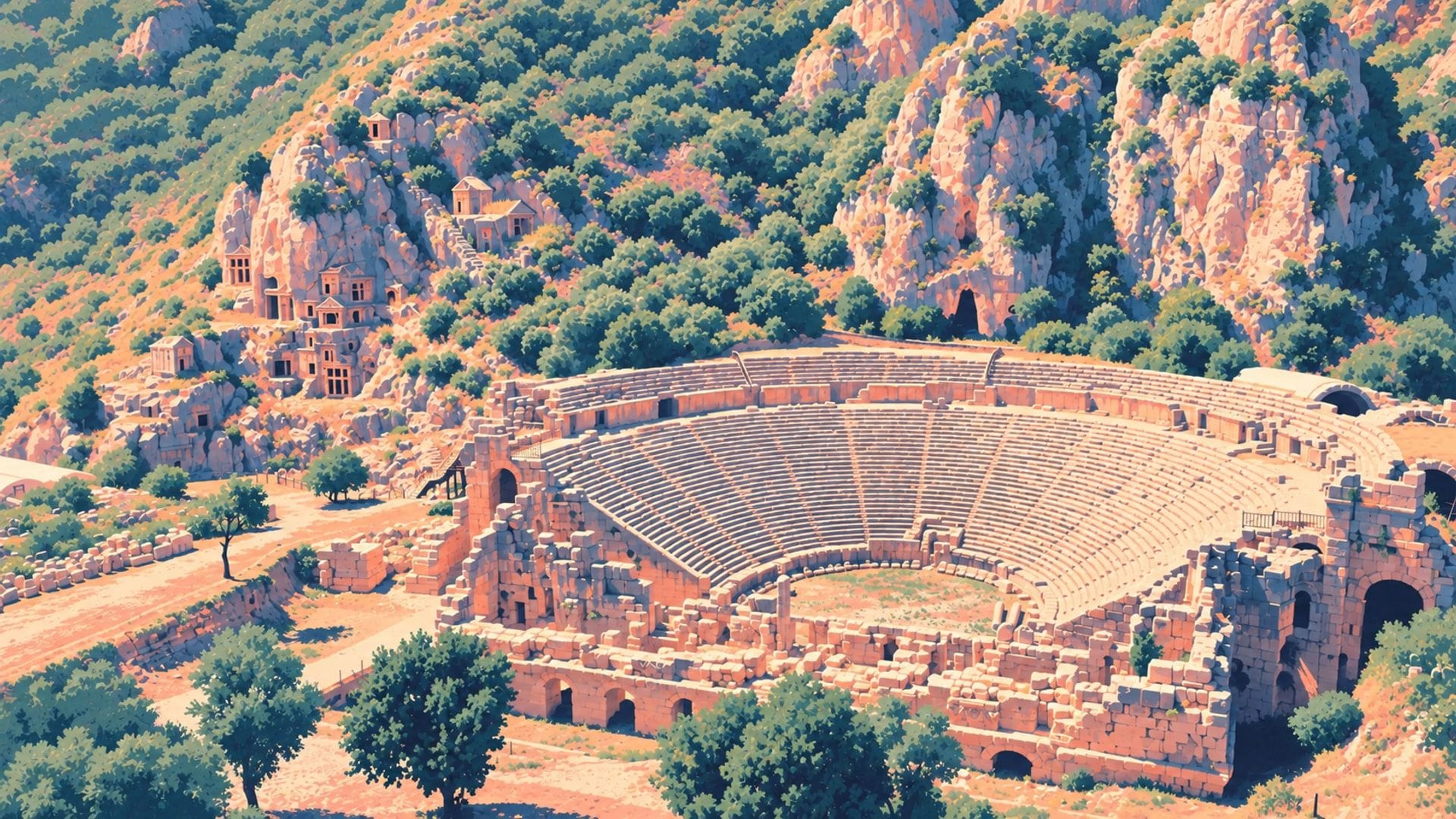
The site is dominated by two extraordinary features: dramatically carved rising from vertical cliff faces, and a remarkably preserved Roman theatre that once seated over 10,000 spectators. Together, they create one of the most visually striking archaeological landscapes in Turkey.
Myra is also deeply connected to early Christian history — this is where Saint Nicholas served as bishop in the 4th century, the man whose legacy eventually evolved into the global figure of Santa Claus.
Most visitors rush through Myra in 45 minutes. Don't. Come in the early morning when the cliff face catches the first golden light — the tombs seem to glow from within. Walk past the theatre to the east side where fewer tourists go, and you'll find relief carvings you can actually study up close.
Highlights of Myra
2,500 Years of Civilization
Practical Information
Tips for Your Visit
Explore Myra Further
What's Nearby
Frequently Asked
Absolutely. Myra offers one of the most visually dramatic archaeological experiences in Turkey. The combination of cliff-face rock tombs and a large Roman theatre in such a compact site is unique in Lycia. Combined with the nearby St. Nicholas Church and Kekova boat tour, it makes for an outstanding cultural day.
Most visitors spend 1.5 to 2 hours. If you're interested in photography or want to explore the eastern necropolis thoroughly, allow 3 hours. The site is compact but there's a lot of detail to absorb.
Yes — this is the most popular combination. Visit Myra and St. Nicholas Church in the morning (2–3 hours), then take an afternoon boat tour to Kekova from Çayağzı harbour (4–5 hours). Start early to fit everything in comfortably.
In Demre alone a pass covers Myra (€13), St. Nicholas Church (€17) and Andriake (€4) — €34 of entrance fees. The MuseumPass Türkiye E-Card costs €165, so it pays off when Demre is one stop on a wider Turkey itinerary rather than your only destination. If you are staying on the south coast, The Mediterranean E-Card (€90) is the better-value option.
The main viewing area near the theatre is partially accessible on relatively flat ground. However, the upper theatre rows and the paths closer to the rock tombs involve uneven terrain and steps. Strollers face similar challenges.
Saint Nicholas, the historical figure behind Santa Claus, served as Bishop of Myra in the 4th century CE. His church is located in modern Demre, a 10-minute walk from the ancient city. His generosity and miracles became the foundation for the Santa Claus tradition centuries later.