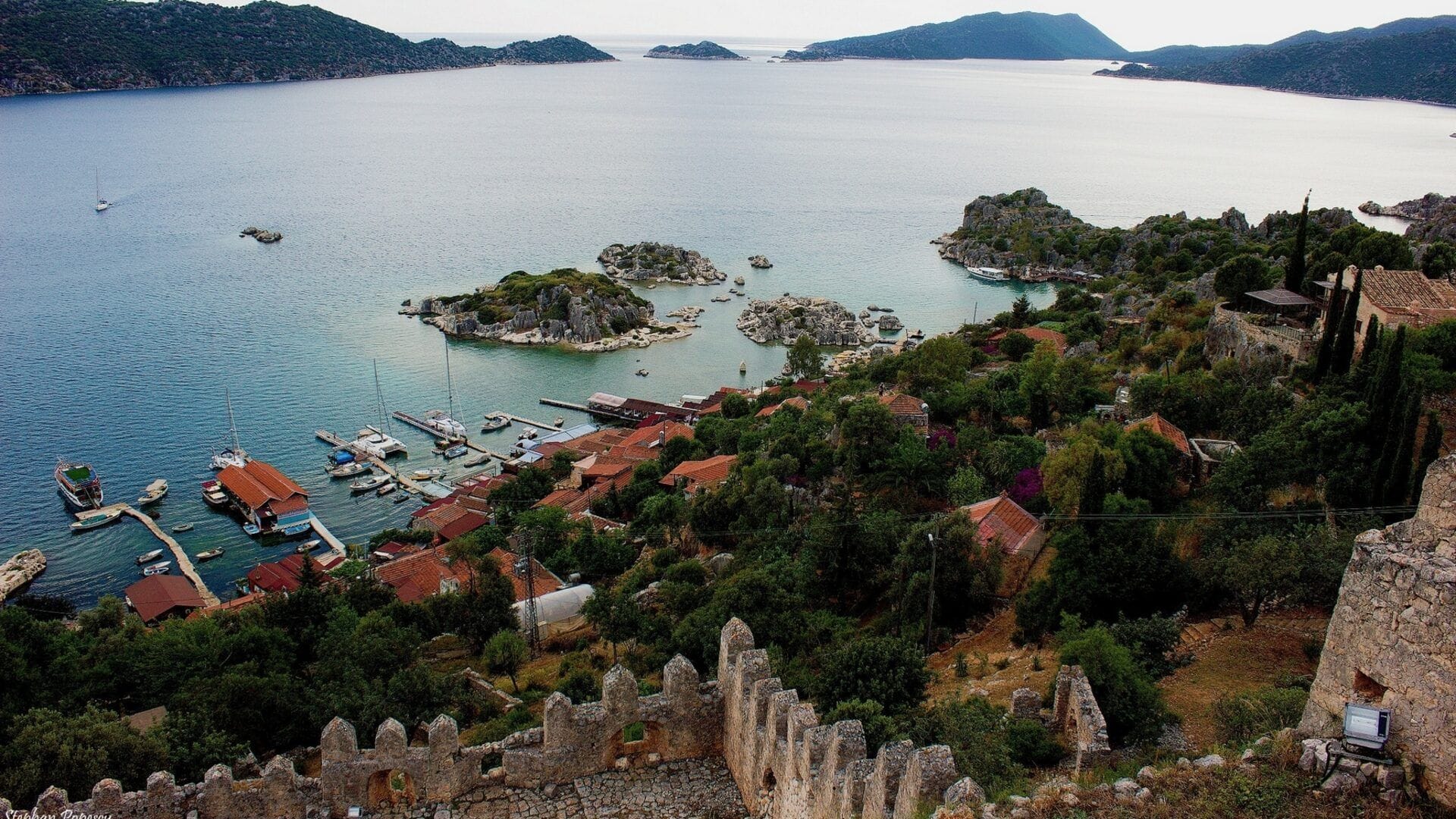
The Kekova you see in photographs — crowded gulets anchored in a line, swimmers jumping off the back of boats, the harbour at Üçağız full of day-trippers — that is July. It is real, and it is beautiful in its own noisy way. But there is another Kekova. It exists for about six weeks every spring, from roughly the second week of April to the end of May, when the water is already warm enough to put your hand in but the tour operators haven’t yet cranked the engine on the season. This is the Kekova I grew up with, and it is a different place entirely.
The Sound of Nothing
The first thing you notice in pre-season Kekova is the quiet. In summer, the bay hums with diesel engines from ten in the morning until five in the afternoon — thirty or forty boats on the same circuit, each one trailing a wake that muddies the water over the sunken city for the next boat behind it. In April, you can sit on the harbour wall at Üçağız (ooch-ah-uhz) and hear the water slap against the stone quay. You can hear a fisherman cough on his boat two hundred metres away. You can hear the call to prayer from the village mosque arrive and fade without competition.
The water is the real revelation. Without boat wakes stirring the sediment, the surface over the sunken city becomes something close to glass. On a still morning — no wind, no boats, the sun at a low angle — you can see the submerged stairways, the harbour wall foundations, the outlines of rooms that were above water two thousand years ago. The visibility is incomparable. Bring polarised sunglasses and you are looking at an archaeological site through a window, not through a washing machine.
Üçağız Waking Up
Üçağız in April is a village preparing for something. Walk along the waterfront and you will see boat captains sanding and repainting their hulls in the strip of land between the harbour and the road. The paint fumes mix with the smell of salt and pine. Fishing nets are spread across the quay for mending — the nylon filaments glinting in the morning sun, a man crouched over them with a plastic shuttle, fixing tears from the winter season.
The restaurants are half-open, half-closed. Some have set out their waterfront tables and are serving to the handful of visitors who’ve come early. Others have their chairs still stacked and their kitchens dark. The ones that are open tend to have better food than in high season — fewer customers means the cook is making fish for ten, not a hundred, and the difference is in every bite.
The Lycian sarcophagi along the eastern shore look different in spring light. In summer they are framed by sunburnt tourists eating ice cream. In April they stand alone against the bay, casting long shadows across empty restaurant terraces, doing what they have done for twenty-three centuries: being quietly monumental while nobody pays attention.
Every April I try to drive down to Üçağız on a weekday afternoon. I tell myself it’s to check on the season, see if anything’s changed. Really, I just want to sit at one of the three restaurants that’s open, order a cup of tea, and look at the bay before it fills up. Last year I sat there for two hours. The waiter brought me three refills without being asked. A cat slept on the table next to mine. A man I’d never met repaired a fishing net ten metres away and we didn’t exchange a single word. It was the best afternoon I had all year. By June, that same table will have a reservation sign on it, and the tea will cost twice as much.
Simena Without the Queue
In peak season, the path from Üçağız to Kaleköy takes thirty minutes and you will share it with dozens of other walkers. The castle at the top has a queue to enter. The tiny ancient theatre — the smallest in Lycia, five rows of seats carved into the rock — has someone sitting on every tier.
In April, you walk the path alone. The wildflowers are at their peak along the Lycian Way markers — red poppies, yellow broom, purple thistle carpeting the hillside between the sarcophagi that line the route. The castle is open (it never closes, technically — there’s no gate and no ticket), and you will likely have the view from the top to yourself: the bay, the island, the sunken city, the Taurus Mountains behind Demre still carrying a dusting of snow on their highest ridges.
The guesthouses in Kaleköy are open but half-empty. If you’ve ever wanted to sleep in a car-free village on a hilltop above a sunken ancient city with nobody else around — late April is your window. By May, it narrows. By June, it’s gone.
The Trade-Offs
I should be honest about what you lose by coming early. The water in April is swimmable but cool — around 18–19°C, comfortable for a quick dip rather than a long afternoon of swimming. By May it warms into the low twenties, and by June it is properly warm. If swimming is the priority, come later.
The boat tour situation is uneven. Some operators start daily departures in mid-April, others not until May. In the early weeks, you may need to arrange a private boat rather than joining a group tour — which costs more but gives you the bay to yourself. Call the Üçağız harbour directly or ask your accommodation in Demre to arrange it. Don’t rely on finding a tour by showing up at the dock.
Some of the Üçağız restaurants and all of the Kaleköy guesthouses may be closed or operating on reduced schedules. Facilities are basic: the village ATM may not be restocked regularly, mobile signal is patchy, and the nearest well-stocked shops are back in Demre. Bring cash, bring patience, and bring low expectations for infrastructure. What you get in return is the bay.
When Exactly
The sweet spot shifts slightly every year, but the pattern holds:
Second week of April through end of May is the window. Earlier than that and the weather is unpredictable — March can bring rain and cold wind that makes the mountain road to Üçağız unpleasant and the bay rough. Later than May and you’re into the early season proper: boats running daily, restaurants at full capacity, the quiet beginning to compress.
Within that window, weekdays are dramatically quieter than weekends. Turkish domestic visitors from Antalya and Kaş make weekend trips to Üçağız from April onward, so a Tuesday or Wednesday gives you the emptiest version of the coast.
For the fullest picture of what to expect month by month — temperatures, sea conditions, crowd levels — see our Demre weather guide. For planning your days around the sites, our itineraries include seasonal adjustments that shift timing around the heat and the crowds.
