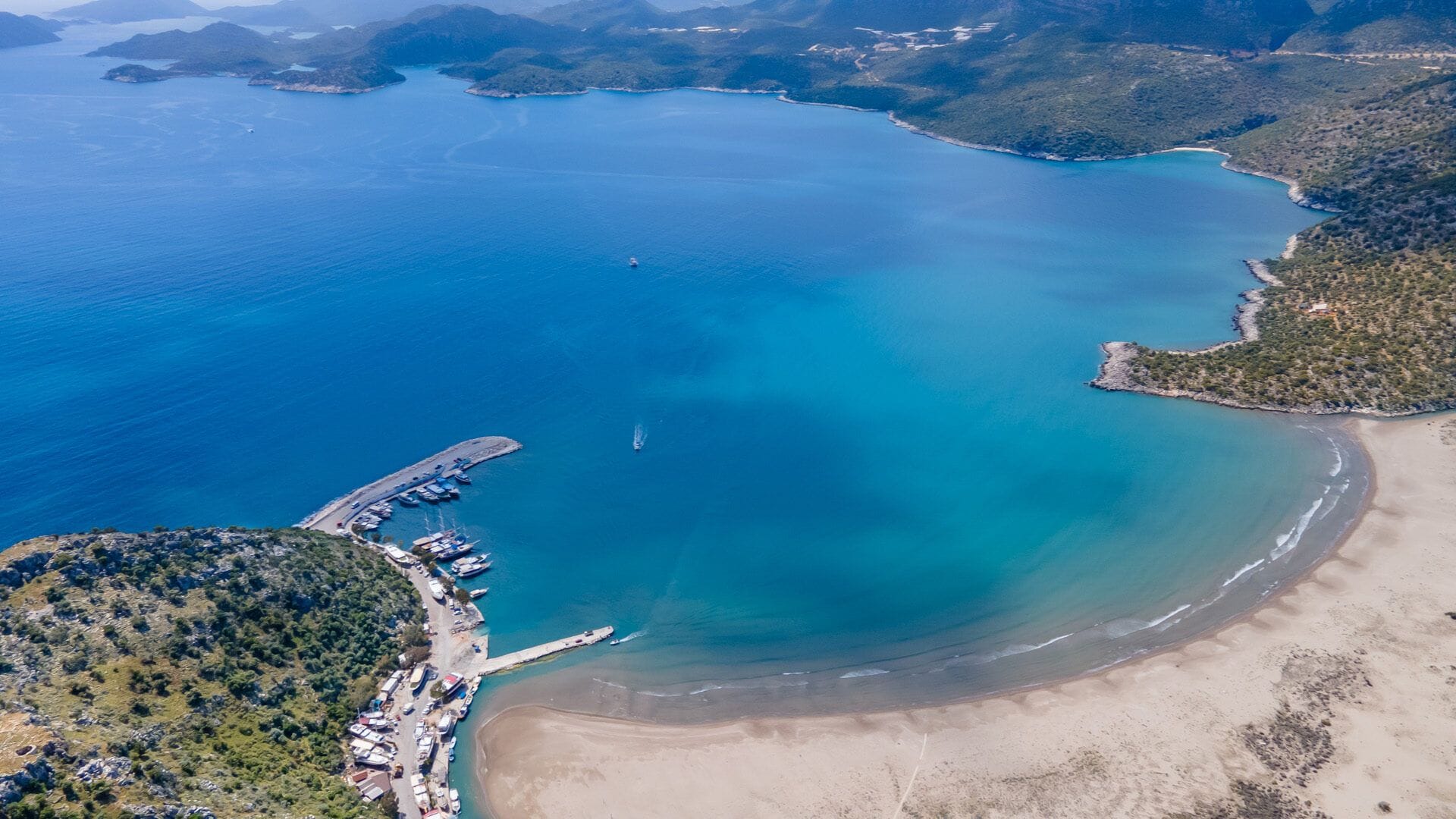
Not Just a Beach — Three Worlds in One Bay
Çayağzı Beach is not a resort beach. There are no sun lounger rows, no beach clubs, no DJ sets. What there is: a kilometre of coarse golden sand where Caretta caretta sea turtles crawl ashore to lay their eggs every summer, a river estuary fringed with reeds that hosts 149 documented bird species, and a working harbour where colourful gulets depart for Kekova's sunken city. Behind it all, the ruins of Andriake — Myra's 2,500-year-old harbour — rise from the plain. This is a coastline that works on three levels simultaneously, and understanding those layers is what makes a visit here extraordinary.
The bay divides naturally into three distinct zones, each with its own character. The eastern harbour is a living Mediterranean port — fishing boats, tour gulets, waterfront fish restaurants, the smell of grilled levrek mixing with diesel and salt air. The central and western beach is the swimming and nesting zone — shallow, calm, sandy, family-friendly, and almost entirely without infrastructure. And the wetland behind the beach, where the Demre River meets the sea, is a birding paradise that draws ornithologists from across Europe.
Most visitors to Demre come for Myra's rock tombs and never make it down here. That's their loss — and, honestly, it's what keeps Çayağzı the way it is.
I grew up swimming at Çayağzı long before anyone thought of it as a destination. What I love about this place is that it hasn't been polished into something generic. The harbour still smells like fish and engine oil, the beach still has more turtle tracks than footprints in the early morning, and the wetland behind it is so alive with birdsong at dawn that you'd never guess you're ten minutes from a town centre. If you come expecting Kalkan or Ölüdeniz, you'll be disappointed. If you come expecting a real, layered, unfiltered piece of Mediterranean coast — you'll understand why locals like me choose this over the resort beaches every time.
The Three Zones of Çayağzı
The Harbour (East)
The eastern end of the bay is where Çayağzı has its pulse. This is a working harbour — small fishing boats moored alongside larger tour gulets, fishermen sorting nets on the quay, the occasional village dog sleeping in the shade of an overturned hull. It's the departure point for Kekova boat tours, and on summer mornings the waterfront comes alive with captains calling out routes and prices.
Two or three seasonal restaurants line the harbour, serving what the boats bring in: grilled sea bream (çipura), sea bass (levrek), octopus salad, and cold meze. Don't expect menus in five languages — this is a fisherman's harbour that happens to serve tourists, not the other way around. The food is simple, fresh, and reasonably priced by coastal Turkish standards.
The harbour also has practical value for visitors. You can arrange boat charters here, buy ice for your cooler, fill water bottles at the tap, and get basic directions from the restaurant owners who know every cove between here and Kaş. If you're planning a Kekova boat tour, arriving early (before 09:30) gives you the best pick of boats and prices.
The Beach (Centre – West)
West of the harbour, the sand begins. Çayağzı Beach stretches for roughly one kilometre — coarse golden sand, not powder-fine, but comfortable enough. The water is clear, shallow for the first 15–20 metres, and usually calm. Entry is gentle and gradual — no sudden drop-offs — which makes it suitable for children and non-swimmers.
Facilities are minimal by design and by circumstance. Near the harbour end, a couple of seasonal operators rent sun loungers and umbrellas. Beyond that: nothing. No showers, no changing rooms, no beach bars, no vendors walking the sand. This is a feature, not a bug — it's what keeps the beach uncrowded even in August, when every resort beach on the Turkish Riviera is shoulder-to-shoulder.
There is no shade on the open beach, no fresh water source, and no food vendors. Bring: umbrella or pop-up shelter, drinking water (at least 2 litres per person), snacks, sunscreen, and a bag for your rubbish. The nearest market is in Demre centre, 5 km away — stock up before you come.
Swimming conditions: The water is generally calm and safe, but watch for currents near the river mouth at the eastern end, especially after heavy rain when the Demre River flow increases. The western end is almost always tranquil. There are no lifeguards — swim at your own discretion. Water temperature ranges from about 18°C in May to 28°C in August, dropping back to 20°C by late October.
The Wetland (Behind the Beach)
Behind the beach, the landscape changes entirely. The Demre River slows into a broad estuary, spreading through reed beds, salt marshes, and shallow lagoons before meeting the sea. This is the Andriake wetland — informally known as Demre Kuş Cenneti (Demre Bird Paradise) — and it hosts 149 documented bird species, making it one of the richest birding sites on the Lycian coast.
The wetland is not fenced or ticketed — you simply walk from the beach into a different ecosystem. Several observation hides, built as part of a conservation initiative, are positioned along the wetland edge. From these wooden platforms you can watch herons stalking through the shallows, kingfishers diving from reed stalks, stilts wading in formation, and — if you're patient and quiet — raptors circling above. During spring and autumn migration (April–May and September–October), the variety peaks: species passing between Africa and Europe use this estuary as a resting point.
Caretta Caretta: Sea Turtle Nesting at Çayağzı
Çayağzı is one of a limited number of Caretta caretta (loggerhead sea turtle) nesting beaches on Turkey's Mediterranean coast. Every year between May and September, adult females — weighing up to 135 kg — haul themselves ashore under cover of darkness to dig nests in the sand and deposit their eggs.
The nesting process is methodical and ancient: each female digs a flask-shaped chamber roughly 50 cm deep, deposits 70–100 ping-pong-ball-sized eggs, covers the nest, disguises it with sand, and returns to the sea. The entire process takes one to two hours. A single female may nest two to four times per season, returning to the same beach — often to within metres of where she was born.
After 40–60 days of incubation, hatchlings emerge — usually at night, guided by the natural light of the horizon over the sea. This is why artificial lighting on nesting beaches is so destructive: it disorients the tiny turtles, sending them inland instead of toward the water. At Çayağzı, nesting zones are marked with wooden stakes during breeding season, and basic conservation rules are enforced.
Do not walk through, dig in, or place items on marked nesting zones. Do not use flashlights, phone screens, or any artificial light on the beach after dark during nesting season (May–September). Do not approach, touch, or photograph nesting turtles with flash. Do keep the beach clean — plastic waste is lethal to sea turtles. Do stick to the wet sand near the waterline if walking the beach at night. If you witness a nesting turtle or hatchling emergence, watch quietly from a distance — it's a once-in-a-lifetime experience that deserves respect.
Best time to see turtles: Nesting adults are most active between late May and mid-July, coming ashore between roughly 22:00 and 04:00. Hatchling emergence peaks in June and July. If you're camping at Andriake, you have the best chance of witnessing either event — but it requires patience, silence, and darkness. Not every night produces a sighting. The magic is in the possibility.
Birdwatching at the Andriake Wetlands
The 149-species count at the Andriake wetlands is an official figure, recorded through systematic ornithological surveys of the Demre River estuary and surrounding habitats. The number is impressive for a relatively compact site — and it continues to grow as new migrant species are documented during seasonal counts.
The wetland's richness comes from its position and structure. Sitting at the junction of a river, a coastal lagoon, salt marshes, and open Mediterranean sea, it offers multiple microhabitats within a small area. Reed beds shelter warblers and herons. Mudflats attract waders and stilts. The open water draws diving birds and cormorants. And the surrounding scrubland and agricultural fields provide hunting grounds for raptors and shrikes.
What You Might See
Year-round residents include grey herons, little egrets, kingfishers, moorhens, coots, and several species of cormorant. Spring migrants (April–May) bring bee-eaters, rollers, hoopoes, and various warblers. Autumn passage (September–October) is the best time for raptors, including short-toed snake eagles, Eleonora's falcons, and ospreys. Winter visitors include flamingos (in good years), various duck species, and the occasional Dalmatian pelican.
Best time of day: Dawn and the hour before sunset. Best seasons: April–May (spring migration) and September–October (autumn passage). Bring: Binoculars (at minimum 8×42), a field guide to Mediterranean birds, patience, and mosquito repellent. Observation hides: Two wooden hides are positioned along the wetland edge — accessible on foot from the beach road. Photography: A 200mm+ telephoto lens is essential for bird shots; a wide-angle captures the wetland landscape beautifully against the Kekova Island backdrop at sunset. See the Andriake Photography Guide for detailed spot recommendations.
For serious birders, the Andriake wetlands can easily fill a full morning. Combine it with an afternoon at the Lycian Civilizations Museum and a sunset swim on the beach, and you have one of the most satisfying nature-and-culture days on the entire Lycian coast.
Burguç Su: The Sulphur Spring
On the road from Demre to Çayağzı, about 3.5 kilometres from the town centre, look for a cluster of parked cars and people gathered around a roadside source. This is Burguç Su — a natural mineral spring that emerges from the limestone at a constant 16.5°C, carrying a distinctive sulphur scent that hits you before you see the water.
The spring contains sodium chloride and magnesium — a mineral profile that locals have valued for skin-soothing properties since antiquity. The Lycians almost certainly knew this spring; archaeological evidence suggests settlement along this road corridor dating back to the 5th century BCE. Today, locals fill bottles, splash the cold water on their skin in the summer heat, and generally treat it as a neighbourhood institution.
The sulphur smell (think boiled eggs) is strong but harmless. The water is icy, clear, and refreshing on a hot day. There's no charge, no formal infrastructure, and no signage — just a natural spring where it's always been. Stop on your way to the beach, fill a bottle, and don't mind the smell. Your skin will thank you later.
Practical Information
Getting There
By car: From Demre centre, follow signs to Çayağzı or Andriake. The road is straightforward — a single 5 km route south through the alluvial plain. You'll pass the sulphur spring (Burguç Su) on the way. Free parking is available at the harbour and along the road behind the beach. The harbour parking area gets full on busy summer days — arrive before 10:00 or park further west along the beach road.
By dolmuş: Limited minibus (dolmuş) service runs between Demre centre and Çayağzı, but schedules are irregular and seasonal. Don't rely on it for return trips — driving, cycling, or taxi is more dependable.
By bicycle: A flat, easy 5 km ride from Demre. The road has minimal traffic outside peak season. Andriake Camping rents bicycles if you're staying there. If cycling from Demre, the route is the same as the car road — mostly flat with one gentle rise.
By boat: If you're coming from a Kekova boat tour, the tour will drop you at Çayağzı harbour. Some visitors arrange the tour as a one-way journey — taking a boat from Üçağız or Kalkan and disembarking at Çayağzı to explore Andriake.
Facilities & Services
Expect the minimum. Near the harbour: a couple of seasonal fish restaurants, basic toilet facilities, and occasional lounger rental. On the main beach: nothing. No showers, no changing rooms, no lifeguards, no Wi-Fi, no vendors. The nearest shops, ATM, pharmacy, and supermarket are in Demre centre (5 km). Andriake Camping, located between the harbour and the beach, has a restaurant (Nomadic Kitchen) and basic facilities accessible to non-guests for a small fee.
When to Visit
April – June: The sweet spot. Warm enough to swim (water 20–25°C), wildflowers in the wetland, spring bird migration at its peak, turtle nesting beginning in late May, and far fewer visitors than midsummer. My personal favourite months.
July – August: Peak summer. Hottest (air up to 40°C, water 26–28°C), most crowded (by Çayağzı standards — still quieter than most Turkish beaches), best for hatchling sightings, worst for mosquitoes near the wetland. Bring serious sun protection and plenty of water.
September – October: Excellent. Swimming is still comfortable, autumn bird migration arrives, tourist numbers drop, and the light turns golden. Late turtles may still be nesting in early September.
November – March: Off-season. The beach is empty, the wetland is at its lushest (winter rains fill the lagoons), winter bird visitors arrive, and the harbour restaurants are mostly closed. Beautiful for solitary walks but not for swimming (water 16–18°C). The museum and archaeological site remain open year-round.
If I had to pick one month for Çayağzı, it would be May. The water is warm enough, the beach is nearly empty, the wildflowers along the wetland edge are extraordinary, the first turtles are arriving, and the evening light over Kekova Island from the beach is the most beautiful thing I know in Demre. Come early, bring a picnic, swim, walk the wetland, watch the fishermen come in, and stay for sunset. That's my perfect day — and it has been since I was twelve.
Safety & Environmental Notes
Swimming safety: No lifeguards. The beach is generally safe — shallow, gradual entry, usually calm sea. Avoid swimming near the river mouth (eastern end) where currents can be strong after rain. Keep children supervised. Jellyfish are rare but possible in late summer.
Sun exposure: There is no natural shade on the beach. From June to September, unprotected exposure can be dangerous. Bring umbrella, hat, sunscreen (SPF 50+), and water. Heat exhaustion is a real risk, especially for children and elderly visitors.
Mosquitoes: The wetland means mosquitoes, particularly from June to September and especially at sunset. Bring repellent. If you're camping, a tent with good mesh is essential. The trade-off — the same ecosystem that breeds mosquitoes is what makes the birdwatching exceptional.
Leave no trace: Çayağzı has no regular beach cleaning service. Everything you bring, take back with you. Plastic on this beach doesn't just look ugly — it kills the turtles that nest here. If you see litter, consider picking some up. The turtles and the birds can't do it themselves.
What Else Is Nearby
Part of Çayağzı's appeal is its position. Within a short drive or walk, you can layer a beach day with some of Demre's most important sites.
Lycian Civilizations Museum — A 10-minute walk from the harbour. Hadrian's Granary restored into a world-class museum with 1,476 artefacts across eight halls. Consider visiting the museum first (for historical context) and then coming to the beach to swim — you'll see the coastline differently after understanding Andriake's role as Myra's great port.
Andriake Camping — Between the harbour and the beach. If a day visit isn't enough, the campsite lets you experience Çayağzı at dawn and dusk — the hours when the wildlife is most active and the light is most beautiful.
Myra Ancient City — 5 km north via Demre. Andriake was Myra's port — the two were a single urban system. A morning at the rock tombs and Roman theatre, followed by an afternoon swimming at Çayağzı, is one of Demre's best half-day combinations.
Other Demre Beaches — If you want to compare, Demre has other coastal spots. But Çayağzı is the only one that combines swimming with sea turtles, birds, ancient ruins, and a working harbour in a single bay.