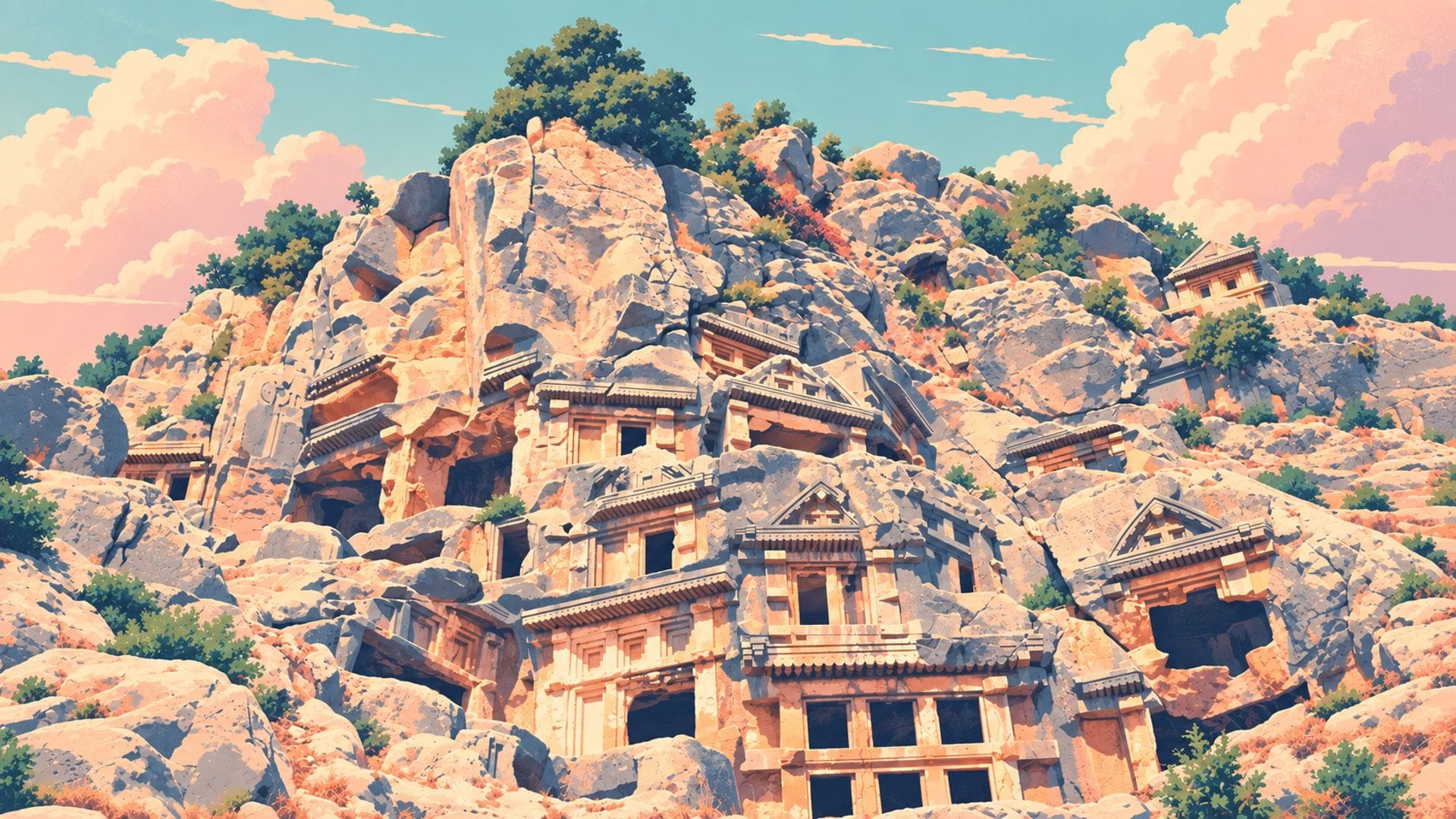
Why Myra's Tombs Are Unique
Most ancient civilizations buried their dead underground. The Lycians did the opposite — they carved elaborate tombs high into vertical cliff faces, believing that winged creatures would carry the souls of the deceased to the afterlife. The higher the tomb, the closer to the gods.
Myra contains two major necropolises that together represent one of the finest surviving collections of Lycian rock-cut tombs in Turkey. Unlike the scattered cliff graves found at other Lycian sites like Fethiye or Dalyan, Myra's tombs are concentrated into dramatic vertical galleries that dominate the landscape — a wall of carved stone façades stacked above the Roman theatre, visible from across the modern town of Demre.
What makes these tombs exceptional isn't just their scale. Many feature highly detailed relief carvings depicting funeral feasts, family scenes, battle moments, and mythological figures. Some replicate the wooden architecture of Lycian houses in stone, offering archaeologists a rare window into what ordinary Lycian buildings looked like — structures that otherwise rotted away millennia ago.
The Two Necropolises
Myra's tombs are organized into two distinct necropolises, each with its own character and best viewing angles. Understanding this distinction helps you plan which areas to prioritize during your visit.
The River Necropolis (West)
The river necropolis is the one you see first when entering the archaeological site — it rises directly above and behind the Roman theatre. This is Myra's most photographed view: the semicircular theatre in the foreground, with dozens of tomb façades carved into the golden limestone cliff behind it.
This necropolis contains the highest concentration of tombs, arranged in multiple tiers. The lower tombs are the most elaborate, likely belonging to Myra's wealthiest citizens. Several feature temple-style façades with columns, pediments, and carved doorways that mimic wooden architecture.
The best view of the river necropolis is from the top rows of the theatre, looking back toward the cliff. In the early morning (before 10:00), the sun hits the cliff face directly and the honey-coloured limestone seems to glow. By afternoon, the cliff is in shadow and the detail vanishes in photographs.
The Sea Necropolis (East)
The sea necropolis — sometimes called the ocean necropolis — is located on the eastern side of the acropolis hill, separate from the main theatre area. It's less visited because the path requires a short climb away from the main route, but it rewards the effort.
Here you'll find the famous Lion Tomb (also called the Painted Tomb), which is arguably the single most important tomb at Myra. Its interior features 11 life-sized painted figures in a funeral banquet scene — one of the finest surviving examples of Lycian funerary painting. The exterior once displayed a pair of lions, from which the tomb takes its name.
Understanding the Tomb Types
Not all Lycian rock-cut tombs are the same. Archaeologists classify them into several distinct types, and Myra has examples of nearly all of them. Knowing what to look for transforms a "wall of holes in the rock" into a readable story about Lycian society.
The temple tombs are the most visually dramatic — they feature Ionic columns flanking a carved doorway, topped by a pediment that often bears relief sculptures. These were reserved for Myra's elite. The house tombs, meanwhile, are perhaps more historically valuable: their wooden-beam details, carved in stone, preserve architectural forms that no longer exist anywhere else.
The plain or "pigeon-hole" tombs are the simplest — small rectangular chambers without decoration, likely used by less wealthy citizens. They're concentrated in the upper tiers of the cliff, where they're hardest to reach and were presumably cheaper to commission.
The Lion Tomb (Painted Tomb)
The Lion Tomb deserves special attention because it's the most artistically significant tomb at Myra — and one of the most important in all of Lycia. Located in the sea necropolis, it dates to approximately the 4th century BCE.
The interior paintings depict a funeral feast with 11 figures — men and women reclining, servants attending, and offerings being made. The colours, though faded, still show traces of red, blue, and ochre.
Based on descriptions from Fellows (1840) and subsequent archaeological surveysThe tomb takes its name from the lion reliefs originally carved on its exterior — a common symbol of power and guardianship in Lycian funerary art. While the lions are now heavily weathered, the interior paintings remain partially visible and represent the finest surviving example of Lycian polychrome tomb decoration.
The tomb area is currently roped off and you cannot enter the chambers. The best views of the Lion Tomb reliefs are from the left side of the theatre, using a telephoto lens or binoculars. Hopefully future restoration will improve visitor access.
Burial Rituals and Lycian Beliefs
The rock tombs are more than architecture — they're a window into how the Lycians understood death. Unlike the Greeks, who generally cremated their dead, or the Egyptians, who focused on preserving the body underground, the Lycians elevated their dead — literally. They believed that winged creatures, sometimes described as bird-like sirens, would carry the souls of the deceased upward to the afterlife. The higher the tomb, the shorter the journey.
This belief explains the striking vertical arrangement of Myra's necropolises: the most prestigious tombs occupy the highest, most inaccessible positions on the cliff face, while simpler chambers sit lower down. Height was a direct marker of social status. A wealthy Lycian family commissioning a high cliff tomb wasn't just honouring their dead — they were making a permanent, visible statement of rank that the entire city could see.
The relief carvings on temple tombs frequently depict funeral banquet scenes: the deceased reclines on a couch, attended by servants and surrounded by family members bearing offerings. These scenes suggest that the Lycians practised ritual feasting at tomb sites — a tradition echoed in the 11 painted figures inside the Lion Tomb. Grave goods found in excavated tombs include pottery, jewellery, bronze mirrors, and small terracotta figurines, indicating that the dead were provisioned for an afterlife of continued comfort.
For the broader historical context of Lycian civilization and Myra's role in the Lycian League, see our Myra History deep-dive →
How Were the Tombs Built?
One of the most common questions visitors ask — and one I asked myself growing up beneath these cliffs — is: how did the Lycians actually carve these tombs into sheer rock faces, hundreds of metres above the ground, 2,400 years ago?
The answer lies in the technique and the material. The Lycians worked from the top down: masons were likely lowered on wooden scaffolding or platforms anchored into the cliff face with rope and timber. They carved the tomb entrance first, then excavated the interior chamber downward, removing stone as they went. This top-down approach meant gravity assisted the work — rubble fell naturally, and the masons could shape columns, pediments, and relief details in situ before moving to the next level.
The local limestone was the key enabler. The golden-coloured rock at Myra is relatively soft when freshly exposed — soft enough to carve with iron chisels and hammers — but it hardens significantly after prolonged exposure to air and weather, a process geologists call case-hardening. This gave the Lycians a workable medium during carving that became durable over time, which is why the tombs have survived 2,400 years of earthquakes, weathering, and neglect.
Tool marks are still visible inside many of the chambers: parallel chisel grooves on walls and ceilings that were never smoothed over, either because they were covered with plaster and paint (now lost) or because the interior finish was considered less important than the exterior façade. The house tombs show another fascinating detail — wooden beam-ends carved in stone, complete with simulated mortise joints and dowel holes. The masons were replicating timber architecture in permanent stone, preserving a record of Lycian wooden building techniques that otherwise vanished completely.
Lycian Inscriptions on the Tombs
Several tombs at Myra bear inscriptions in the Lycian language — a now-extinct Anatolian language written in a modified Greek alphabet. These inscriptions are among the most important surviving texts in Lycian, and they played a significant role in the decipherment of the language during the 19th and 20th centuries.
Most tomb inscriptions follow a formulaic pattern: they identify the tomb owner by name, state their father's name and sometimes their grandfather's, and declare who is permitted to be buried in the tomb — typically the owner and their immediate family. Some include penalty clauses threatening fines or divine punishment against anyone who violates the burial. These formulae, because they're repeated across dozens of tombs at different Lycian sites, gave linguists the critical data points needed to crack the grammar and vocabulary of the language.
The 2021 discovery by Professor Nevzat Çevik's team from Akdeniz University added substantially to the corpus. Dozens of terracotta sculptures with Lycian inscriptions were found near the theatre — not tomb inscriptions in this case, but votive texts that expand our understanding of Lycian religious practices at Myra. These are now displayed at the Lycian Civilizations Museum at Andriake.
Discovery, Archaeology & Conservation
For most of history, Myra's tombs were known only to the local population. The first Western documentation came from Charles Fellows in 1840, whose published drawings of the cliff-face tombs caused a sensation in Victorian London. His sketches are now invaluable archaeological records — they capture painted decorations on the tomb façades that have since completely vanished due to weathering. If you compare Fellows' 1840 illustrations to photographs from today, the loss of surface detail over just 180 years is striking.
Systematic Turkish-led excavation has been ongoing since the 1960s, primarily under Akdeniz University's archaeology department. The most intensive recent campaigns, led by Professor Nevzat Çevik, have focused on the theatre area and surroundings. The 2021 terracotta mask discovery demonstrated that significant finds can still emerge from soil that has been walked over for centuries.
Weathering and Threats
The tombs face several ongoing conservation challenges. Natural weathering — rain, wind, temperature fluctuations, and biological growth (lichens, mosses, root intrusion) — continues to erode surface detail. The painted decorations that Fellows documented in the 1840s are now almost entirely invisible. Relief carvings that were sharp and detailed a century ago are noticeably softer and less defined in current photographs.
Human factors compound the problem. Air pollution from greenhouse agriculture in the Demre valley, vibration from traffic on the nearby road, and decades of unregulated climbing on the tombs before modern restrictions all contributed to accelerated degradation. The current roping-off of the tomb area, while frustrating for visitors, is an essential preservation measure.
When I was a kid in the 1990s, there were no barriers — we used to scramble up to the lower tombs and peer inside the chambers. I remember fragments of faded paint on some of the interior walls that I haven't been able to spot from ground level since. The conservation restrictions are necessary, but part of me wishes everyone could have experienced them up close the way I did. Bring binoculars — they're the next best thing.
Excavation and conservation work at Myra is ongoing. New findings are published annually by the Akdeniz University team. The information in this article reflects the state of knowledge as of early 2026 — visit the Lycian Civilizations Museum at Andriake for the very latest discoveries and artefacts from the site.
Tips for Viewing the Tombs
Getting the most out of Myra's tombs requires a bit of planning. The tombs are roped off — you can't walk up to them or enter them — so viewing distance and light conditions matter enormously.
For the classic shot of tombs + theatre together: stand at the top of the theatre, wide-angle lens, morning light (8:30–10:00). For tomb detail close-ups: a 70–200mm telephoto from the theatre base. For the Lion Tomb: walk to the left side of the theatre and aim your telephoto toward the sea necropolis cliff face.
Most visitors only see the river necropolis (the one directly above the theatre) and miss the sea necropolis entirely. If you have time, walk the path east past the theatre to reach the second group of tombs — it's quieter, less crowded, and home to the Lion Tomb.
Allow at least 30–45 minutes just for the tombs, on top of your theatre visit. Bring binoculars if you have them — the upper-tier relief carvings are visible but too high to appreciate with the naked eye. For a comprehensive breakdown of the best angles, lens choices, and golden-hour timing, see our dedicated Myra photography guide.
How Do Myra's Tombs Compare?
Lycian rock-cut tombs exist at many sites along Turkey's Mediterranean coast — Fethiye (Amintas), Dalyan (Kaunos), Pinara, and others. In terms of artistic quality, sheer concentration, and the dramatic combination with the Roman theatre, Myra arguably offers the most complete rock-tomb experience on the Lycian coast. For a detailed side-by-side breakdown of each site, see our Myra vs Xanthos vs Patara comparison guide.
