First Impressions
You hear it before you understand it — a strange acoustic intimacy in a space built for 10,000. Someone whispers at the orchestra level and you catch it clearly from the top row, 30 metres above. Myra's Roman theatre is not the best-preserved in Turkey, but it might be the most atmospherically powerful.
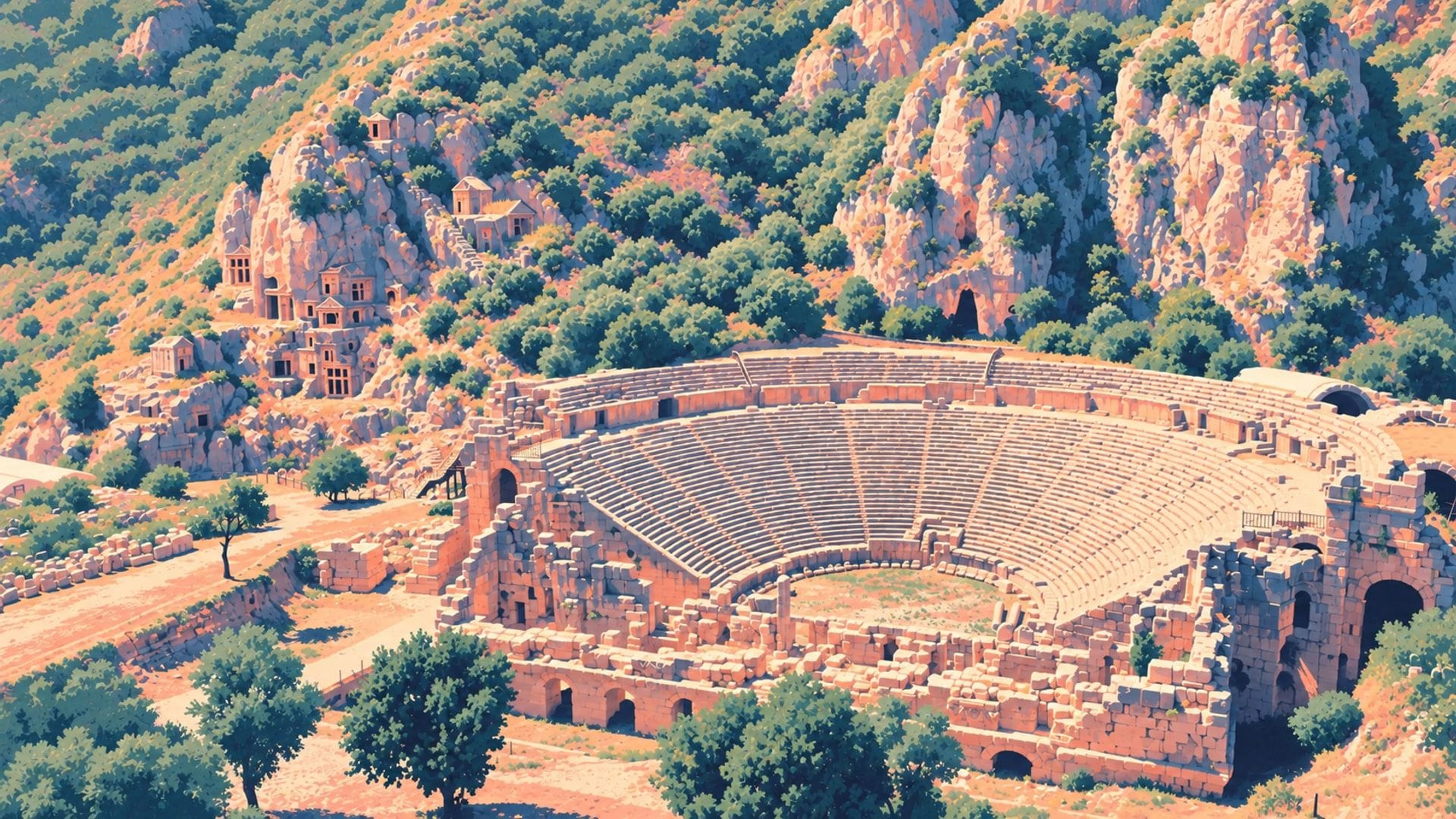
What makes this theatre unique is not just its size or its 2nd-century engineering — it's the setting. Where most Roman theatres face open countryside or urban landscapes, Myra's cavea looks directly onto a vertical cliff face covered in Lycian rock-cut tombs. The dead literally watched the performances. This collision of Roman entertainment culture and Lycian funerary tradition — two civilizations in one field of view — exists nowhere else in the ancient world.
The theatre is the first thing you encounter when entering the Myra archaeological site. It dominates the space: a massive semicircular bowl of pale limestone seating, backed by the crumbled remains of a once-ornate stage building, all of it framed by that extraordinary cliff of tombs behind and above.
Architecture and Dimensions
The theatre at Myra follows the standard Roman theatre plan — a semicircular auditorium (cavea) facing a rectangular stage building (scaenae frons) — but at a scale that puts it among the largest in the Lycian region. Its dimensions speak to Myra's importance as a provincial capital.
The cavea is divided into two main sections by a horizontal walkway called the diazoma. The lower tier (ima cavea) has 29 rows and was reserved for dignitaries, priests, and important citizens. The upper tier (summa cavea) adds 9 more rows and was for the general public. Vertical stairways (scalaria) divide the seating into wedge-shaped sections (cunei), allowing efficient crowd flow — an engineering solution that modern stadiums still use.
Parts of the Theatre
Understanding the theatre's anatomy helps you read what you're looking at. Here's a quick guide to the major structural elements, from bottom to top:
When I bring visitors to Myra, I always ask them to sit in the centre of the ima cavea (lower tier) first and close their eyes. Even with tourist chatter, the acoustics funnel sound toward you in a way that feels almost directional. Then climb to the top row for the view. That sequence — intimacy first, grandeur second — mirrors how the Romans designed the experience.
What Happened Here: Beyond Drama
It's tempting to think of Myra's theatre purely as a playhouse, but Roman theatres were multi-purpose civic venues — closer to a modern convention centre than a single-purpose auditorium. Dramatic performances were the headline act, but the theatre hosted a rotating programme of events that served the entire city.
Religious festivals were central. Performances typically opened with sacrifices and prayers to the gods — at Myra, to Artemis Eleuthera, whose image decorated the stage building. The theatre was also used for gladiatorial displays and animal hunts (venationes), particularly during imperial feast days. Political assemblies met here too: the Lycian League's federal gatherings and local civic votes were conducted in theatre settings where the acoustics allowed a speaker to address thousands. Imperial proclamations, honours for benefactors, and public trials all took place in these same seats.
The tradition of public spectacle at this site has a remarkably long afterlife. As recently as the 1990s, the theatre hosted open-air concerts — a practice that has since been discontinued for conservation reasons.
When I was a kid in the 1990s, the theatre still hosted public concerts — big names like Hülya Avşar and Müslüm Gürses played here, and my family would go along with half of Demre. I remember sitting on the same 2,000-year-old stone rows, eating sunflower seeds, watching a pop concert backed by Lycian tombs. It felt completely normal at the time. Looking back, I'm glad they stopped — thousands of people, vibration from amplified sound, foot traffic on ancient stone. The theatre needs protecting more than it needs an audience. But I won't pretend those evenings weren't magical.
The Theatrical Mask Reliefs
The most artistically significant feature of Myra's theatre is the collection of marble relief panels that once decorated the scaenae frons — the monumental stage wall. These panels depict theatrical masks: the exaggerated character faces used in Greek and Roman drama.
These are not generic comedy-and-tragedy symbols. Each mask represents a specific stock character from the dramatic tradition: the old man with his wrinkled brow and gaping mouth, the young hero with idealized features, the cunning slave with arched eyebrows, the braided-hair courtesan, the stern matriarch. Some panels show the masks arranged in groups, as if a cast of characters is being presented before the play begins.
Beyond the masks, several panels also depict Artemis Eleuthera, Myra's patron goddess. Her presence on the theatre's façade was not incidental — theatres in the Roman world were not just entertainment venues but civic-religious spaces. Performances began with sacrifices and prayers, and the theatre building itself was understood as a kind of temple.
Many of the original mask reliefs are now displayed at the Lycian Civilizations Museum at Andriake, about 5 km south. What remains at the theatre site are mostly fragments embedded in the rubble of the collapsed stage wall. The museum pieces are in dramatically better condition and worth the detour.
The 2021 Terracotta Discovery
The theatrical tradition at Myra received remarkable new evidence in 2021, when a team led by Professor Nevzat Çevik from Akdeniz University discovered dozens of 2,200-year-old terracotta theatre masks and votive sculptures near the theatre. These date to the Hellenistic period — centuries before the current Roman theatre was built — suggesting that a Hellenistic predecessor existed on this same hillside.
This is a significant finding. It means the site has been used for performances since at least the 3rd or 2nd century BCE — pushing the theatrical tradition at Myra back by several hundred years. The earlier structure was presumably smaller and built of less durable materials (timber and earth, perhaps), which would explain why no physical trace of it survived the Roman rebuilding. But the terracotta masks prove it existed: they are distinctly Hellenistic in style, with exaggerated comic and tragic features far more expressive than the formal Roman marble reliefs.
Many of the terracotta pieces bear Lycian inscriptions — votive texts that expand our understanding of Lycian religious practices associated with performance. They are now among the highlights of the Lycian Civilizations Museum at Andriake.
Acoustics
Roman theatre designers were empirical acousticians — they understood sound behaviour through centuries of accumulated building knowledge, even without the physics vocabulary to explain it. Myra's theatre demonstrates several of their key techniques.
The cavea's curvature and the limestone seating rows act as a natural amplifier: sound waves from the stage are reflected upward and focused toward the audience by the concave shape. The steep rake of the upper rows ensures that reflected sound reaches the back seats without bouncing aimlessly. And the now-destroyed stage wall (scaenae frons) would have acted as a massive sound reflector, projecting the actors' voices back toward the audience.
Vitruvius, the Roman architect, recommended placing bronze resonating vessels in niches within the cavea to enhance specific frequencies. While no such vessels have been found at Myra, the acoustic properties of the limestone itself serve a similar function — it reflects high-frequency sounds more efficiently than softer stone.
Based on Vitruvius, De Architectura, Book VToday, with the stage building collapsed, the acoustics are diminished but still impressive. A clap at orchestra level is audible at the top row, and a speaking voice carries well through the lower tier. In antiquity, with the full scaenae frons intact, the effect would have been considerably more powerful — comparable to the famous acoustics at Aspendos or Epidaurus.
Earthquakes and Collapse
The theatre you see today is not quite the theatre the Romans built. Myra sits in a seismically active zone, and earthquakes have repeatedly damaged and reshaped the structure over the centuries.
The 141 CE Earthquake
The earliest documented damage was a major earthquake in 141 CE — only decades after the theatre was completed. This event was destructive enough to require significant reconstruction, particularly of the upper cavea and portions of the stage building. The repair work is visible today: the upper rows use a different stone and rougher construction compared to the finely finished lower tiers.
Opramoas, a wealthy benefactor from the Lycian city of Rhodiapolis, funded the restoration. His generosity was so extensive that an inscription at Rhodiapolis lists donations to 26 Lycian cities affected by the earthquake — a remarkable document of ancient disaster relief that confirms just how widespread the destruction was.
Later Damage and Burial
The 1044 CE earthquake — the same event that accelerated the silting and burial of the lower city — caused the scaenae frons to collapse entirely. The elaborate marble façade with its masks, columns, and statues fell forward into the orchestra area, where much of it was buried under debris and later sealed by alluvial deposits.
This collapse is paradoxically what preserved so many of the mask reliefs. Buried under tonnes of rubble and river silt, the marble panels were protected from weathering and looting for nearly a millennium — until archaeologists began systematically excavating the theatre area in the 20th century.
After Rome: The Theatre Through the Centuries
After the Roman period, the theatre's story mirrors that of the wider city. During the Byzantine era, the structure appears to have fallen out of regular use as a performance venue — Christian authorities were often hostile to the theatrical traditions associated with pagan religion. Parts of the theatre may have been repurposed: stone was quarried from the collapsed stage building for use in other construction, and the vomitoria likely served as sheltered passageways or storage.
By the Ottoman period, the lower sections of the theatre were partially buried under alluvial sediment from the Demre River, just like the rest of the ancient city. The upper cavea — carved into the hillside rather than built up from the plain — remained visible, a semicircle of pale stone jutting from the slope. When Charles Fellows arrived in 1840, he found the theatre in roughly the state we see today: the seating largely intact, the stage building a field of rubble, and the rock tombs in the cliff above still dominating the scene.
Systematic excavation of the theatre area began in the 1960s under Turkish archaeologists from Akdeniz University. The most significant recent campaign, led by Professor Nevzat Çevik, produced the 2021 terracotta mask discovery — evidence that this hillside has hosted performances for far longer than the Roman structure alone would suggest.
Excavation and conservation work at Myra is ongoing. New findings are published annually by the Akdeniz University team. The information in this article reflects the state of knowledge as of early 2026 — visit the Lycian Civilizations Museum at Andriake to see the latest artefacts from the theatre, including the 2021 terracotta masks.
Myra vs Other Theatres
Turkey has an extraordinary density of ancient theatres — over 200 documented sites — so how does Myra compare to the most famous ones?
The inevitable comparison is with Aspendos (near Antalya), which has the best-preserved Roman theatre in the world. Aspendos wins on preservation: its stage building is largely intact, its acoustics are legendary, and it still hosts performances. But Myra wins on setting. No other theatre in Turkey — arguably none in the Mediterranean — offers the experience of sitting in Roman seating while looking directly at a cliff covered in Lycian rock-cut tombs. That visual collision of civilizations is uniquely powerful.
Compared to the Lycian theatres at Patara and Xanthos, Myra is larger and better preserved. Patara's theatre is partially excavated but heavily sand-filled; Xanthos's is smaller and more ruined. Among Lycian sites, only the theatre at Antiphellos (Kaş) competes for atmosphere, thanks to its stunning Mediterranean view — but it's a fraction of Myra's size.
For a side-by-side guide comparing Myra, Aspendos, Patara, and Xanthos — including accessibility, crowds, and which to prioritize — see our Lycian Cities Compared guide.
Visiting Tips
The theatre is the first thing you'll reach at the Myra archaeological site, immediately after the ticket gate. Here's how to make the most of it.
When to Visit
The theatre faces roughly northwest, which means the morning sun illuminates the cavea and the cliff behind it directly. Between 8:30 and 10:00, the honey-coloured limestone seems to glow, and the rock tomb details are at their most visible. By early afternoon, the cliff falls into shadow and photographs lose their drama. If you're primarily interested in the theatre and tombs, morning is non-negotiable.
The Climb
You can walk up the stone seating rows from the orchestra to the top of the upper cavea — a climb of about 30 metres. The steps are uneven and there are no handrails, so sturdy shoes are essential (no flip-flops). The climb takes 5–10 minutes at a comfortable pace. The view from the top row — tombs filling your field of vision, the Demre valley and greenhouses stretching to the sea behind you — is one of the iconic experiences at the site.
Three essential shots: (1) From the top row looking down — the theatre bowl with tombs behind, use a wide-angle lens (16–24mm). (2) From the orchestra looking up — the cavea towering above you, vertigo-inducing perspective. (3) From the diazoma walkway — the best angle for capturing individual tomb details in the cliff face with a telephoto (70–200mm).
How Long to Spend
The theatre itself can be appreciated in 30–45 minutes. But combined with the rock-cut tombs directly behind it and the sea necropolis to the east, plan for 2–3 hours at the site. There's very little shade inside the theatre, so bring water and sun protection — especially between May and October. For a comprehensive breakdown of the best angles, lens choices, and golden-hour strategy across the whole site, see our Myra photography guide.
