Before You Shoot
Myra is one of those rare archaeological sites where the drama does most of the work for you — a cliff wall of ancient tombs above a Roman theatre, warm limestone, Mediterranean light. But the difference between a snapshot and a compelling photograph here comes down to timing, position, and knowing which corners of the site most visitors walk right past.
This guide is organised as a walking route through the site, from the entrance gate to the far end of the sea necropolis. Each spot has a specific shooting position, recommended focal length, and the time window when the light is at its best. Whether you're working with a phone or a full-frame kit, the principles are the same — it's the position and the timing that matter most.
Drone flights over archaeological sites in Turkiye are prohibited without government permission. This applies to Myra, St. Nicholas Church, Andriake, and all Ministry of Culture sites. Penalties include equipment confiscation and fines. Small travel tripods are generally tolerated; full-size professional tripods may draw attention from site guards.
Understanding the Light
The single most important thing to know about photographing Myra is that the rock-tomb cliff faces roughly southeast. This means the cliff receives direct sunlight in the morning and falls into shadow by early afternoon. The difference is dramatic — in morning light the limestone glows a warm honey-gold and every carved detail is visible; by 14:00 the cliff is flat grey and two-dimensional.
The site opens at 8:30. If you arrive at opening, you get approximately 90 minutes of prime light before the angle shifts. By 10:00–10:30, the light is still good but increasingly harsh. After 11:00, you're fighting contrast. Afternoon visits (after 14:00) are fine for the theatre itself — the seating rows are west-facing and catch warm late-afternoon side-light — but terrible for the tombs.
Overcast days are a reasonable alternative: the flat light eliminates harsh shadows and lets you capture tomb details without contrast problems. But the golden glow — Myra's signature photographic quality — only happens in direct morning sun.
Gear Recommendations
The 8 Essential Spots
The following spots are arranged as a walking route through the site. You'll naturally encounter them in this order if you follow the main path from the entrance.
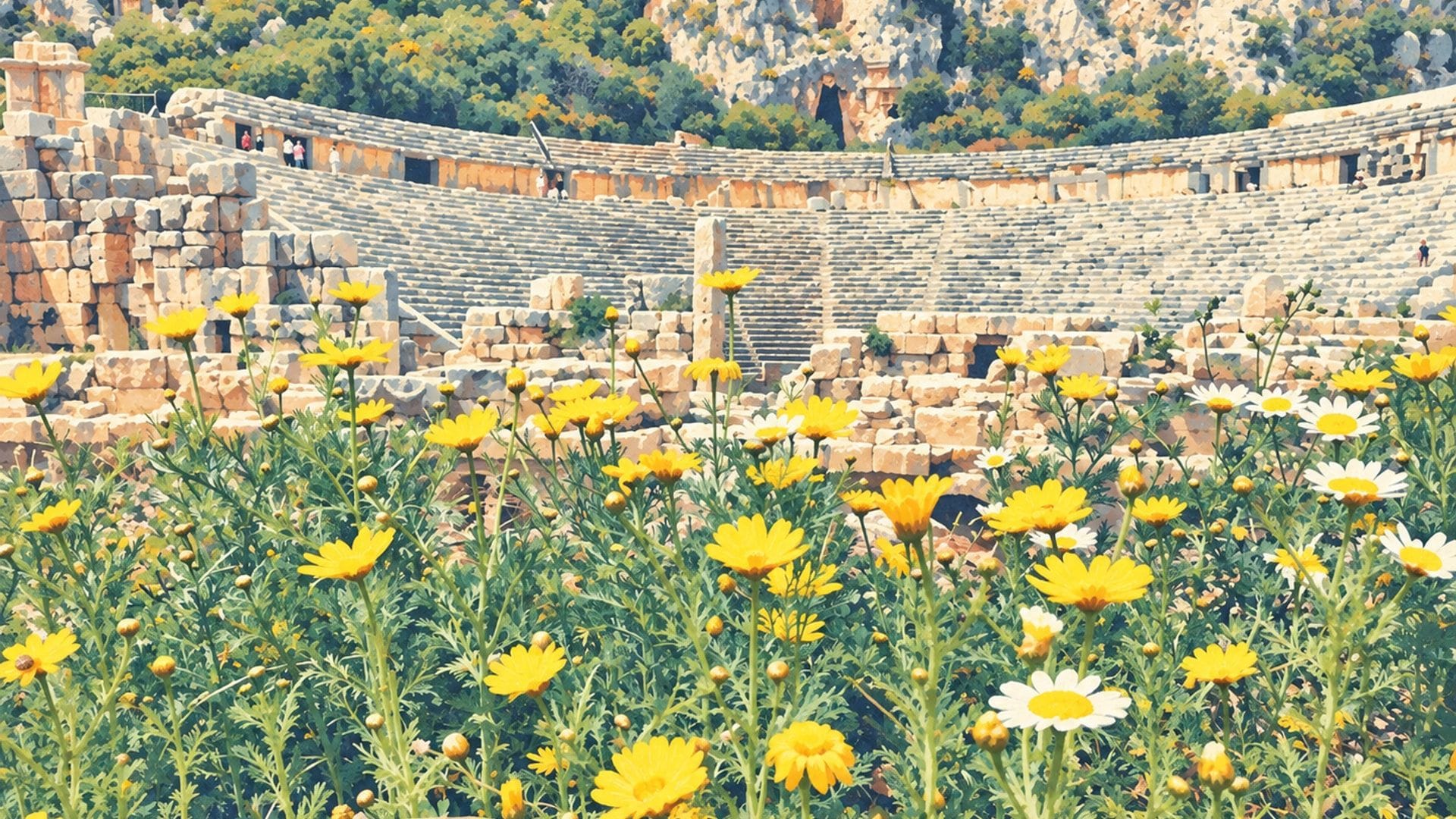
This is Myra's signature image — the semicircular theatre in the foreground, the cliff wall of tombs rising behind. You get this shot from the open area just past the ticket gate, before you enter the theatre itself. Shoot wide enough to capture the full sweep of the cavea and the tomb cliff in one frame. Include a human figure for scale — the tombs look abstract without it.
Stand at the centre of the orchestra (the flat semicircular area at the theatre's base) and shoot straight up. The cavea towering 30 metres above creates a vertigo-inducing perspective — rows of ancient stone seats converging toward the sky. This is an underused angle that captures the theatre's monumental scale in a way the panoramic view doesn't.
Climb to the very top row of the upper cavea for Myra's most comprehensive viewpoint. The entire river necropolis spreads across the cliff directly ahead, the theatre bowl curves below you, and the Demre valley stretches south toward the sea. This is where you earn the shot — the climb is steep and the seats uneven, but the perspective is unmatched.
The diazoma (the horizontal walkway dividing the upper and lower tiers) puts you at eye-level with the mid-range tombs — the most elaborately carved zone of the necropolis. From here, a telephoto lens can isolate individual temple-style tombs with their Ionic columns, pediments, and relief carvings. This is where tomb detail shots happen.
The collapsed scaenae frons lies in large stone blocks around the orchestra area. Among the rubble you'll find fragments of the theatrical mask reliefs — carved marble faces of comic and tragic characters. These make exceptional detail shots, especially with a shallow depth of field that isolates a single face against the blurred stone behind.
The western vomitorium — the barrel-vaulted entrance tunnel — is one of Myra's most atmospheric corners. Walk inside the passage and shoot outward: the bright, sunlit theatre framed by the dark stone arch creates a natural light-and-shadow composition. Silhouetting a fellow visitor walking through the tunnel adds a human element.
Walk past the theatre toward the base of the river necropolis cliff. From directly below, the stacked tiers of tomb façades rise vertically above you — a perspective that communicates the sheer ambition of the Lycian builders better than any other angle. Wide-angle for the full cliff; telephoto for isolating individual tomb rows against the blue sky.
Most visitors never reach the sea necropolis — it requires walking east past the theatre along an unmarked path. But this is where the Lion Tomb is located, Myra's most artistically important tomb. The viewing distance is considerable, so a telephoto is essential. Shoot the painted interior details and the weathered lion reliefs from the closest accessible point.
Seasonal Considerations
The quality of your Myra photographs is affected not just by time of day but by season. Here's how the site changes through the year.
In spring (March–May), the Demre valley is green with citrus orchards and wildflowers. The cliff face has been washed clean by winter rains, making carved details crisper. Temperatures are comfortable (18–25°C) and the light has a softer quality than summer. This is the optimal season for photography.
Summer (June–August) brings harsh, high-contrast light by 10:00 and extreme heat (35–40°C) that limits your endurance on site. The upside: tourist crowds thin dramatically at midday, giving you empty compositions if you can tolerate the heat. The valley is dry and dusty, which can create a warm haze that softens backgrounds.
Autumn (September–November) offers a return to comfortable temperatures and lower sun angles that extend your golden-hour window. October is arguably the best single month — warm enough for comfortable shooting, low enough sun for dramatic shadows, and dramatically fewer tour groups than spring.
Winter (December–February) brings occasional rain but also dramatic skies. On clear winter mornings, the low sun angle creates the most extreme raking light on the cliff face — long shadows from every carved detail. The site is virtually deserted. The catch: shorter days mean the 8:30 opening doesn't align with sunrise, and cloud cover is unpredictable.
If I could only photograph Myra once, I'd choose a clear morning in late October. The sun is low enough for dramatic shadows by 9:00, the temperature is around 22°C, the valley has its early-autumn colour, and there are maybe 20 people on the entire site compared to 200 in July. It's the sweet spot.
