Why Compare?
Turkey's Mediterranean coast has the highest density of Lycian ruins on Earth — over 150 documented sites between Fethiye and Antalya. If you're based in Demre, you're within day-trip range of at least a dozen significant ancient cities. The question isn't whether to see Lycian ruins — it's which ones, in what order, and why.
This guide is written from Demre, with Demre as the base. I've visited every site listed here multiple times over many years, in different seasons and light conditions. The comparisons below reflect personal experience, not guidebook summaries — I'll tell you which sites underwhelm as well as which ones exceed expectations.
The guide is in two parts: the first covers the four major Lycian League cities you're most likely to consider (Myra, Xanthos, Patara, and Olympos), and the second covers the lesser-known ruins near Demre that reward adventurous visitors with solitude and unexcavated atmosphere.
Quick Comparison
Before the detailed profiles, here's a side-by-side reference. Distances are measured from Demre centre by car.
| Site | Distance | Best For | Rock Tombs | Theatre | Beach | Crowds | Time Needed |
|---|---|---|---|---|---|---|---|
| Myra ★ | 0 km | Cliff tombs, theatre, Saint Nicholas | ★★★★★ | ★★★★☆ | — | Moderate | 2–3 hrs |
| Xanthos | 95 km (1.5 hrs) | Lycian League history, UNESCO site | ★★★☆☆ | ★★★☆☆ | — | Low | 1.5–2 hrs |
| Patara | 70 km (1.5 hrs) | Beach + ruins combo, Lycian parliament | ★★☆☆☆ | ★★★☆☆ | ★★★★★ | Low–Mod | Half day |
| Olympos | 100 km (1.5 hrs) | Overgrown atmosphere, Chimera flames | ★★☆☆☆ | ★☆☆☆☆ | ★★★★☆ | High (summer) | Half day |
The Four Major Sites
I'm biased — this is my home town. But I'd argue Myra honestly offers the most visually dramatic single experience of any Lycian site. The cliff-face tomb galleries rising above the Roman theatre create a visual collision of Lycian and Roman culture that exists nowhere else. Add the Saint Nicholas connection and the Andriake museum, and you have a full day of genuinely world-class content within a 5-kilometre radius.
What Myra lacks: it has no beach on-site (the nearest is Çayağzı, 5 km away), and most of the ancient city remains buried under modern Demre. The visible ruins — theatre, tombs — represent perhaps 15–20% of what once existed.
Xanthos carries more historical weight than any other Lycian city. It was the League's de facto capital, the site where the famous Xanthos Stele — the longest known inscription in the Lycian language — was discovered, and the place where the Nereid Monument once stood (now in the British Museum). Twice in its history, the entire population chose collective suicide rather than surrender to invading armies — first to the Persians in 545 BCE, then again to Brutus in 42 BCE.
The site today is atmospheric but somewhat underwhelming visually if you arrive expecting Myra-level drama. The remains are spread over a large, partially excavated hillside: a Roman theatre (smaller than Myra's), pillar tombs, an acropolis area, Roman-era agora, and a Byzantine basilica. The most important artefacts — the Nereid Monument, the Xanthos Stele — have been removed to London and Istanbul.
Xanthos is a UNESCO World Heritage Site (jointly with the nearby Letoon sanctuary) and is free to enter. It's quietly powerful if you know the history; somewhat confusing if you don't.
Patara is the best "two-for-one" Lycian site — significant archaeological ruins and Turkey's longest unbroken Mediterranean beach (18 km of sand) in a single location. It was another three-vote League member, the birthplace of Saint Nicholas (before he moved to Myra), and home to the Lycian League's parliament building — the bouleuterion, which has been reconstructed and is one of the few surviving examples of an ancient parliamentary chamber.
The archaeological site is still being actively excavated and includes a monumental gateway, a partially sand-filled theatre, Roman baths, a colonnaded street, a granary, and the parliament. Because the site is large and spread out, it's less immediately dramatic than Myra but rewards a longer visit. The beach — a protected turtle nesting site — is one of the finest in the Mediterranean and adds a dimension no other Lycian site can match.
Olympos is the atmospheric outlier. Where Myra, Xanthos, and Patara are excavated and organised, Olympos is overgrown, wild, and half-swallowed by vegetation in a narrow river valley that opens onto a beautiful pebble beach. The ruins — Hellenistic walls, Roman baths, a theatre foundation, Byzantine churches, pirate-era fortifications — poke through tangled scrub and pine forest. It feels less like a museum and more like discovering something forgotten.
The real draw is the combination with Yanartaş (the Chimera), a hillside 7 km away where natural gas vents create eternal flames emerging from the rock — the original source of the Chimera legend in Greek mythology. The Olympos-Çıralı area also offers treehouse accommodations, organic restaurants, and a protected turtle beach. It's a completely different vibe from the other Lycian sites.
If I'm advising someone with three days in the region, here's my honest recommendation: Day 1 is Myra + St. Nicholas + Kekova (your home base). Day 2 is Patara + Xanthos + Letoon (a Lycian heritage day-drive). Day 3 is Olympos + Yanartaş (overnight in Çıralı). That sequence gives you the full range — monumental, historical, atmospheric — and builds in a beach day.
Hidden Ruins Near Demre
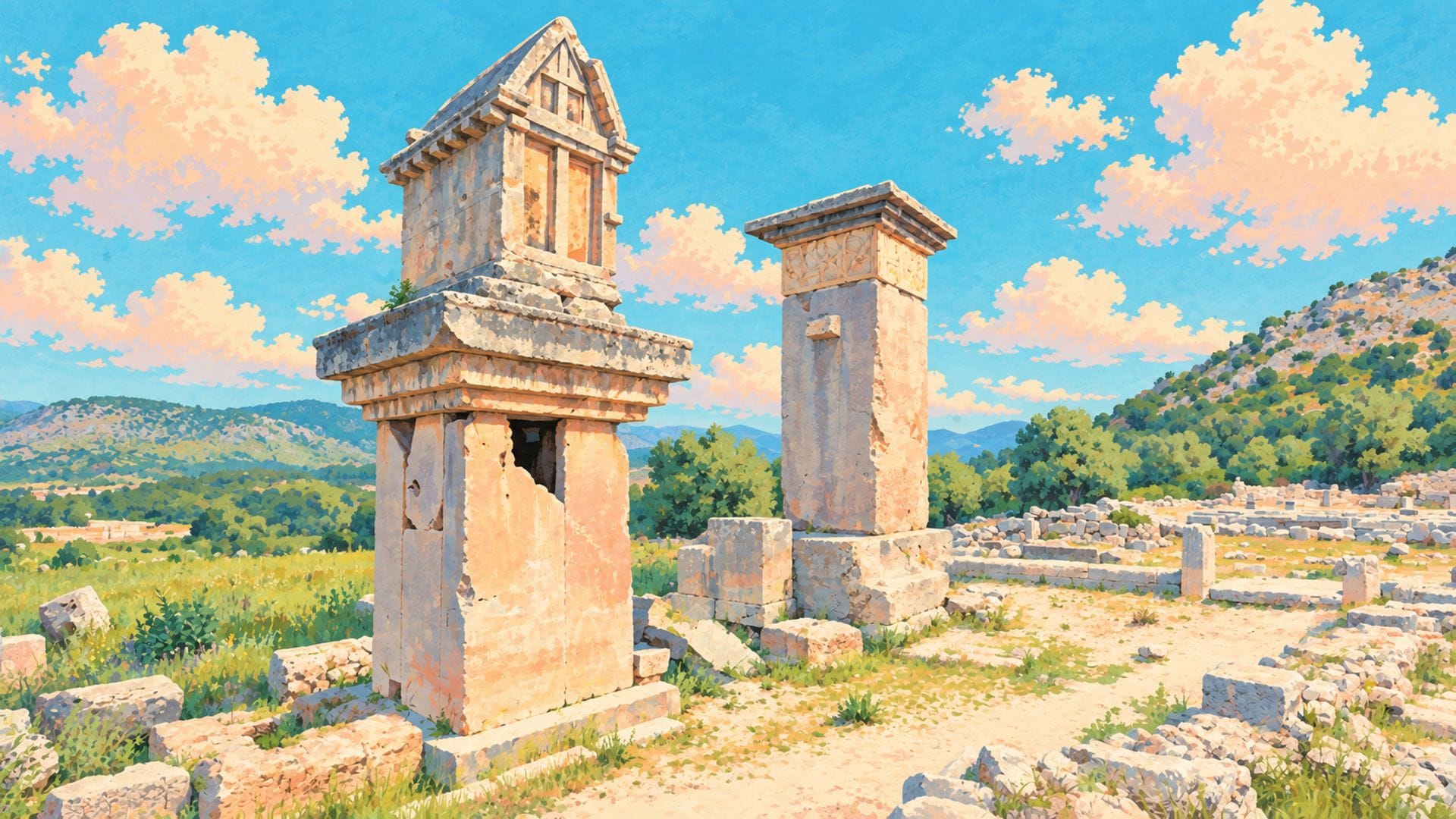
Beyond the four cities above, the Demre district is scattered with smaller Lycian sites that never make the guidebooks: Kyaneai on its ridge above Yavu, with more than three hundred sarcophagi; Soura, where an oracle of Apollo once read the future in the movements of fish; the Heroon of Trysa, whose carved frieze has stood in Vienna since the 1880s; and the house-type rock tombs of Istlada and Hoyran above Kekova.
None of them has a ticket office, a marked path or a guard, and all four need a car. They are the natural next step once you have seen Myra and want to go deeper — and what they pay you back with, mostly, is solitude.
Full guide to the hidden Lycian ruins near Demre →
Which Sites Should You Prioritise?
Your priority order depends on what you value. Here's my honest ranking for three different traveller types:
If you're a history enthusiast: Myra first (dramatic, well-preserved), then Xanthos + Letoon (political heart of Lycia, UNESCO), then Kyaneai (atmospheric solitude). Skip Olympos unless you want the mythology angle (Chimera/Yanartaş).
If you're a photographer: Myra first (morning light on the cliff, the photography guide tells you exactly where to stand), then Patara (sand-filled theatre, monumental gate at golden hour), then Kyaneai (scattered tombs in wildflower meadows). Olympos is photogenic too, but in a wilder, less classical way.
If you're a family or mixed group: Myra + Kekova boat tour (Day 1), Patara ruins + beach (Day 2). That gives you the best of Lycian heritage plus a beach day. The minor ruins are too rough for small children.
For detailed day-by-day itineraries that incorporate these sites — including driving times, lunch stops, and optimised visiting orders — see our Demre Itineraries Guide →
