Why Demre Is the Perfect Base
I've lived in Demre most of my life, and it took me years to fully appreciate what most visitors never realise: this small agricultural town on the Lycian coast sits at the exact centre of one of the Mediterranean's richest concentrations of ancient sites, pristine coastline, and mountain trails. Within an hour's drive in any direction, you reach places that most people only see in travel documentaries.
Demre occupies a unique geographic position on the Lycian coast. To the east, the D400 highway winds through dramatic mountain passes toward Finike and eventually Antalya. To the west, it follows one of Turkey's most spectacular coastal roads to Kaş and Patara. Directly south, the harbour at Çayağzı opens onto the Kekova Sound — a sheltered stretch of Mediterranean water scattered with sunken ruins, island castles, and hidden bays. And above the town, the Lycian Way trail climbs into the Taurus mountains toward abandoned Byzantine churches that few people have ever visited.
The five routes in this guide cover the full range of what's accessible from Demre: a classic boat tour, a history-focused half-day, a multi-day hiking route, an off-the-beaten-path archaeology circuit, and a coastal culture day combining beaches, ancient ruins, and a charming harbour town. Each has been tested repeatedly — these are the itineraries I recommend to friends, not the generic ones you'll find in package tour brochures.
Route 1: Kekova Boat Tour — The Full Day
If you do only one day trip from Demre, make it this one. The Kekova boat tour is the single most popular excursion on the Lycian coast, and for good reason — it combines a sunken ancient city, a medieval castle village, turquoise swimming bays, and a traditional gulet cruise into one unforgettable day on the water.
The route follows a well-established circuit from Çayağzı harbour, Demre's small fishing port located 5 kilometres south of the town centre at the mouth of the Demre River. Most boats depart between 09:00 and 10:00 and return by late afternoon. The first stop is Kekova Island itself, where the boat slows to a crawl along the northern shore — here, the remains of the ancient city of Dolichiste slide beneath the waterline, clearly visible through the crystalline water. Staircases, walls, mosaic floors, and the outlines of rooms extend from the rocky shoreline into the sea, submerged by a series of earthquakes in the 2nd century CE.
From Kekova Island, the boat crosses to Tersane Bay — a sheltered cove with the ruins of an ancient shipyard and some of the warmest, most protected swimming water on the coast. Most tours allow 45 minutes to an hour here for swimming and snorkelling. The water is remarkably clear, and if you swim toward the rocky edges of the bay, you'll find submerged pottery fragments and worked stone blocks from the ancient harbour.
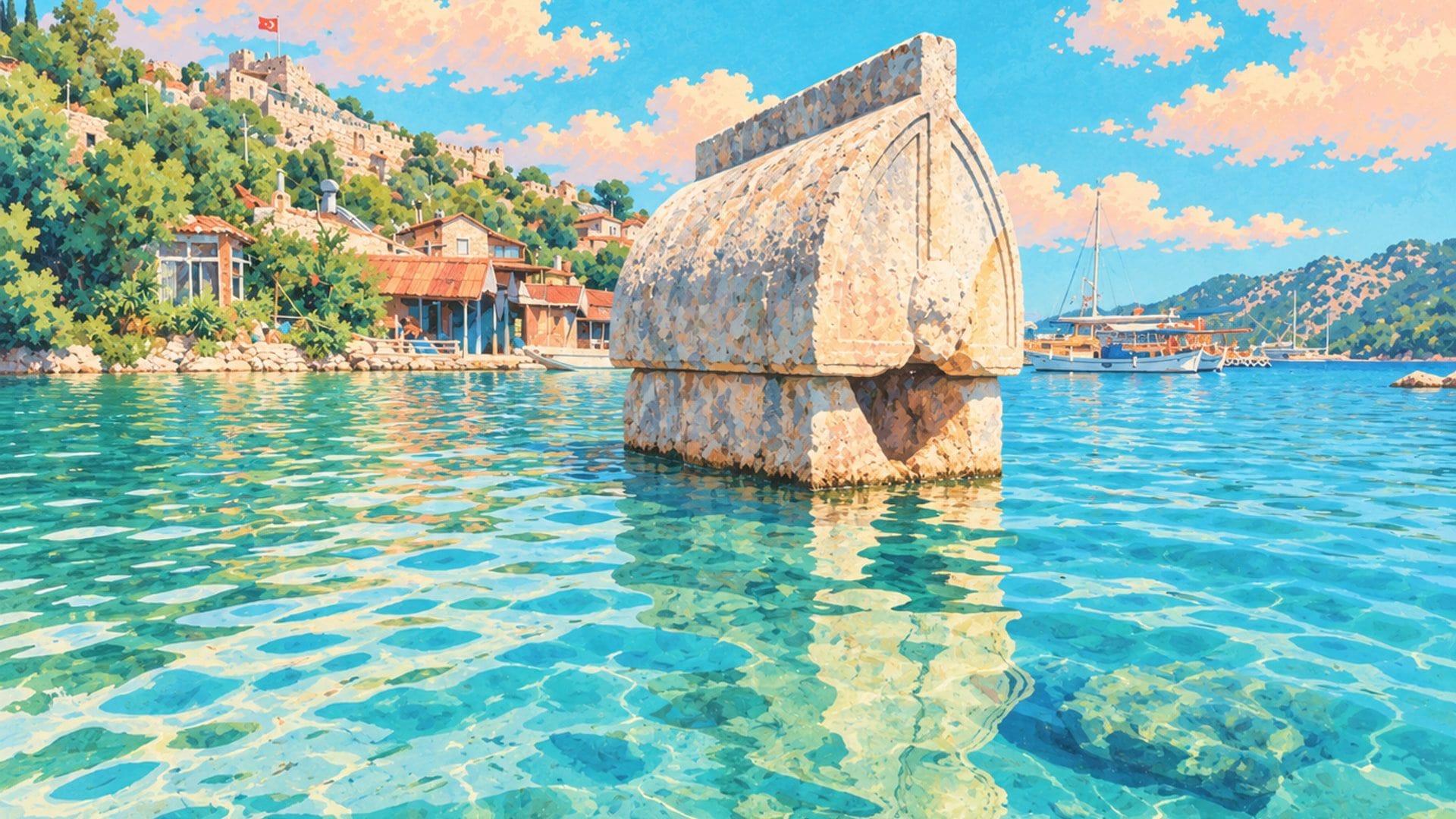
The highlight of the day for many visitors is the stop at Kaleköy, also known by its ancient name Simena. This tiny village — accessible only by boat or a steep mountain trail — is crowned by a crusader-era castle containing a small Lycian theatre carved directly into the rock, the smallest known theatre in Lycia. The climb to the castle takes about 15 minutes through a maze of village houses, and from the top, the panoramic view across the entire Kekova Sound is one of those images that stays with you. At the waterline, a Lycian sarcophagus stands half-submerged in the sea — perhaps the most photographed single monument on the entire Turkish coast.
Book a small gulet (10–15 people max) rather than the big party boats. You'll get closer to the sunken ruins, the captain will wait for you at Simena, and you can swim at hidden coves the big boats skip. Ask at the harbour the evening before — the captains sit at the tea house by the jetty after 17:00 and you can negotiate directly. Expect to pay from 10,000 TL for the whole boat depending on the season.
For detailed boat tour options, pricing comparisons, and booking tips, see our complete Kekova Boat Tour Guide →
Route 2: St. Nicholas Church + Andriake — The History Loop
This is the ideal half-day itinerary for history lovers — a compact loop that takes you through the Christian and Roman layers of Demre's story in a single morning. It's also the perfect complement to a Kekova boat tour in the afternoon, giving you a full day that covers the region's two biggest draws.
Start at St. Nicholas Church in the centre of Demre, the 6th-century basilica built over the tomb of the 4th-century bishop who became Santa Claus. Allow 1.5 hours to properly explore the nave, the Byzantine frescoes (some remarkably well-preserved, showing scenes from the life of Christ and portraits of saints), and the marble sarcophagus traditionally associated with Nicholas himself. The church sits below the current street level — you descend into it, which gives you a visceral sense of the centuries of alluvial deposit that have buried much of ancient Myra.
From the church, drive south toward the coast for about 10 minutes to reach Andriake, Myra's ancient harbour. The centrepiece here is Hadrian's Granary — a monumental eight-chambered Roman warehouse built in the 2nd century CE to store grain shipments bound for Rome. It has been beautifully restored and now houses the Lycian Civilizations Museum, one of the best small museums on the Turkish coast. The exhibits include Lycian coins, the remarkable terracotta theatre masks discovered at Myra in 2021, ship anchors from the ancient harbour, and a detailed model showing what Andriake looked like at its height.
After the museum, walk down to the Çayağzı wetlands and beach. The marshes around the old harbour are now a protected bird habitat — in spring and autumn, you'll see herons, egrets, and occasionally flamingos. Grab lunch at one of the simple fish restaurants near the harbour before heading back.
Start at St. Nicholas Church right when it opens (8:30) — you'll have the frescoes and the sarcophagus almost to yourself. By 10:00 the tour buses arrive and the experience changes completely. Then head to Andriake where it stays quiet all day — even in peak season, I rarely see more than a handful of visitors at the Lycian Museum.
Deep dive: St. Nicholas Church Guide → and Andriake Guide →
Route 3: Lycian Way — Demre to Finike (2–3 Days)
The Lycian Way — the 540-kilometre long-distance trail that runs from Fethiye to Antalya along the ancient Lycian coast — is consistently ranked among the world's top ten long-distance hiking routes. The section that passes through the Demre region is one of its most dramatic and least crowded stretches, combining mountain archaeology, pine forests, and spectacular coastal cliff scenery.
Day 1: Myra to Alakilise (12 km). The trail begins at the Myra archaeological site and climbs steadily through terraced olive groves and pine forest into the mountains above Demre. After about three hours of uphill walking, you reach Alakilise — the ruins of a Byzantine church and monastery hidden in a remote mountain valley. The church, dedicated to the Archangel Michael, dates to the 5th or 6th century CE and features carved marble doorframes and traces of fresco decoration. It is utterly deserted — in dozens of visits, I have never encountered another person here. From Alakilise, the trail continues to the small village of Zeytin, where there are basic pensions and camping possibilities.
Day 2: Zeytin to Finike (23 km). The second day is longer and more demanding, following the trail east along exposed coastal ridges with dramatic views down to the Mediterranean. The path descends through maquis scrubland and rocky terrain, passing occasional goat farms and abandoned terraces. The final stretch drops steeply into the fertile Finike plain — one of Turkey's major orange-growing regions — and ends at the pleasant harbour town of Finike. From Finike, regular dolmuş services run back to Demre (45 minutes).
If you only have one day, do the Myra to Alakilise section (12 km return). The abandoned church at Alakilise — hidden in a mountain valley with nobody around — is one of those places that makes you understand why the Lycian Way is rated one of the world's best long-distance trails. Pack a lunch, fill your water bottles in Demre, and give yourself 5–6 hours for the round trip.
The Lycian Way between Demre and Finike includes steep coastal sections with significant elevation changes. Carry at least 2 litres of water per person. The trail is waymarked with red-white blazes but a GPS track is recommended as some sections pass through unmarked terrain. In summer, temperatures on the exposed ridges can exceed 40°C — start early and carry sun protection.
Route 4: Hidden Lycian Cities — Kyaneai, Istlada & Soura
This is the route for archaeology enthusiasts — the people who get more excited about an unexcavated ruin with nobody around than a restored monument with an audio guide. The three sites on this circuit are all members of the ancient Lycian League, all within 40 minutes of Demre, and all virtually unknown to mainstream tourism. On a typical visit, you will have each site entirely to yourself.
Kyaneai is the first and most impressive stop, located about 30 minutes south of Demre via a winding mountain road through the village of Yavu. The ancient city sprawls across a rocky hilltop and includes a remarkably well-preserved Roman theatre (small but atmospheric, with views across a vast mountain landscape), extensive city walls, a Roman bath complex, and — most strikingly — one of the largest sarcophagus fields in all of Lycia. Dozens of massive Lycian stone tombs are scattered across the hillside in various states of preservation, their Gothic-arched lids and carved relief panels standing open to the sky. The effect is deeply atmospheric — like walking through a Lycian cemetery frozen in time.
Istlada (near the modern village of Hoyran) is a 20-minute drive from Kyaneai, perched on a cliff overlooking the Kekova Sound. The site is best known for its spectacular Lycian rock-cut tombs, carved into a sheer cliff face with sweeping views down to the turquoise sea and Kekova Island. The tombs are similar in style to those at Myra but set in a far more dramatic natural landscape. There's no ticket office, no signage, and no other visitors — you park near the village and walk 10 minutes along a goat track to reach the ruins.
Soura is the most remote of the three, located near the Demre wetlands about 15 minutes north of the town. The ruins — including a small theatre, temple foundations, and scattered architectural fragments — are partially overgrown and set in a surprisingly lush, marshy landscape quite different from the rocky hillsides of Kyaneai and Istlada. Soura is best visited in the cooler months when the wetlands are green and the birdlife is active.
Kyaneai is my personal favourite day trip from Demre. The sarcophagus field is like a Lycian Pompeii — dozens of tombs scattered across a hillside with nobody else around. Bring a picnic and spend a couple of hours exploring. The view from the theatre across to the mountains is extraordinary, and in spring the hillside is carpeted with wildflowers growing between the ancient stones. I've brought visitors here who said it was the highlight of their entire Turkey trip.
Site-by-site detail — access, parking, walking times and what is actually left at each — is in our guide to the hidden Lycian ruins near Demre →. For how these compare with Myra, Xanthos and Patara, see Lycian Cities Compared →
Route 5: Kaş & Patara — Coastal Culture Day
This is the most diverse day trip from Demre — combining a major ancient site, Turkey's longest beach, a charming Mediterranean harbour town, and one of the coast's most famous cove beaches into a single, richly varied day. Head west along the D400 coast road and you'll cover 2,500 years of history, some exceptional food, and scenery that belongs on a postcard.
Morning: Patara. Drive west from Demre for about an hour (passing through Kaş) to reach Patara, one of the most important cities in the ancient Lycian world. Patara was the seat of the Lycian League's federal assembly — the parliament building has been excavated and partially restored, and it's a genuinely moving site when you consider that representative democracy was being practised here two millennia before most of the world caught up. Beyond the ruins, Patara's 18-kilometre beach is one of the longest and most pristine in the Mediterranean — a protected turtle-nesting site with fine golden sand and almost no development. The beach entry is included with the archaeological site ticket.
Lunch: Kaş. Drive back east to Kaş (30 minutes from Patara), a charming harbour town that has evolved from a fishing village into one of the Lycian coast's most appealing small towns. The narrow streets of the old quarter are lined with boutique shops, art galleries, and excellent restaurants. For lunch, head to the Balıkçı Barınağı (fishing shelter) where a row of waterfront fish restaurants serve the day's catch grilled over charcoal. The fresh sea bass (levrek) and grilled octopus (ahtapot) are exceptional. After lunch, wander the old town — there's a well-preserved Lycian rock tomb right in the centre of town, an ancient theatre overlooking the harbour, and views across the strait to the Greek island of Kastellorizo.
Afternoon: Kaputaş Beach (optional). If time allows on the drive back to Demre, stop at Kaputaş Beach — a tiny, dramatically beautiful cove wedged between two towering cliffs, accessed by a steep staircase from the road above. The water is an almost unreal shade of turquoise. It gets crowded in high summer, but in spring and autumn it's one of the most beautiful swimming spots on the Mediterranean. The drive from Kaputaş back to Demre takes about 30 minutes.
The drive from Demre to Kaş along the D400 is one of the most beautiful coastal roads in Turkey. Stop at the viewpoint just past the Kekova junction — you can see the entire sunken city area from above, with Kekova Island stretching across the bay like a sleeping dragon. In Kaş, eat at one of the fish restaurants on Balıkçı Barınağı (the fishing shelter) — the grilled octopus is exceptional, and the sunset views across to Kastellorizo are worth the trip alone.
Planning Your Day Trips
Choosing between these five routes depends on your interests, available time, and transport options. The table below provides a quick comparison to help you decide.
| Route | Duration | Best For | Difficulty |
|---|---|---|---|
| Kekova Boat Tour | Full day | Everyone | Easy |
| Church + Andriake | Half day | History lovers | Easy |
| Lycian Way Hike | 1–3 days | Hikers | Moderate |
| Hidden Lycian Cities | Full day | Archaeology fans | Easy–Moderate |
| Kaş & Patara | Full day | Mixed interests | Easy |
Getting Around: Transport Options
Rental car: This is the most practical option for exploring the Demre region. Several small agencies in town offer daily rentals (from around 1,500–2,500 TL per day depending on season). A car gives you access to all five routes and the flexibility to stop at viewpoints, hidden beaches, and roadside restaurants along the way. Roads are generally well-maintained, though some routes to archaeological sites (Kyaneai, Istlada) involve narrow mountain roads.
Dolmuş (minibus): Regular dolmuş services connect Demre to Kaş (hourly, 45 minutes) and Antalya (several daily, 2.5 hours via Finike). A local dolmuş runs to Çayağzı harbour for the Kekova boat tours. However, there is no public transport to Kyaneai, Istlada, Soura, or the Lycian Way trailheads.
Organised tours: Several operators in Demre and Kaş offer guided day trips, particularly to Kekova and the Lycian Way. These are convenient if you're travelling solo or prefer not to drive. Ask at your hotel or pension for current recommendations — the operators change seasonally and word-of-mouth is more reliable than online listings for this area.
Dolmuş (minibus) service in the Demre area is limited — buses to Kaş and Antalya run regularly, but reaching Kekova, Kyaneai, or Istlada requires your own transport or a pre-arranged tour. If you're staying in Demre for multiple days, renting a car gives you the most flexibility. Book at least a day in advance during July–August when demand is highest.
